Summary
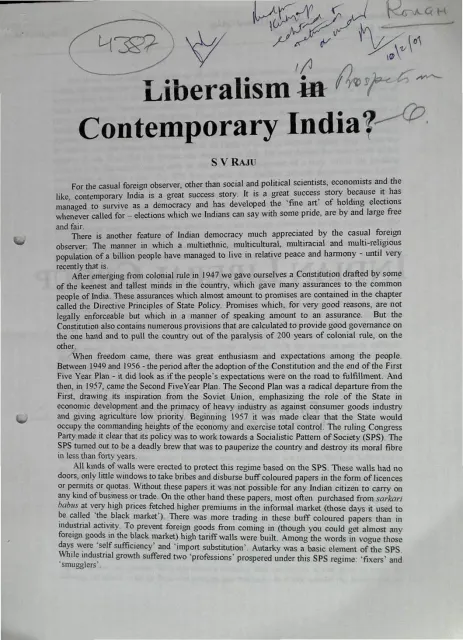
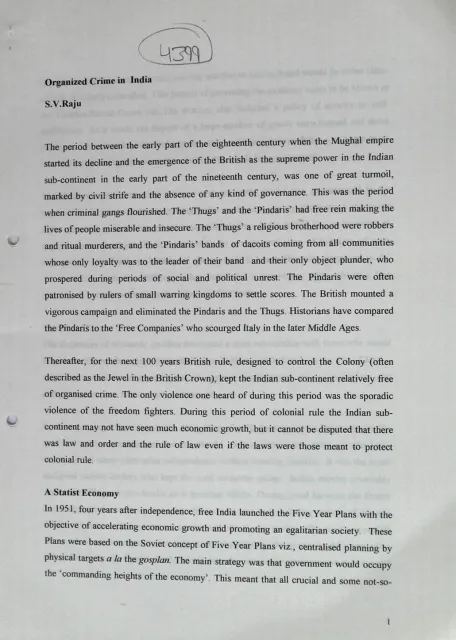
In the rendered pages, S. V. Raju traces organised crime in India from the Thugs and Pindaris of the eighteenth and early nineteenth centuries to the crime syndicates of the late twentieth century. He contrasts the disorder before British consolidation with the colonial state’s subsequent enforcement of law and order, then argues that post-independence economic controls recreated conditions in which illicit markets could flourish. The Five Year Plans, centralised control, import restrictions, and the Licence-Permit-Quota raj are presented as producing scarcity, smuggling, black markets, and a politically connected “New Class” of businessmen, politicians, and bureaucrats.
In the rendered pages, Raju follows the development of organised crime from gold smuggling into political financing, extortion, protection rackets, film production, real estate, and attacks on professionals and businesses. He describes the Dawood network and related gangs as increasingly connected with political parties and public officials, while identifying unemployment, ineffective policing, judicial delay, and compromised elections as conditions sustaining recruitment and impunity. In the rendered pages, his proposed remedy is to dismantle excessive governmental control, strengthen judicial and administrative independence, expand primary education and entrepreneurial opportunity, reform election law, and enforce existing statutes. The essay closes by arguing that India has retained the forms of democracy without adequately defending its substance.
Key points
- The essay links the historical suppression of the Thugs and Pindaris with the later emergence of modern organised crime.
- Post-independence central planning and the Licence-Permit-Quota raj are presented as generating scarcity, smuggling, and black markets.
- Raju describes a corrupt “New Class” formed through cooperation among economic officials, businessmen, politicians, and bureaucrats.
- Gold smuggling developed into organised syndicates associated with Haji Mastan and Dawood Ibrahim, with operations extending from Dubai into India.
- Crime syndicates allegedly financed elections, extracted political quid pro quo, and eventually entered electoral politics directly.
- The essay describes the expansion of criminal activity into communal violence, arms trafficking, extortion, film finance, real estate, and protection rackets.
- Raju attributes weak enforcement to political interference, judicial delays, compromised civil-service administration, and inadequate electoral rules.
- The proposed response combines economic deregulation, judicial and governance reform, education, entrepreneurial opportunity, and stronger enforcement of existing law.
Metadata and summary are AI-extracted from the source PDF and reviewed for editorial accuracy. The original work is available via the Read PDF tab above (where present); paragraph-level citation inside the PDF is deferred to a future engagement.