essay
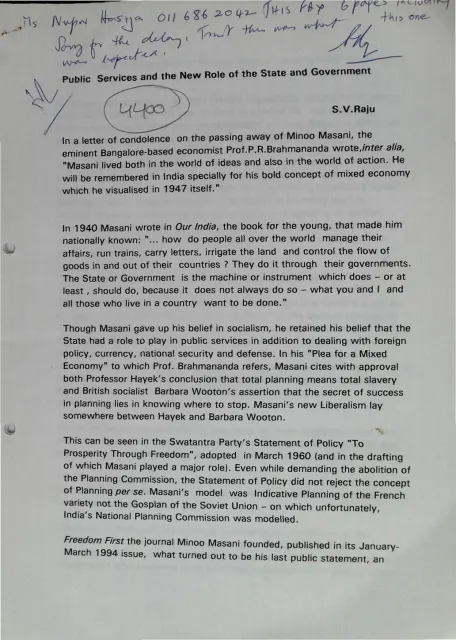
Public Services and the New Role of the State and Government
By S. V. Raju
Mumbai · 1998
6 pages
Summary
In this essay, S. V. Raju argues that liberalism requires neither an all-purpose state nor a minimal state indifferent to public need. Drawing on Minoo Masani’s writings and the Swatantra Party’s policy, he distinguishes between activities from which government should withdraw—especially commercial and industrial enterprise—and public services for which the state must accept responsibility. These include law and order, clean drinking water, primary education and health, transport infrastructure, and targeted support for the poor. The essay presents Masani’s “New Liberalism” as a position combining free-market economics with social welfare and a firm commitment to individual freedom and dignity.
Key points
- The state should govern rather than conduct business, while retaining responsibility for essential public services.
- Masani’s approach rejected total planning but accepted indicative planning and a mixed economy.
- Individual freedom and dignity are presented as the non-negotiable ends of liberal economic policy.
- The essay criticizes Nehruvian socialism for weakening incentives, encouraging corruption, and neglecting basic services.
- Limited government is distinguished from weak government, particularly in relation to law enforcement and citizen security.
- Raju identifies clean water, primary education, primary health, roads, railways, and targeted distribution for the poor as urgent state responsibilities.
- Private initiative and enterprise should be welcomed in infrastructure, education, and health, provided public services improve rapidly.
Metadata and summary are AI-extracted from the source PDF and reviewed for editorial accuracy. The original work is available via the Read PDF tab above (where present); paragraph-level citation inside the PDF is deferred to a future engagement.