Summary
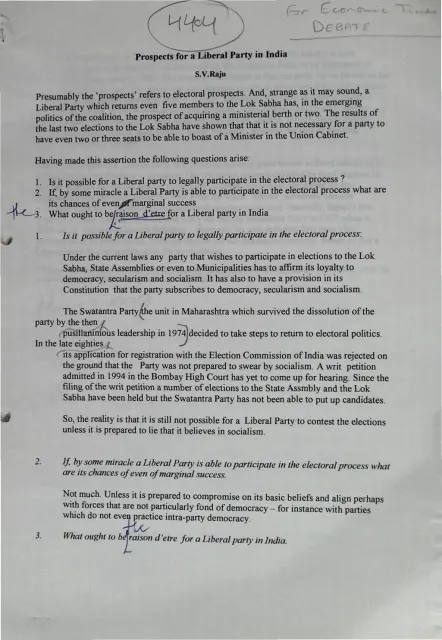
In this two-page essay, S. V. Raju examines whether a liberal party can legally enter India’s electoral process, whether it could achieve even marginal electoral success, and what its raison d’être should be. He argues that existing legal requirements oblige parties contesting elections to affirm democracy, secularism, and socialism. Using the Swatantra Party’s unsuccessful attempt to register as an example, he concludes that a genuinely liberal party cannot currently contest elections without falsely claiming adherence to socialism.
Key points
- Indian electoral law, as described in the essay, requires political parties to affirm democracy, secularism, and socialism.
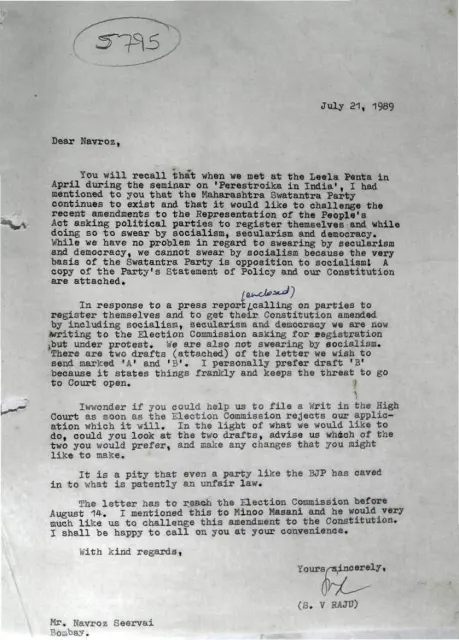
- The Swatantra Party’s attempt to return to electoral politics was rejected because it was not prepared to swear by socialism.
- A liberal party would have little chance of electoral success unless it compromised its principles or allied with undemocratic forces.
- Liberalism is presented as distinctive because it treats political power as a means rather than an end.
- The essay defines the liberal objective as prosperity through individual liberty, dignity, a minimal state, the rule of law, and expeditious justice.
- The state should provide basic services, including clean drinking water, primary health care, and primary education, while leaving room for private and voluntary participation.
- Raju argues that a liberal party’s existence is justified only if it offers strong government without interfering in matters outside the state’s proper concerns.
- The essay links this programme to the Swatantra Party’s 1959 economic policy and to the economic reforms initiated by Congress in the late 1980s.
Metadata and summary are AI-extracted from the source PDF and reviewed for editorial accuracy. The original work is available via the Read PDF tab above (where present); paragraph-level citation inside the PDF is deferred to a future engagement.