Summary
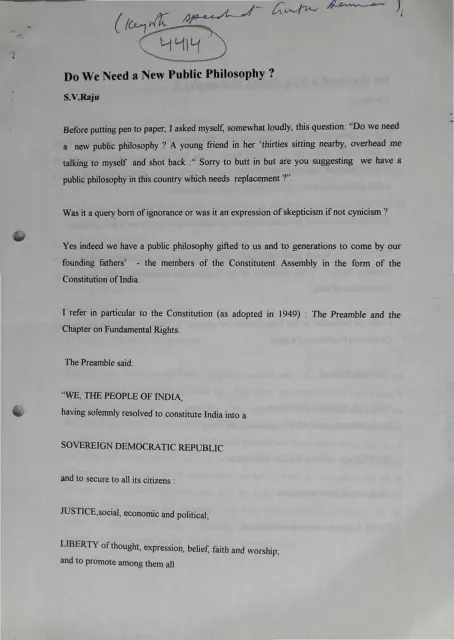
S. V. Raju argues that India does not need a new public philosophy because the Constitution already provides one. He identifies the Preamble and Fundamental Rights as the country’s inherited political faith, grounded in justice, liberty, equality, fraternity, dignity, national unity, and protections including freedom, religious liberty, cultural rights, property, and constitutional remedies. He traces this philosophy to the freedom movement and to earlier Indian political thinkers and reformers, while citing Granville Austin’s account of the institutional and cultural conditions that enabled the Constitution to function.
Key points
- The Indian Constitution, especially its Preamble and Fundamental Rights, is presented as India’s existing public philosophy.
- The essay lists equality, freedom, protection from exploitation, religious freedom, cultural and educational rights, property, and constitutional remedies as core rights.
- Raju links constitutional ideals to the freedom struggle, the Indian National Congress, and earlier reformers and statesmen.
- The essay contrasts constitutional promise with the later Emergency, amendments to the Preamble, political instability, and declining public morality.
- Examples from Uttar Pradesh politics illustrate defections, oversized ministries, legislative disorder, and weak political accountability.
- Raju argues that the answer is not a replacement philosophy but a recovery of civilised political traditions and public responsibility.
- He calls for grassroots democracy, civic participation, education in liberal values, accountable government, and a smaller but more effective state.
Metadata and summary are AI-extracted from the source PDF and reviewed for editorial accuracy. The original work is available via the Read PDF tab above (where present); paragraph-level citation inside the PDF is deferred to a future engagement.