speech · convention address
"IN SEARCH OF NATIONAL VALUES : INDIA AT THE THRESHOLD OF 21ST CENTURY"
(Under the Serial "IN SEARCH OF INDIA'S RENAISSANCE")
Madras · 1994
13 pages
Summary
In this keynote address delivered at the 6 March 1994 national seminar, Justice H. R. Khanna presents India’s national values through the Constitution, secularism, social tolerance, democratic discipline, and personal integrity. He argues that secularism requires the State to treat the devout, agnostic, and atheist alike, while India’s civilisational tradition is defined by assimilation, catholicity of outlook, and freedom of thought. Drawing on Gandhi, S. Radhakrishnan, and Swami Vivekananda, Khanna frames religious harmony and the fellowship of faiths as central to the Indian ideal.
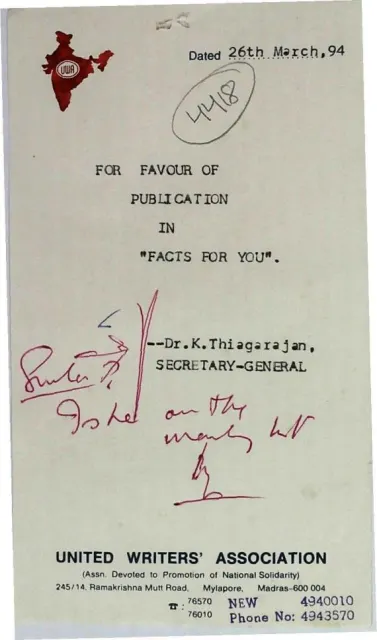
The address then turns to post-independence decline: political and administrative corruption, criminalisation of politics, parliamentary disorder, misuse of Article 356, and the erosion of constitutional morality. Khanna links these failures to inadequate attention to Directive Principles, education, population control, and human development, citing India’s 123rd-place ranking among 160 countries in the 1990 Human Development Index. His proposed agenda for the twenty-first century includes reawakening national conscience, building character and discipline, strengthening public opinion, reforming the electoral system, auditing party funds, and creating a work culture. The booklet also includes a covering letter and seminar title pages; no material beyond the address’s printed page 10 was present.
Key points
- The Constitution and its Directive Principles are presented as the normative foundation of national life.
- Secularism is defined as equal treatment of the devout, agnostic, and atheist, without discrimination on grounds of religion.
- India’s traditions of assimilation, tolerance, and fellowship of faiths are contrasted with contemporary communal and political divisions.
- Political corruption is described as fostering administrative, judicial, and academic corruption.
- The criminalisation of politics is linked to weakened law enforcement and declining parliamentary standards.
- Misuse of Article 356 is cited as an example of constitutional power being used for partisan advantage.
- Low human-development outcomes are attributed partly to inadequate fulfilment of the Directive Principles, especially in education and public priorities.
- The proposed national agenda includes character-building, electoral reform, public vigilance, population control, and a culture of work.
Metadata and summary are AI-extracted from the source PDF and reviewed for editorial accuracy. The original work is available via the Read PDF tab above (where present); paragraph-level citation inside the PDF is deferred to a future engagement.