Summary
In this two-page speech, S. V. Raju distinguishes liberalism from the American usage of “liberal,” defining it instead as a preference for a minimalist state. He presents liberalism as a wider moral and political commitment encompassing values, character, tolerance, human rights, social justice, and an essentially free society. The speech situates this tradition in Indian history, recalling the liberal leadership of the Indian National Congress before 1925 and contrasting it with Gandhi’s later mass-agitation approach.
Raju argues that the Indian Constitution remains essentially liberal despite amendments restricting individual freedom, but criticises the post–First Five Year Plan turn toward socialist economic policies and state control. He credits B. R. Shenoy and the Swatantra Party with sustaining economic liberalism, while distinguishing economic liberalisation from liberal society: China, he notes, liberalised economically without becoming democratic, and India’s economic reforms have not eliminated corruption or intolerance. The Indian Liberal Group is presented as seeking both sound economic policy and a civil society grounded in tolerance, anti-corruption, and respect for the rule of law. The text is based on a talk delivered to the Rotary Club, Mangalore, on January 22, 2004.
Key points
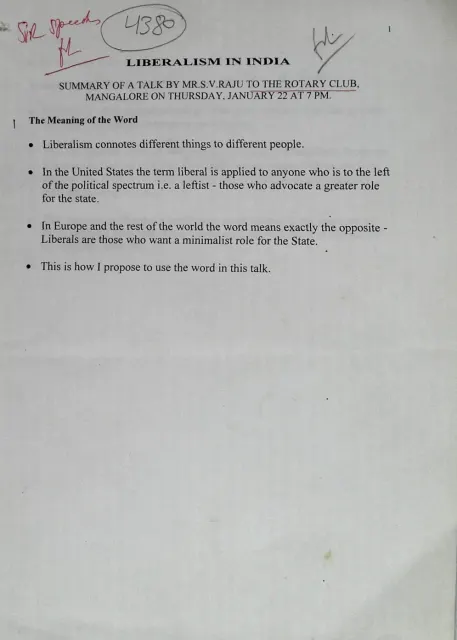
- Raju uses “liberalism” to mean advocacy of a minimalist role for the state, distinguishing it from the contemporary American usage of the term.
- He defines liberalism as a values-based tradition involving tolerance, human rights, social justice, character, and freedom.
- The speech traces an Indian liberal lineage through Congress leaders before 1925 and contrasts it with Gandhi’s turn toward agitation and civil disobedience.
- Raju regards the Constitution as essentially liberal but criticises post-1950 socialist economic policy and state control of the economy.
- B. R. Shenoy and the Swatantra Party are presented as important defenders of economic liberalism in post-independence India.
- Economic liberalisation is distinguished from political liberalism: liberalised markets do not necessarily produce democracy or tolerance.
- The Indian Liberal Group is described as combining economic reform with anti-corruption work, civil society, tolerance, and the rule of law.
Metadata and summary are AI-extracted from the source PDF and reviewed for editorial accuracy. The original work is available via the Read PDF tab above (where present); paragraph-level citation inside the PDF is deferred to a future engagement.