Summary
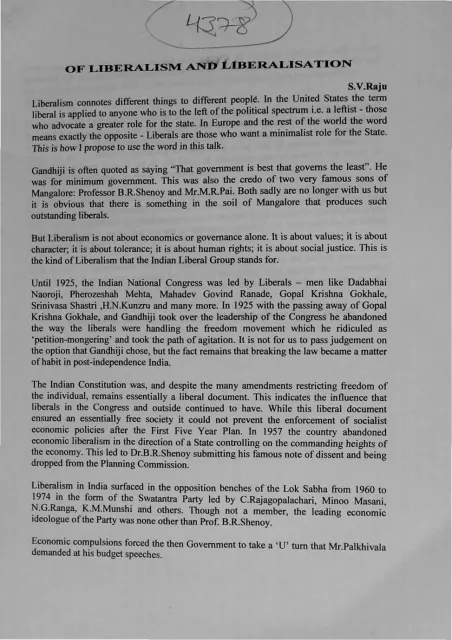
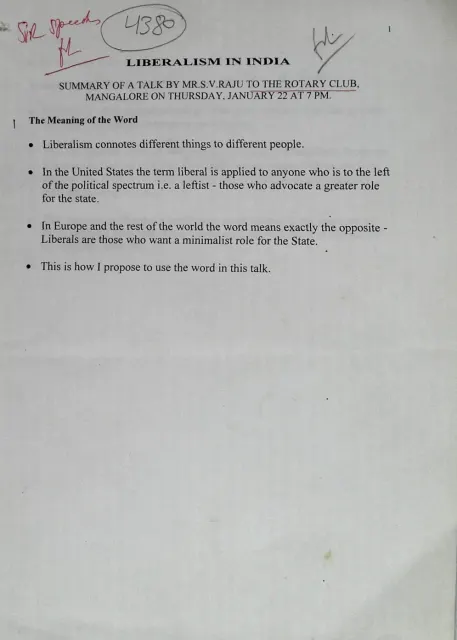
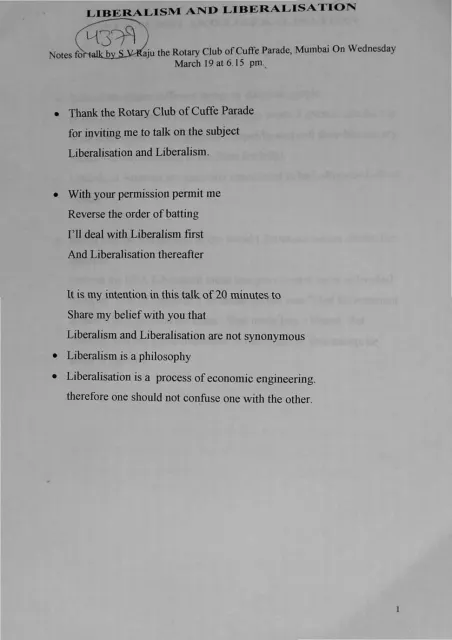
In these notes for a talk to the Rotary Club of Cuffe Parade, S. V. Raju distinguishes liberalism from liberalisation. Liberalism is presented as a philosophy concerned with limited government, individual freedom, human dignity, tolerance, human rights, social justice, and the rule of law; liberalisation, by contrast, is described as a process of economic engineering. Raju stresses that support for free markets does not automatically make someone liberal, and that liberalism is not reducible to economics or governance.
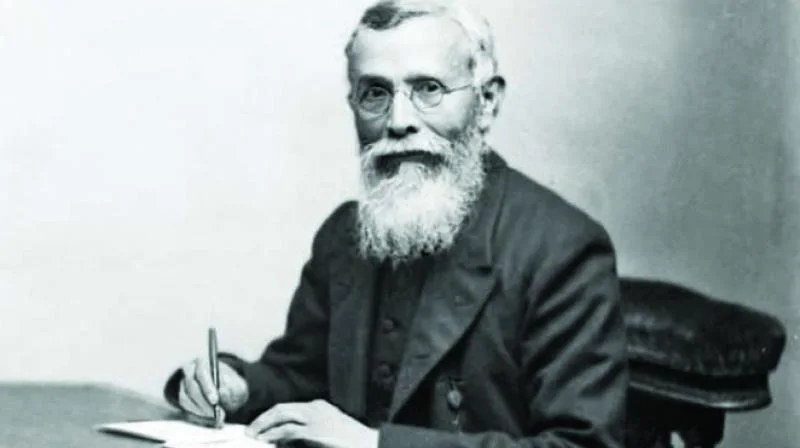
The talk then traces an Indian liberal tradition through the early Indian National Congress and figures including Dadabhai Naoroji, Pherozeshah Mehta, Mahadev Govind Ranade, Gopal Krishna Gokhale, Srinivasa Shastri, and H. N. Kunzru. Raju argues that these reformers valued social reform and education before independence, contrasting their constitutional approach with Gandhi’s later reliance on agitation, satyagraha, and hartals. In discussing liberalisation, he uses China to show that market-oriented economic policy can coexist with authoritarian political control, and India to argue that economic reform has not produced a genuinely liberal society. He concludes by recalling the Swatantra Party’s liberal parliamentary record and defending the Indian Constitution as a surviving liberal document. The final rendered page is an attached 2008 email exchange concerning the invitation to give the talk.
Key points
- The notes define liberalism as a philosophy and liberalisation as an economic-engineering process.
- The European meaning of liberalism is associated with minimum government, individual freedom, law and order, infrastructure, and the rule of law.
- Raju broadens liberalism beyond economics to include human dignity, character, tolerance, human rights, and social justice.
- The speech recovers an early Indian liberal tradition within the Indian National Congress and links it to social reform and education.
- Gandhi’s mass-agitation strategy is contrasted with the earlier liberals’ constitutional and reformist approach.
- China’s economic liberalisation is presented as evidence that free markets do not necessarily produce political freedom.
- India’s economic reforms are criticised as insufficient in the face of intolerance, personality-driven politics, corruption, and weak policy-based party competition.
- The Swatantra Party and the Indian Constitution are presented as important surviving expressions of Indian liberalism.
Metadata and summary are AI-extracted from the source PDF and reviewed for editorial accuracy. The original work is available via the Read PDF tab above (where present); paragraph-level citation inside the PDF is deferred to a future engagement.