pamphlet · manifesto
THE GANDHIAN ALTERNATIVE
Towards a free society
Published & Printed by Rajinder Puri Jan-Society, Janata Party, New Delhi & Printed at Maharashtra Printers & Stationers, Bombay-16. · New Delhi
4 pages

Summary
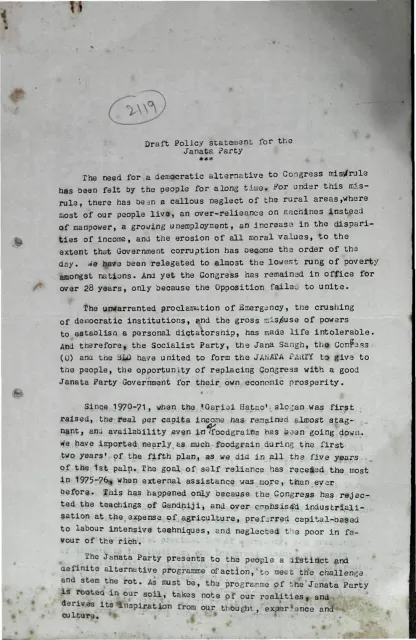
The four-page English pamphlet presents the Janata Party as a national political alternative committed to democracy, service, and a society organised around Gandhian principles. Its political programme stresses civil liberties, restoration of democratic institutions, opposition to authoritarian rule, decentralisation, village-level initiative, an independent judiciary, electoral reform, and safeguards against corruption and administrative abuse. The pamphlet also frames the Janata Party as a unified national party rather than merely an alliance of opposition groups, and contrasts its electoral prospects with Congress’s past ability to win a disproportionate share of seats.
Key points
- The pamphlet describes the Janata Party as a unified national party formed from the merger of opposition groups.
- Its political charter calls for constitutional democracy, civil liberties, judicial independence, electoral reform, and decentralised government.
- The programme advocates Gandhian values, village self-government, rural development, and a reduced role for centralised state power.
- The economic charter proposes abolition of property as a fundamental right, a right to work, full employment, agricultural priority, appropriate technology, and decentralisation.
- The economic programme includes an end to destitution within ten years, rural-urban integration, wage and price policies, redistributive taxation, and national water and energy policies.
- The social charter proposes universal schooling, literacy, safe drinking water, preventive health, housing, social insurance, rights protections for Scheduled Castes and Tribes, women’s and youth welfare, legal aid, and anti-corruption machinery.
- The question-and-answer section presents the party’s post-election role as either a governing party or a united democratic opposition.
Metadata and summary are AI-extracted from the source PDF and reviewed for editorial accuracy. The original work is available via the Read PDF tab above (where present); paragraph-level citation inside the PDF is deferred to a future engagement.