
essay
What India Meant To Me
1971
2 pages
Summary
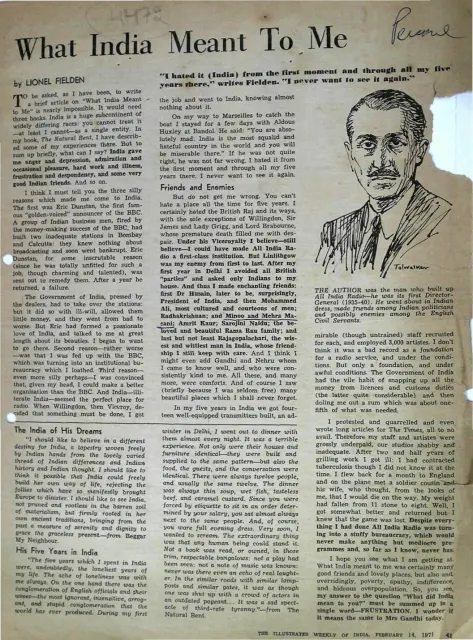
In the rendered article page, Lionel Fielden reflects on his five years in India, resisting any single, simplified account of the country. He describes arriving through a chain of partly accidental decisions: Eric Dunstan of the BBC persuaded him to repair failing broadcasting stations, while Fielden was also disillusioned with the BBC’s bureaucracy and believed India offered an opportunity to build a better organisation. His initial response was intensely hostile, reinforced by Aldous Huxley’s warning that India was “the most squalid and hateful country in the world,” but the article gradually complicates that reaction through Fielden’s friendships with Indian public figures and his appreciation of Indian places.
Fielden’s strongest criticisms concern the colonial and postcolonial administrative culture he encountered. He recalls British official society as narrow, repetitive, and culturally stifling, and portrays All India Radio as undermined by government micromanagement, licensing practices, inadequate facilities, and bureaucratic habits. He also describes overpopulation, poverty, indifference, and administrative failure as sources of continuing frustration. At the same time, he credits India with producing enduring friendships and beautiful experiences, ending with the deliberately ambivalent judgment that India meant “FRUSTRATION”—though he wonders whether that answer would now be different for Mrs Gandhi.
Key points
- Fielden argues that India cannot be reduced to a single national or cultural identity because of its size and diversity.
- He recounts arriving in India to repair and reorganise failing BBC broadcasting stations.
- His first reaction to India was profoundly negative, but personal friendships altered and complicated that judgment.
- He praises Indian friends including Dr Husain, Mohammed Ali, Sarojini Naidu, Rajagopalachari, Gandhi, and Nehru.
- He criticises British official society for cultural insularity, repetitive social conventions, and bureaucratic conformity.
- He presents All India Radio as weakened by poor funding, government interference, licensing practices, inadequate studios, and administrative inertia.
- The article closes on an unresolved tension between India’s beauty and friendships and its poverty, overcrowding, and institutional frustration.
Metadata and summary are AI-extracted from the source PDF and reviewed for editorial accuracy. The original work is available via the Read PDF tab above (where present); paragraph-level citation inside the PDF is deferred to a future engagement.
Related across the archive
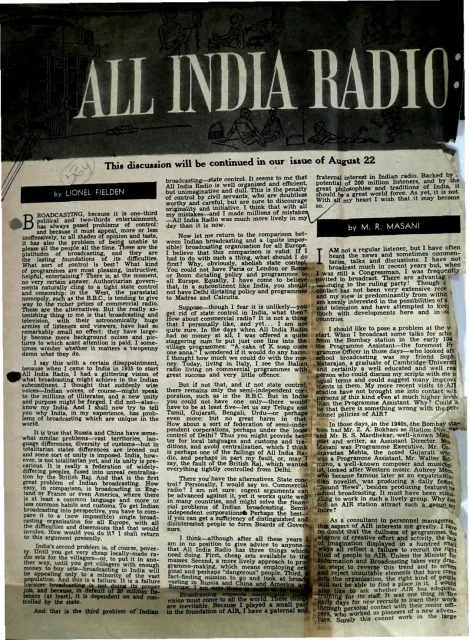 Primary workTHE ILLUSTRATED WEEKLY OF INDIA
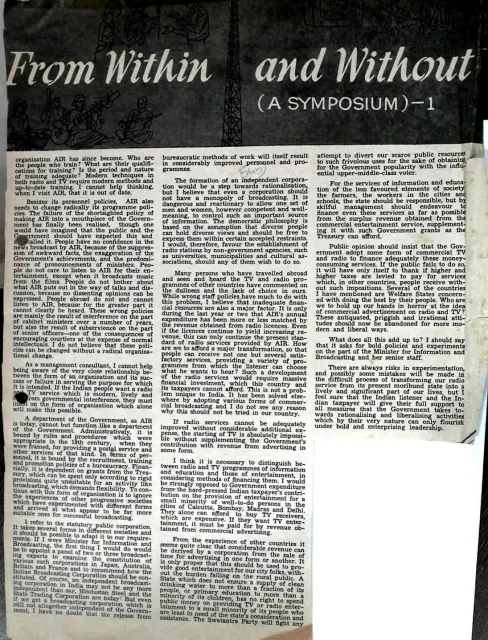 Primary workFrom Within and Without
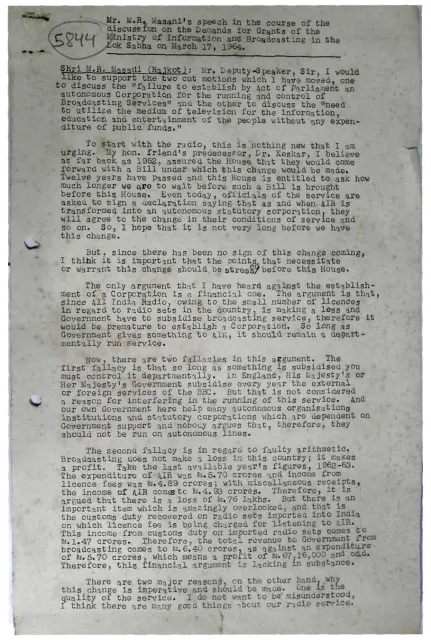 Primary workMr. M.R. Masani's speech in the course of the discussion on the Demands for Grants of the Ministry of Information and Broadcasting in the Lok Sabha on March 17, 1964.
 ExcerptThe Secular State
 OpinionDadabhai Naoroji: Social Reforms, Transnational Connections and Statistical Liberalism