Summary
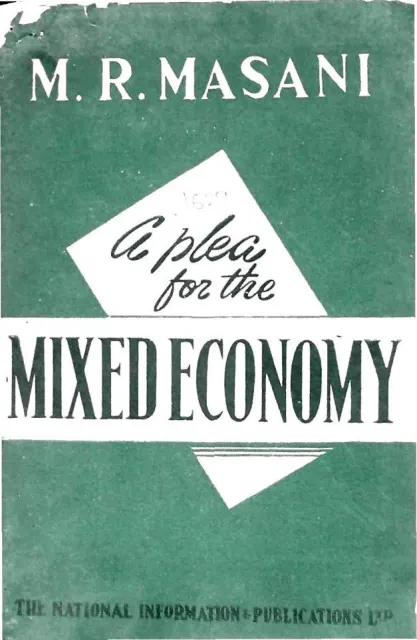
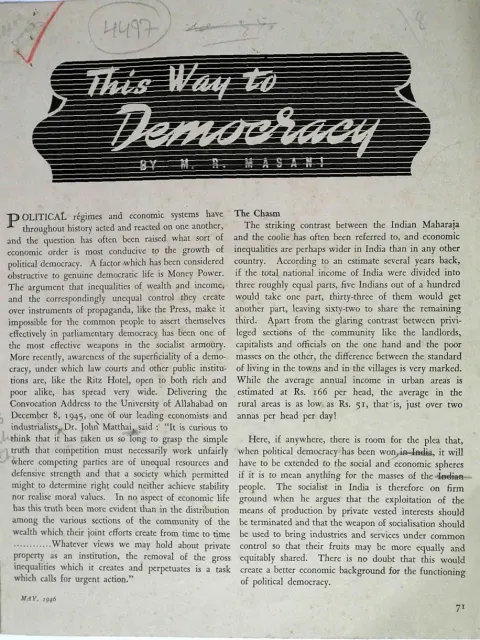
In the rendered pages, M. R. Masani argues that political democracy cannot function securely amid extreme inequalities of wealth and income. He treats concentrated economic power as a political danger because it controls instruments such as the Press and prevents ordinary people from asserting themselves effectively. Using India’s sharply unequal rural and urban incomes as evidence, he maintains that political democracy must be extended into the social and economic spheres.
In the rendered pages, Masani rejects both laissez-faire and comprehensive nationalisation as inadequate alternatives. He presents Soviet Russia as evidence that nationalisation is no guarantee against exploitation, profit-seeking, or dictatorship, and warns that centralised control can destroy both liberty and equality. His proposed middle course combines democratic political institutions with a gradual reduction of inequality: taxation and the elimination of absentee ownership to “level down,” and social services, minimum wages, public utilities, co-operatives, and selective socialisation to “level up.” The goal is economic equality as a democratic aspiration, without treating it as a precondition that justifies sacrificing political freedom.
Key points
- Masani links economic inequality to unequal political power and weakened democratic participation.
- The rendered pages present India’s distribution of national income and rural-urban income differences as evidence of severe inequality.
- The Soviet experiment is used to argue that state ownership can coexist with dictatorship, exploitation, and social stratification.
- Masani rejects both laissez-faire and all-round nationalisation as the two horns of a false dilemma.
- He advocates democratic limits on profit and a gradual movement toward socialisation and communal control.
- “Levelling down” would involve taxation and the elimination of absentee ownership, while “levelling up” would involve public services, fair wages, and low-cost utilities.
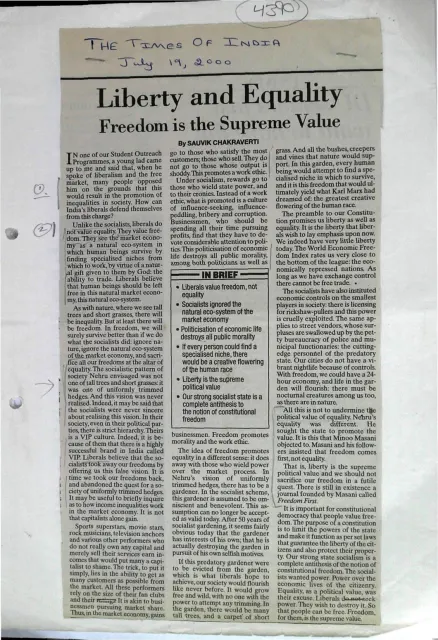
- The essay treats economic equality as a goal of democracy, but allows differential incentives to remain in democratic societies.
Metadata and summary are AI-extracted from the source PDF and reviewed for editorial accuracy. The original work is available via the Read PDF tab above (where present); paragraph-level citation inside the PDF is deferred to a future engagement.