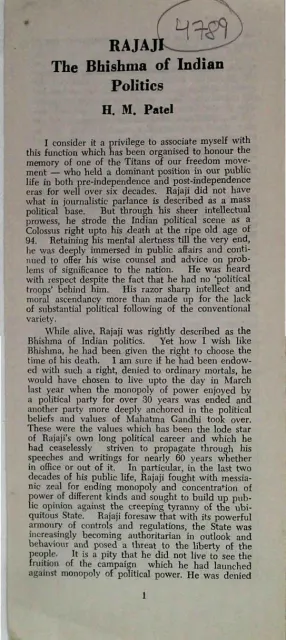
speech
The Bhishma of Indian Politics
By H. M. Patel
Published by the Rajaji Foundation and Printed by it at the States' People's Press, Bombay-1. · Bombay-1 · 1978
6 pages
Summary
In this speech, H. M. Patel presents C. Rajagopalachari (Rajaji) as a morally independent statesman whose influence exceeded the limits of mass politics. Patel emphasizes Rajaji’s long public career, intellectual range, closeness to Mahatma Gandhi, and willingness to sacrifice office, popularity, and personal relationships for what he considered the national interest. Rajaji’s political ethic is described through the idea of dharma: political action required integrity, attention to both means and ends, and resistance to personal ambition or sectional privilege.
The speech then interprets Rajaji’s administrative and liberal commitments. Patel praises his distinction between policymaking by elected politicians and implementation by politically protected civil servants, and links Rajaji’s opposition to controls, licences, and concentrated state power to the defence of individual dignity and initiative. Rajaji is also remembered as a writer in Tamil and English who conveyed ethical and cultural values to younger generations. The text closes by urging systematic study of Rajaji’s ideas so that India might become a country whose people are “free, fearless and self-reliant.” The pamphlet identifies this text as a speech delivered at a Rajaji Foundation subscription dinner in Bombay on January 22, 1978.
Key points
- Patel portrays Rajaji as a statesman whose intellectual authority compensated for the absence of a large mass political base.
- Rajaji’s political conduct is framed through moral values, personal integrity, and a willingness to dissent from colleagues and prevailing opinion.
- The speech highlights Rajaji’s association with Gandhi and his contribution to programmes including temple entry, the removal of untouchability, Khadi, and village industries.
- As an administrator, Rajaji is praised for respecting civil servants’ professional judgment while retaining political responsibility for decisions.
- Rajaji’s opposition to controls, licences, and the “permit, licence and quota Raj” is presented as a defence of individual freedom and economic initiative.
- The speech links Rajaji’s critique of centralisation to decentralisation, federalism, and greater power and resources for the States.
- Patel presents Rajaji’s Tamil and English writings as a lasting vehicle for cultural education and ethical instruction.
Metadata and summary are AI-extracted from the source PDF and reviewed for editorial accuracy. The original work is available via the Read PDF tab above (where present); paragraph-level citation inside the PDF is deferred to a future engagement.