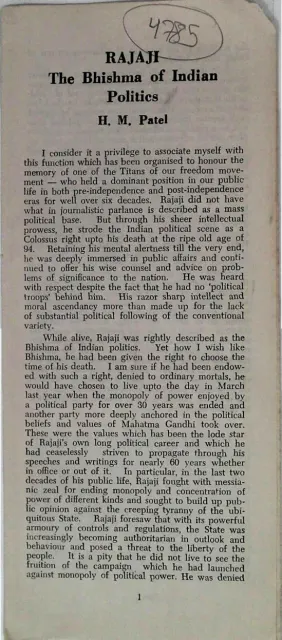
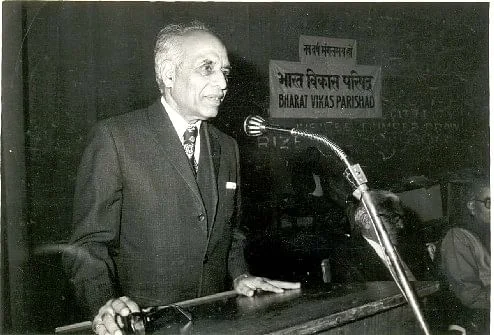
speech · memorial lecture
The Bhishma of Indian Politics
By H. M. Patel
Published by the Rajaji Foundation and Printed by it at the States' People Press, Bombay-1. · Bombay-1 · 1978
4 pages
Summary
In this memorial speech, H. M. Patel presents C. Rajagopalachari (Rajaji) as a statesman whose intellectual force, moral independence, and longevity made him “the Bhishma of Indian politics.” Patel emphasizes that Rajaji exercised influence without a mass political base, relying instead on his reasoning, integrity, and willingness to dissent. He links Rajaji’s public life to the ethical ideals of Mahatma Gandhi, while also stressing Rajaji’s distinctive opposition to political monopoly, concentrated power, and the expanding authority of the state.
The speech surveys Rajaji’s roles as freedom fighter, administrator, political philosopher, and writer. Patel highlights his administrative standards in Madras and at the Centre, his protection of civil servants from political interference, and his belief that policy-making should remain distinct from routine administration. The later sections defend Rajaji’s commitment to individual dignity, initiative, and freedom against what he called the “permit, licence and quota Raj,” and describe his opposition to controls, government–industry collusion, gigantism, and excessive centralisation. Patel closes by recalling Rajaji’s literary contribution in Tamil and English and urging systematic study of his ideas so that they might help build an India that is free, fearless, and self-reliant.
Key points
- Patel memorializes Rajaji as an exceptionally influential statesman whose intellectual authority compensated for the absence of a mass political following.
- Rajaji is portrayed as a moral and political heir of Gandhi who nevertheless maintained the courage to dissent from Gandhi and other colleagues.
- The speech praises Rajaji’s administrative judgment, especially his distinction between political policy-making and the professional execution of law and regulations.
- Rajaji’s political philosophy is presented as centred on individual dignity, freedom, initiative, and human potential.
- The speech attacks excessive controls and licensing, arguing that they foster corruption and political and economic oligarchy rather than protecting ordinary people.
- Patel associates Rajaji with decentralisation, federalism, and opposition to concentration of political and economic power.
- Rajaji’s literary work in Tamil and English is treated as a major part of his enduring public contribution.
Metadata and summary are AI-extracted from the source PDF and reviewed for editorial accuracy. The original work is available via the Read PDF tab above (where present); paragraph-level citation inside the PDF is deferred to a future engagement.