speech · memorial lecture
RAJAJI
The Bhishma of Indian Politics
By H. M. Patel
Published by the Rajaji Foundation and Printed by it at the States’ People Press, Bombay-1. · Bombay-1 · 1978
4 pages
Summary
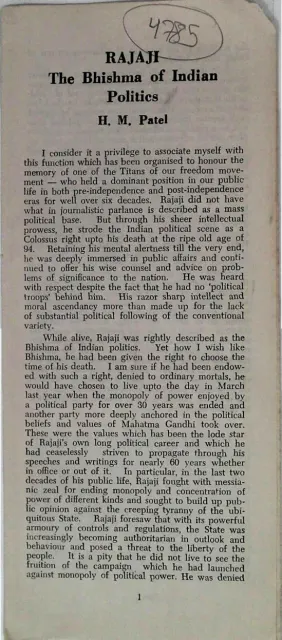
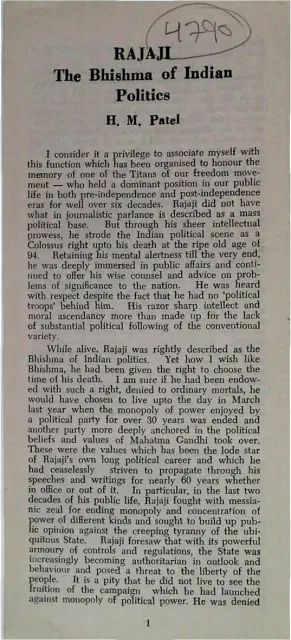
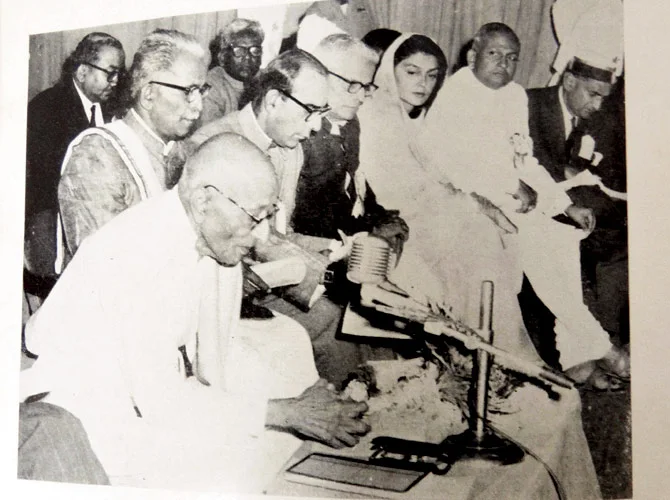
In this memorial speech, H. M. Patel presents C. Rajagopalachari (Rajaji) as an intellectually formidable statesman whose authority rested not on a mass political base but on sharp intelligence, moral conviction, and sustained public service. Patel surveys Rajaji’s roles as politician, administrator, philosopher, social reformer, and writer, emphasizing his commitment to ethical politics, Gandhian social programmes, and the importance of moral values in public life. He also recalls Rajaji’s willingness to dissent from colleagues, including his advocacy in 1942 of accepting partition in principle as a means of securing the transfer of power from Britain to India.
The speech then develops Rajaji’s political philosophy as a defence of individual dignity and freedom against an omniscient, interventionist State. Patel associates Rajaji’s opposition to controls, licences, concentration of power, and excessive state ownership with a broader concern for decentralisation, federalism, administrative responsibility, and the protection of civil servants from political interference. Rajaji is also remembered as a writer in Tamil and English whose retellings of the Ramayana and Mahabharata, journalism, and cultural teaching extended his influence beyond formal politics. The booklet closes by urging systematic study of his ideas rather than the creation of a personal cult. It is identified as the text of a speech delivered at a Rajaji Foundation subscription dinner in Bombay on January 22, 1978.
Key points
- Patel portrays Rajaji as a statesman whose intellectual and moral authority compensated for the absence of a mass political base.
- Rajaji’s public career is described as encompassing politics, administration, social reform, philosophy, and literature.
- The speech stresses Rajaji’s Gandhian commitments, including temple entry for Harijans, the removal of untouchability, khadi, village industries, and prohibition.
- Rajaji’s opposition to controls and licences is presented as an argument against corruption, political oligarchy, and excessive state power.
- The speech links his defence of individual freedom to decentralisation, federalism, and limits on administrative and political interference.
- Patel presents Rajaji’s support for partition in 1942 as a courageous and unpopular position intended to accelerate the transfer of power.
- Rajaji’s Tamil and English writings, including versions of the Ramayana and Mahabharata, are treated as an enduring part of his public legacy.
- The speech calls for study of Rajaji’s ideas and values rather than commemorative glorification.
Metadata and summary are AI-extracted from the source PDF and reviewed for editorial accuracy. The original work is available via the Read PDF tab above (where present); paragraph-level citation inside the PDF is deferred to a future engagement.