speech · memorial lecture
RAJAJI
The Bhishma of Indian Politics
By H. M. Patel
Published by the Rajaji Foundation and Printed by it at the States’ People Press, Bombay-1. · Bombay-1
4 pages
Summary
In this memorial speech, H. M. Patel presents C. Rajagopalachari (Rajaji) as a statesman whose authority rested not on a mass political following but on intellectual alertness, moral seriousness, and independence of judgment. Patel traces Rajaji’s association with Mahatma Gandhi, his work in advancing programmes such as temple entry, the removal of untouchability, khadi, village industries, and prohibition, and his willingness to dissent when conscience required it. Rajaji’s advocacy of partition in 1942 is described as an unpopular but principled attempt to secure the transfer of power from Britain to Indian hands.
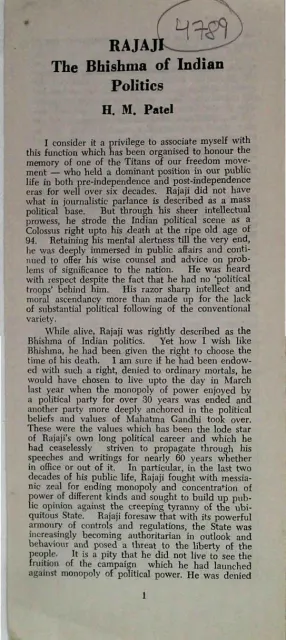
The speech also emphasizes Rajaji’s administrative philosophy and his defence of the civil service, clear distinctions between policy and administration, and responsible government. Patel links Rajaji’s later political work to a defence of individual dignity and freedom against an intrusive, centralised state, socialism, and the system of permits, licences, and quotas. The closing sections portray Rajaji as a writer and teacher whose Tamil and English writings, including versions of the Ramayana and Mahabharata, helped transmit ethical and cultural values to younger generations. The visible text is the complete four-page PDF booklet, though its printed folios run from 1 through 5.
Key points
- Rajaji is commemorated as a morally independent statesman whose influence exceeded his formal political following.
- His relationship with Mahatma Gandhi is presented as central to his political formation and public service.
- The speech defends Rajaji’s dissent over partition in 1942 as a principled response to the question of transferring power.
- Rajaji’s administrative record is associated with civil-service independence, accountable decision-making, and a distinction between policy and implementation.
- His later political philosophy centres on human dignity, individual freedom, and resistance to an all-embracing state.
- Patel criticises permits, licences, quotas, and excessive controls as sources of corruption, oligarchy, and diminished economic initiative.
- Rajaji’s literary work is treated as part of his enduring public contribution and as a means of transmitting moral and cultural values.
Metadata and summary are AI-extracted from the source PDF and reviewed for editorial accuracy. The original work is available via the Read PDF tab above (where present); paragraph-level citation inside the PDF is deferred to a future engagement.