speech · memorial lecture
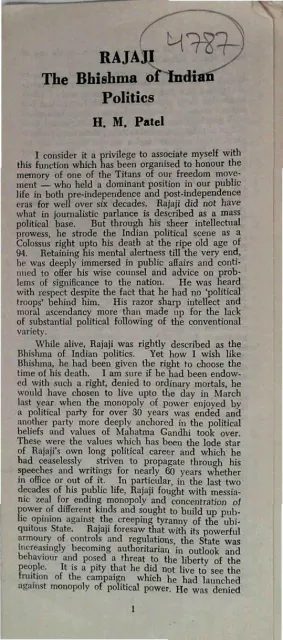
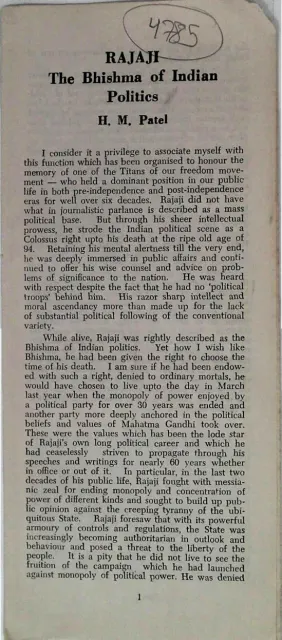
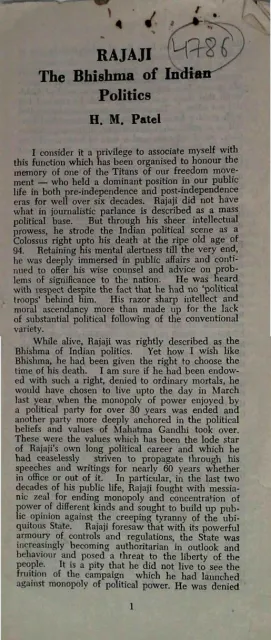
The Bhishma of Indian Politics
By H. M. Patel
Published by the Rajaji Foundation and Printed by it at the States' People Press, Bombay-1. · Bombay · 1978
4 pages
Summary
In this memorial speech, H. M. Patel presents C. Rajagopalachari (Rajaji) as a statesman whose intellectual independence, moral seriousness, and public service spanned the freedom struggle and the post-independence period. He portrays Rajaji as a Gandhian who nevertheless retained the courage to dissent, including over the question of partition in 1942, and as a public figure whose influence rested on conviction rather than a mass political organisation.
The speech emphasises Rajaji’s opposition to concentrated political and administrative power. Patel connects his defence of individual dignity, freedom, and initiative with his criticism of socialism, controls, licences, and the expanding State. Rajaji is also remembered as an administrator who respected civil servants while maintaining a firm distinction between policy-making and implementation, as a writer in Tamil and English, and as a teacher of ethical and cultural values. The closing appeal is for systematic study of Rajaji’s ideas so that India may become “free, fearless and self-reliant.”
Key points
- Patel memorialises Rajaji as a major figure of Indian public life whose career covered the pre- and post-independence eras.
- Rajaji is described as a close associate and “conscience keeper” of Mahatma Gandhi, while also being willing to dissent from Gandhian positions.
- The speech highlights Rajaji’s commitment to moral values, personal integrity, and public service rather than personal advancement or factional loyalty.
- Rajaji’s political philosophy is presented as a blend of Upanishadic wisdom and British liberalism centred on human dignity, freedom, and individual initiative.
- Patel endorses Rajaji’s critique of controls, licences, State power, and the alliance between government and industry.
- Rajaji is praised for administrative competence, support for civil servants, decentralisation, and a federal distribution of power.
- The speech also treats Rajaji’s Tamil and English writing, including his renderings of the Ramayana and Mahabharata, as a major part of his legacy.
Metadata and summary are AI-extracted from the source PDF and reviewed for editorial accuracy. The original work is available via the Read PDF tab above (where present); paragraph-level citation inside the PDF is deferred to a future engagement.