essay
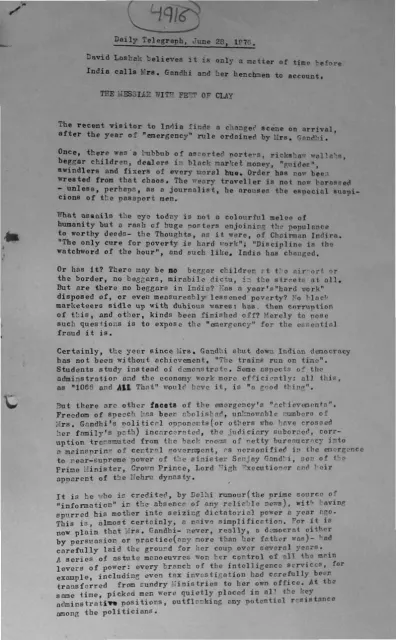
THE MESSIAH WITH FEET OF CLAY
Daily Telegraph · 1976
2 pages
Summary
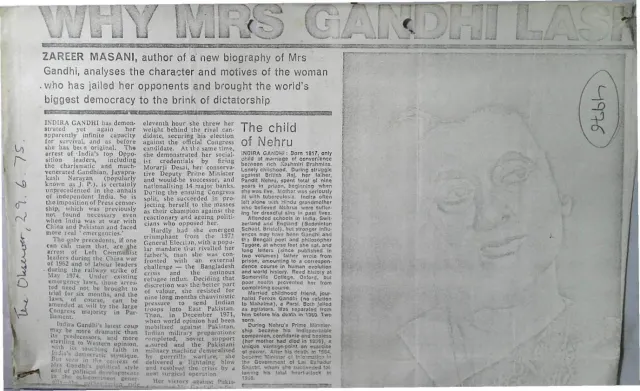
In the rendered pages, this unsigned Daily Telegraph article argues that India’s Emergency, imposed by Indira Gandhi, has not fundamentally transformed the country but has intensified existing weaknesses in its political and administrative system. It contrasts the earlier public disorder associated with beggars, black-market dealers and petty corruption with the Emergency’s claims of discipline, punctual trains, increased administrative efficiency and reduced public protest. The article accepts some of these achievements but insists that they cannot justify the suppression of democratic freedoms or the human cost of authoritarian rule.
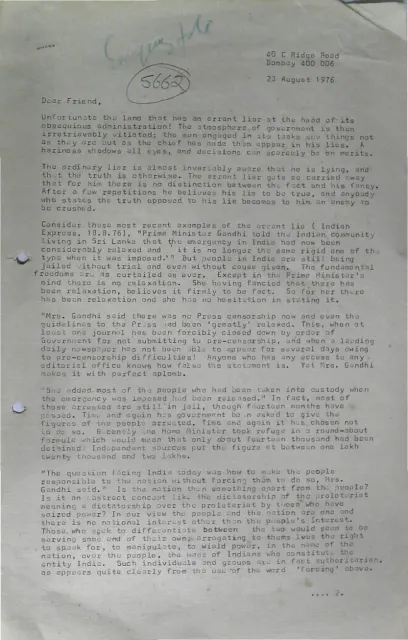
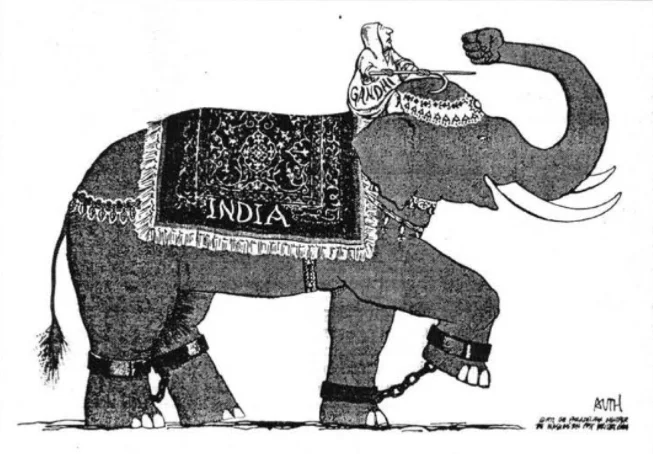
In the rendered pages, the article’s central indictment concerns the abolition of free speech, the detention of political opponents, the erosion of judicial independence, press censorship, parliamentary paralysis and the concentration of power in the prime minister’s office. It rejects the claim that only a small middle-class and intellectual minority has been inconvenienced, pointing to mass poverty, hunger, inadequate shelter, health care and education. The closing warning is that Indira Gandhi’s apparently strong position is fragile because it rests on coercion rather than durable political legitimacy; with Gandhi in sole charge and Sanjay Gandhi seeking greater control, the article predicts that India may eventually hold the rulers accountable, potentially at a heavy human cost.
Key points
- The article presents the Emergency as a continuation of earlier political tendencies rather than a genuinely new phase for India.
- It acknowledges improvements such as punctual trains, reduced demonstrations and greater administrative efficiency, while arguing that these do not offset authoritarian abuses.
- It challenges the claim that the Emergency has inconvenienced only a small urban middle-class and intellectual minority.
- It condemns restrictions on speech, detention of opponents, press censorship, parliamentary weakening and the erosion of judicial independence.
- It argues that corruption has been centralised and made more politically consequential rather than eliminated.
- It portrays Indira Gandhi’s authority as dependent on coercion, personal control and the removal of institutional checks and balances.
- It warns that the concentration of power in Indira Gandhi and the rising influence of Sanjay Gandhi could eventually provoke accountability and serious bloodshed.
Metadata and summary are AI-extracted from the source PDF and reviewed for editorial accuracy. The original work is available via the Read PDF tab above (where present); paragraph-level citation inside the PDF is deferred to a future engagement.