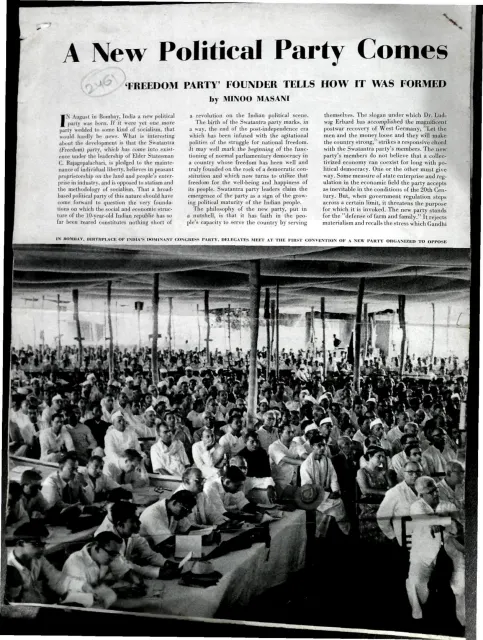
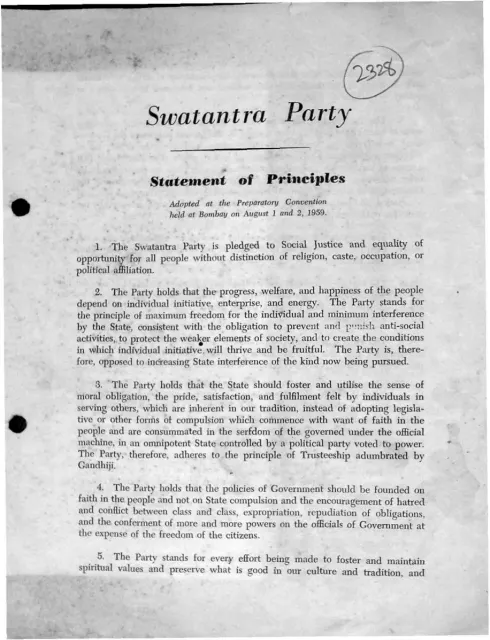
interview
WHAT SWATANTRA STANDS FOR
( An interview with Sri.C.Rajagopalachari by Hindustan Times Special Correspondent.)
Hindustan Times · BOMBAY
8 pages
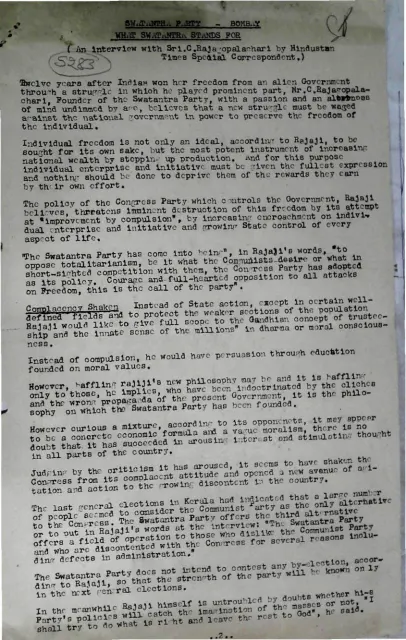
Summary
This eight-page interview presents C. Rajagopalachari’s case for the newly formed Swatantra Party as a defense of individual freedom, private enterprise, and limited government. Rajaji argues that the Congress government’s programme of “improvement by compulsion,” expanding state control, and collectivist planning threatens individual initiative and the freedom to pursue enterprise. He presents Swatantra as an opposition to totalitarianism and as a political alternative to both Congress and Communism, while accepting state action to protect weaker sections and provide essential services.
The interview develops this position across agriculture, industry, taxation, education, foreign policy, and party strategy. Rajaji supports voluntary cooperation rather than compulsory cooperative farming, private incentives rather than socialism, and democratic planning that sets direction without relying on coercion. He also invokes Gandhi’s doctrine of trusteeship and dharma, arguing that wealth should be increased through enterprise and that social responsibility should be encouraged by moral persuasion rather than confiscatory regulation. The closing discussion addresses Swatantra’s electoral prospects, its relationship to Congress and the Communist Party, the bifurcation of Bombay State, religious non-discrimination, and the party’s eventual aim of reaching power in Delhi.
Transcript
Summary
This eight-page interview presents C. Rajagopalachari’s case for the newly formed Swatantra Party as a defense of individual freedom, private enterprise, and limited government. Rajaji argues that the Congress government’s programme of “improvement by compulsion,” expanding state control, and collectivist planning threatens individual initiative and the freedom to pursue enterprise. He presents Swatantra as an opposition to totalitarianism and as a political alternative to both Congress and Communism, while accepting state action to protect weaker sections and provide essential services.
The interview develops this position across agriculture, industry, taxation, education, foreign policy, and party strategy. Rajaji supports voluntary cooperation rather than compulsory cooperative farming, private incentives rather than socialism, and democratic planning that sets direction without relying on coercion. He also invokes Gandhi’s doctrine of trusteeship and dharma, arguing that wealth should be increased through enterprise and that social responsibility should be encouraged by moral persuasion rather than confiscatory regulation. The closing discussion addresses Swatantra’s electoral prospects, its relationship to Congress and the Communist Party, the bifurcation of Bombay State, religious non-discrimination, and the party’s eventual aim of reaching power in Delhi.
Key points
- Rajagopalachari identifies individual freedom as both a moral ideal and an instrument for increasing national wealth through production.
- He criticizes Congress policies of state expansion, compulsory improvement, collectivism, and interference with land ownership.
- The Swatantra Party is presented as an alternative to Congress and Communism, with opposition to attacks on freedom as its central political purpose.
- Rajaji supports private enterprise, profit incentives, and voluntary cooperation, while allowing limited government action for essential services and weaker sections.
- He argues that planning can be democratic if government educates and persuades citizens rather than imposing its preferred programme by compulsion.
- His account of trusteeship combines increased production with voluntary moral responsibility, drawing on Gandhi’s ideas of dharma and social obligation.
- The interview portrays Swatantra as a field for people dissatisfied with Congress who do not necessarily wish to join the Communist Party.
- Rajaji maintains that the party will not discriminate against Muslims or other communities and that its electoral future will be tested by subsequent general elections.
Metadata and summary are AI-extracted from the source PDF and reviewed for editorial accuracy. The original work is available via the Read PDF tab above (where present); paragraph-level citation inside the PDF is deferred to a future engagement.