
minutes · report
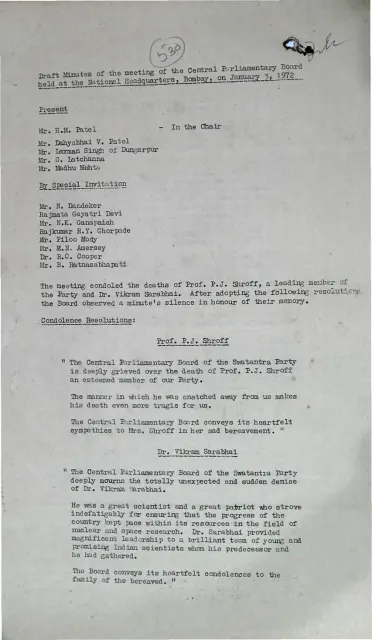
Draft Minutes of the meeting of the Central Parliamentary Board held at the National Headquarters, Bombay, on January 3, 1972
Swatantra Party · Bombay · 1972
6 pages
Summary
These six pages record the draft minutes of the Swatantra Party’s Central Parliamentary Board meeting held at its National Headquarters in Bombay on January 3, 1972. The meeting began with condolences for the deaths of Prof. P. J. Shroff and Dr. Vikram Sarabhai, confirmation of earlier minutes, and a resolution praising India’s armed forces, the public, and the Government of India for their conduct during the recent conflict with Pakistan.
The principal business concerned strategy for the forthcoming Assembly elections. The Board reviewed polling schedules, relations with opposition parties, possible electoral adjustments in Punjab and Telangana, state-level manifestos, military training, land-ceiling policy, fundraising, candidate selection, and a proposed Rajya Sabha by-election nomination in Orissa. It rejected national-level alliances while allowing limited state-level seat adjustments, insisted that the Party retain its identity, opposed further lowering of urban land ceilings while calling for implementation of existing land-reform laws, and endorsed supplementary manifesto points on constitutional defence, the permit-licence-quota raj, and increased production. The minutes end with a request for official verification of K. P. Singh Deo’s Party membership before approving his nomination.
Key points
- The Board adopted condolence resolutions for Prof. P. J. Shroff and Dr. Vikram Sarabhai and observed a minute’s silence.
- It unanimously congratulated India’s armed forces, the people, and the Government of India for their conduct during the recent conflict with Pakistan.
- The Board discussed Assembly-election timing, state-level strategy, candidate selection, campaign finance, and electoral adjustments.
- It opposed alliances or adjustments with opposition parties at the national level, while permitting state units to negotiate limited seat adjustments without common programmes or joint campaigns.
- The Telangana unit was permitted to negotiate participation in a united opposition front, provided the Swatantra Party retained its identity and members sat as Swatantra legislators.
- The Board supported two years of compulsory military training for college students and opposed any further lowering of urban land ceilings while urging implementation of existing land-reform laws.
- Rajaji’s proposed manifesto emphases were constitutional defence, opposition to the permit-licence-quota raj, and increased production; N. Dandekar was asked to draft a supplementary note.
Metadata and summary are AI-extracted from the source PDF and reviewed for editorial accuracy. The original work is available via the Read PDF tab above (where present); paragraph-level citation inside the PDF is deferred to a future engagement.
Related across the archive
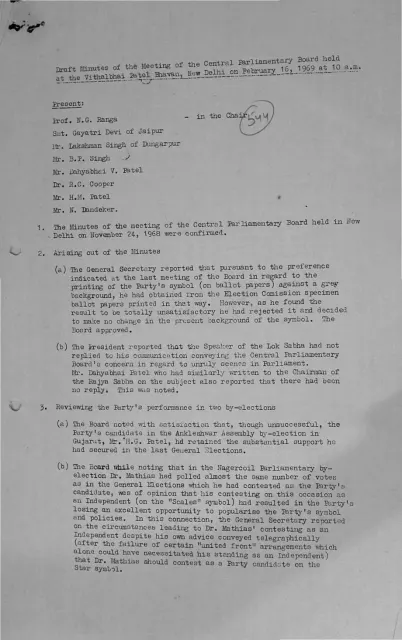 Primary workDraft Minutes of the Meeting of the Central Parliamentary Board held at the Vithalbhai Patel Bhavan, New Delhi on February 16, 1969 at 10 a.m.
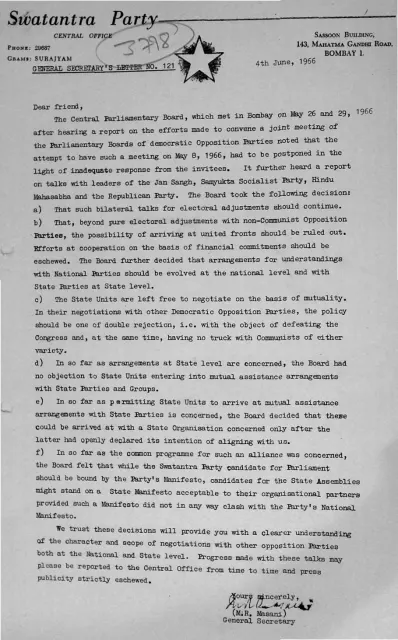 Primary workGENERAL SECRETARY'S LETTER NO. 121
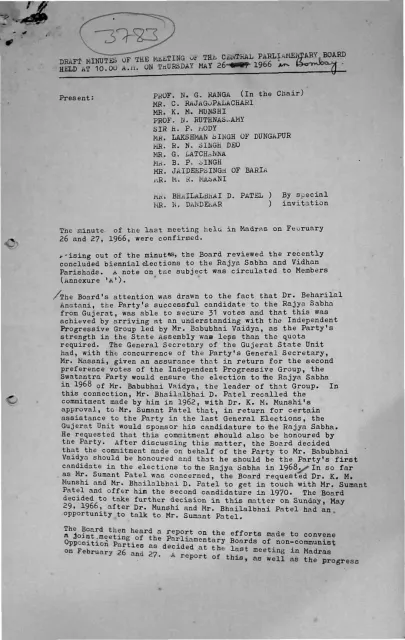 Primary workDRAFT MINUTES OF THE MEETING OF THE CENTRAL PARLIAMENTARY BOARD HELD AT 10.00 A.M. ON THURSDAY MAY 26, 1966 in Bombay
 OpinionThe Swatantra Way for Forging a Formidable Coalition
 ExcerptCeilings on Landholdings - M.A. Venkata Rao