pamphlet
ANSWERING YOU
20 pages
Summary
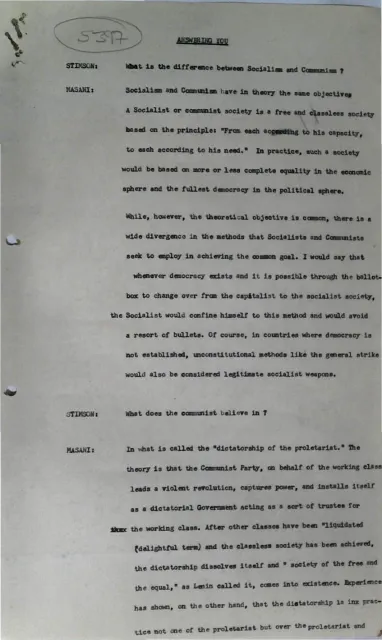
ANSWERING YOU is a question-and-answer pamphlet in which speakers identified as Masani, Hampton, Myers, and Stimson discuss socialism and communism, post-war education, India’s language problem, modern English literature, journalism, and patriotism. The discussion distinguishes socialism from communism primarily by method: communism is presented as accepting violent revolution and dictatorship to abolish private property, while socialism is associated with preserving political democracy and individual liberty while pursuing economic equality. The pamphlet also advocates broad, compulsory, practical education without privilege based on wealth or social status.
The language discussion argues that India’s multilingual education system places an excessive burden on students and can leave them mastering neither their own language nor English. Myers proposes Basic English as a practical tool and imagines its wider use helping create a neutral, Roman-script Hindustani lingua franca, while acknowledging that Hindi and Urdu appear to be diverging. The speakers further argue for teaching modern English literature in Indian universities, identify Gandhi and Nehru as important Indian writers in English, describe journalism as an underdeveloped but promising profession, and distinguish humane patriotism from aggressive nationalism. The supplied pages do not identify the pamphlet’s date, publisher, place of publication, or full speaker identities.
Key points
- The pamphlet contrasts communist revolutionary dictatorship with socialist democratic methods.
- Masani presents political democracy and individual liberty as more important than rapid abolition of private property.
- Hampton advocates equal educational opportunity, free compulsory schooling, and practical curricula open to students regardless of wealth or status.
- Myers argues that India’s multilingual education system burdens students and impedes clear thinking.
- Basic English is proposed as a practical, compressed form of English that could reduce the time spent on language learning.
- The discussion considers a Roman-script Hindustani as a possible Indian lingua franca, while noting the divergence of Hindi and Urdu.
- The speakers support greater attention to modern English literature, Indian writing in English, and the development of journalism.
- Patriotism is defended as love of country only when joined to love of humanity; aggressive nationalism is condemned.
Metadata and summary are AI-extracted from the source PDF and reviewed for editorial accuracy. The original work is available via the Read PDF tab above (where present); paragraph-level citation inside the PDF is deferred to a future engagement.