essay
The I.P.R. Conference at Lucknow
1952
4 pages
Summary
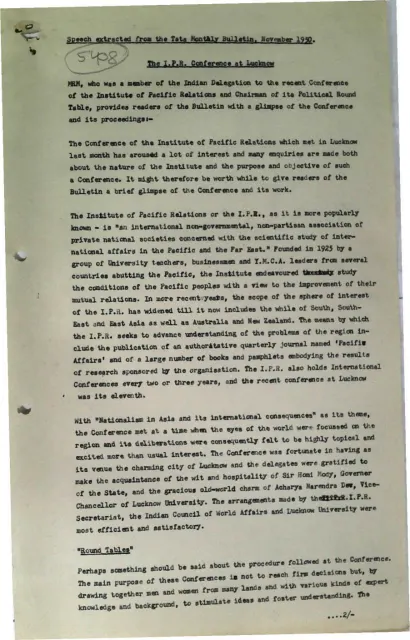
This four-page English extract, identified at the top as a speech taken from the Tata Monthly Bulletin of November 1952, describes the Institute of Pacific Relations (I.P.R.) conference held at Lucknow. The unnamed speaker explains that the I.P.R. was a non-governmental, non-partisan association devoted to studying international affairs in the Pacific and Far East. The Lucknow meeting, themed “Nationalism in Asia and its international consequences,” brought together delegates and guests from Asia, Europe, North America, and the Pacific region.
The account presents the conference as an educational forum rather than a body intended to reach binding decisions. Delegates worked in successive “Round Tables” on regional, political, economic, social, and financial questions, with the principal gains said to be greater knowledge, mutual understanding, and personal contacts. The extract then considers criticism of the conference, especially accusations that American delegates and the I.P.R. had treated Asian concerns through an anti-communist or pro-American lens. It concludes by questioning whether India was becoming intellectually isolated from both the West and its Asian neighbours, while presenting Southeast and East Asian delegates’ calls for economic, technical, and strategic assistance as a challenge to Indian non-alignment or isolationism.
Key points
- The I.P.R. is described as an international, non-governmental, non-partisan association studying Pacific and Far Eastern affairs.
- The Lucknow conference used regional and thematic “Round Tables” to exchange views rather than produce binding resolutions.
- Delegates came from a wide range of Asian, Western, and Pacific countries, and the speaker stresses the value of cross-national contacts.
- The conference produced no concrete agreements but was said to increase awareness of political attitudes and trends in other countries.
- Indian and Pakistani criticism portrayed American policy as imperialistic and economically or strategically exploitative in Asia.
- The speaker argues that these criticisms offered an incomplete account because much of the conference discussion was moderate and practical.
- The extract highlights a divide between Indian positions and the security concerns of Southeast and East Asian countries facing communist expansion.
- The conclusion asks whether India should reconsider an isolated approach to international affairs and attend more carefully to neighbouring countries’ perspectives.
Metadata and summary are AI-extracted from the source PDF and reviewed for editorial accuracy. The original work is available via the Read PDF tab above (where present); paragraph-level citation inside the PDF is deferred to a future engagement.