
Summary
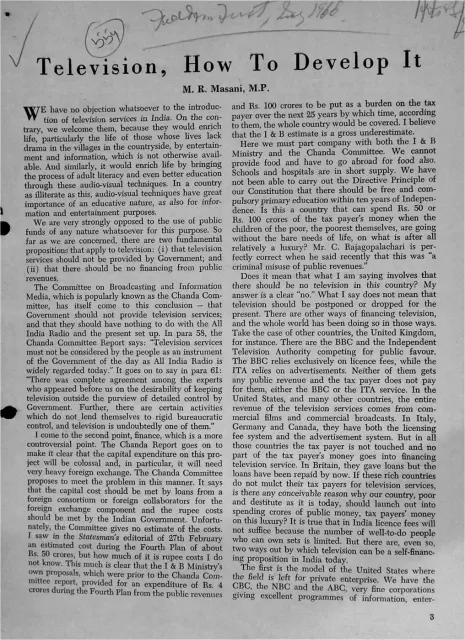
In the rendered pages, M. R. Masani argues that India should develop television but should not finance or administer it through the state. He welcomes television for its potential to provide entertainment and information to underserved rural audiences and to support adult literacy and education. At the same time, he endorses the Chanda Committee’s view that television should remain outside direct governmental control and insists that public revenues should not be used for its expansion. He warns that the proposed expenditure—estimated at roughly Rs. 50 to Rs. 100 crores—would divert scarce resources from food, schools, hospitals, and compulsory primary education.
In the rendered pages, Masani proposes two alternatives to a taxpayer-funded service: a commercially financed system modeled on the United States, or an autonomous statutory corporation modeled on Britain’s Independent Television Authority, with licence fees, sponsored programmes, and advertising. He rejects the Chanda Committee’s proposed government capital contribution and argues that an autonomous corporation should become self-financing rather than being bound by an arbitrary seven-year national coverage target. The article is based on a speech in Parliament and closes by emphasizing that television is desirable but should rank below more urgent claims on public funds.
Key points
- Masani supports introducing television in India for rural entertainment, information, adult literacy, and education.
- He opposes both direct government provision of television and financing from public revenues.
- He argues that proposed television spending must be weighed against shortages of food, schools, hospitals, and primary education.
- He cites the Chanda Committee’s support for keeping television outside detailed government control.
- He presents commercial broadcasting and an autonomous statutory corporation as alternative financing and governance models.
- He proposes licence fees, sponsored programmes, and advertising as means of making television self-financing.
- He criticizes the proposed seven-year target for nationwide coverage as unnecessarily rigid.
- He invokes C. Rajagopalachari’s description of using public revenues for television as a ‘criminal misuse of public revenues.’
Metadata and summary are AI-extracted from the source PDF and reviewed for editorial accuracy. The original work is available via the Read PDF tab above (where present); paragraph-level citation inside the PDF is deferred to a future engagement.
People in this work
Related across the archive
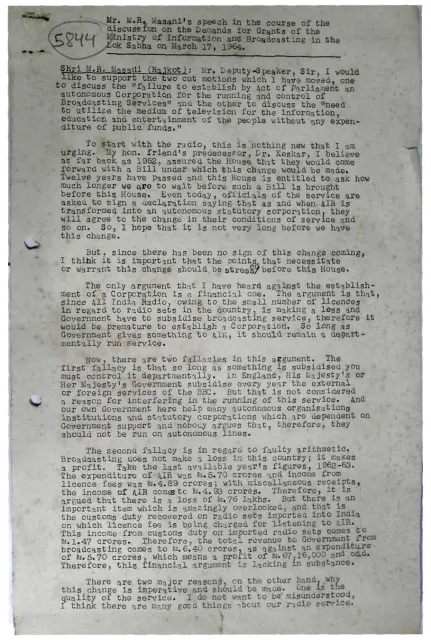 Primary workMr. M.R. Masani's speech in the course of the discussion on the Demands for Grants of the Ministry of Information and Broadcasting in the Lok Sabha on March 17, 1964.
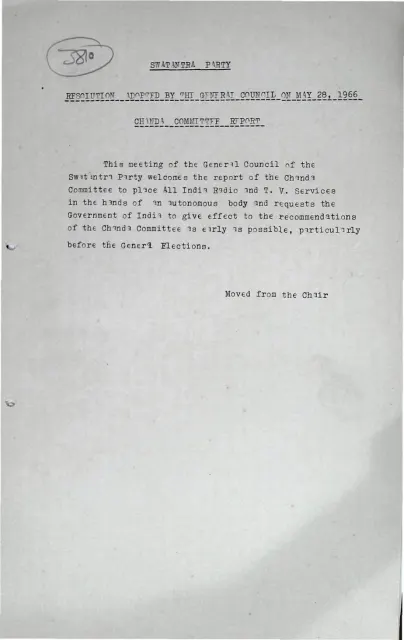 Primary workRESOLUTION ADOPTED BY THE GENERAL COUNCIL ON MAY 28, 1966
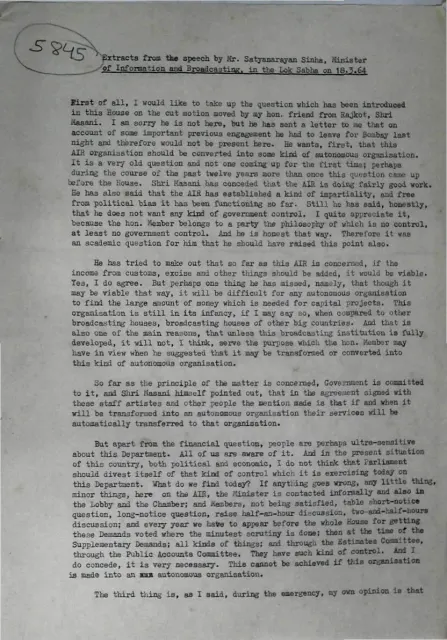 Primary workExtracts from the speech by Mr. Satyanarayan Sinha, Minister of Information and Broadcasting, in the Lok Sabha on 18.3.64
 ExcerptEconomic Reforms In India: Where Are We And Where Do We Go?
 ExcerptThe Myth of Free Education