
speech · parliamentary
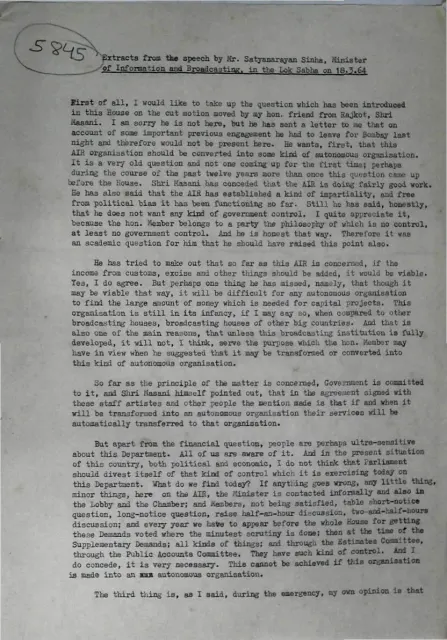
Extracts from the speech by Mr. Satyanarayan Sinha, Minister of Information and Broadcasting, in the Lok Sabha on 18.3.64
1964
2 pages
Summary
These two rendered pages reproduce extracts from Satyanarayan Sinha’s speech as Minister of Information and Broadcasting in the Lok Sabha on 18 March 1964. Responding to Minoo Masani’s proposal to convert All India Radio into an autonomous organisation, Sinha accepts the principle in the long term but argues that autonomy is impractical while the organisation remains financially dependent, subject to extensive parliamentary scrutiny, and vulnerable to takeover during an emergency. He maintains that the broadcasting service’s developmental needs require substantial capital and that the existing system of government control is necessary for accountability.
The speech then turns to television. Sinha describes television as valuable for information, education, and entertainment, but says India’s financial circumstances make nationwide expansion impossible without choosing between commercialisation or postponement. He rejects commercialisation of All India Radio, while keeping an open mind about sponsored television and inviting a decision based on weighing its advantages and disadvantages. The pages end with this discussion; any subsequent portion of the speech is not visible.
Key points
- Sinha responds to Minoo Masani’s call for All India Radio to become autonomous.
- He argues that financial dependence and the need for capital make immediate autonomy impractical.
- He defends parliamentary oversight of All India Radio as necessary for accountability.
- He argues that an autonomous broadcaster would still have been taken over by the Government during an emergency.
- He distinguishes All India Radio from television, rejecting commercialisation of the former.
- He presents nationwide television as a costly policy choice requiring either commercialisation or postponement.
- He remains open to sponsored television if its advantages can be demonstrated.
Metadata and summary are AI-extracted from the source PDF and reviewed for editorial accuracy. The original work is available via the Read PDF tab above (where present); paragraph-level citation inside the PDF is deferred to a future engagement.
Related across the archive
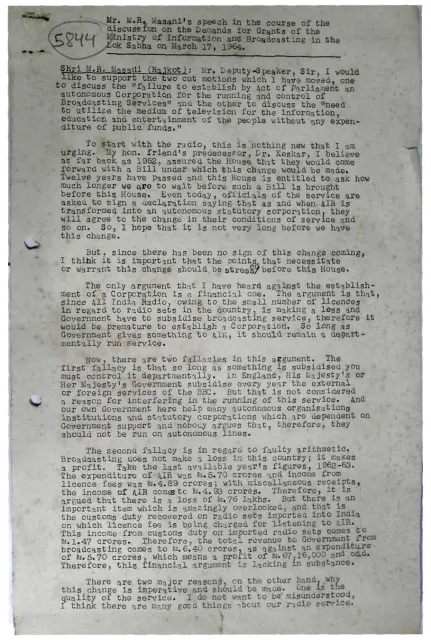 Primary workMr. M.R. Masani's speech in the course of the discussion on the Demands for Grants of the Ministry of Information and Broadcasting in the Lok Sabha on March 17, 1964.
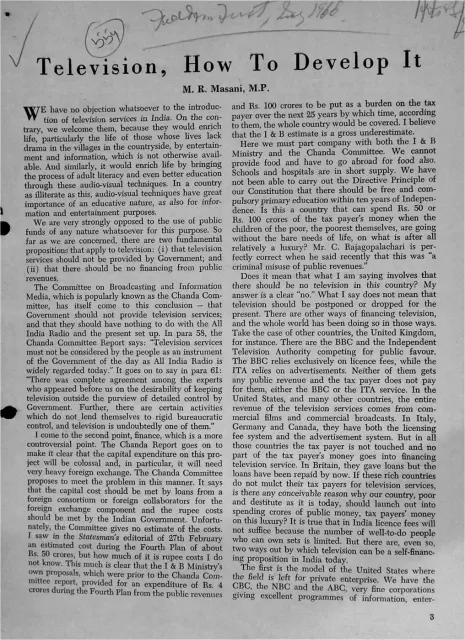 Primary workTelevision, How To Develop It
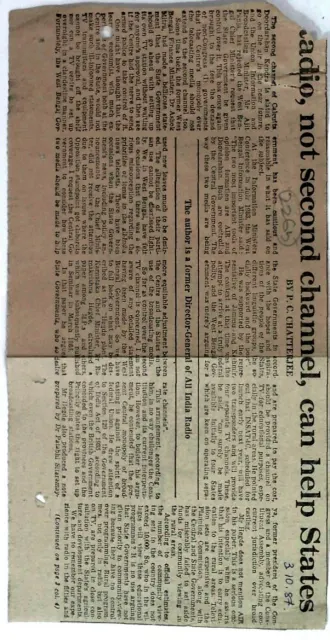 Primary workRadio, not second channel, can help States
 ExcerptParth Shah on Education and Choice
 ExcerptTHE APPLICATION OF SCIENCE AND TECHNOLOGY TO SOCIO-ECONOMIC DEVELOPMENT