
speech · parliamentary
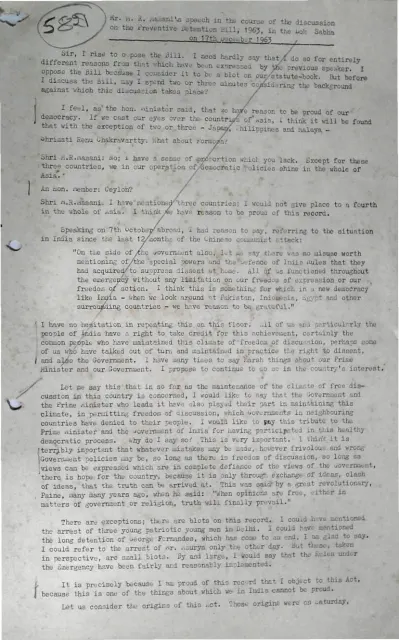
Mr. M. R. Masani's speech in the course of the discussion on the Preventive Detention Bill, 1963, in the Lok Sabha on 17th December 1963
By Minoo Masani
1963
5 pages
Summary
In this speech delivered in the Lok Sabha on 17 December 1963, Minoo Masani opposes the Preventive Detention Bill, calling it a blot on the statute-book. He begins by contrasting India’s democratic record with other Asian countries, while acknowledging that democratic freedoms have not been perfectly maintained. Masani argues that open discussion, dissent, and governmental accountability are precisely what allow truth to emerge and democracy to correct its mistakes.
Masani traces the Bill’s origins to the emergency legislation of 1950 and argues that the measure has outlived the circumstances that supposedly justified it. He contends that preventive detention is being used against patriotic citizens rather than only against Communist subversion, citing several detainees and the All-India Civil Liberties Council’s criticism of detention without trial. Comparisons with Ghana, wartime Britain, and West Germany support his claim that detention without charge is incompatible with a free constitutional order.
In the closing pages, Masani proposes that the Bill should either be allowed to lapse or replaced by narrowly framed legislation directed at a clearly demonstrable and present danger. He identifies three defects: the Act is vague and arbitrary, it has become a habit-forming instrument of government, and it divides democrats while weakening opposition to totalitarianism. He concludes that surrendering essential liberty for temporary safety protects neither liberty nor safety.
Key points
- Masani opposes the Preventive Detention Bill as a derogation from India’s democratic and constitutional commitments.
- He defends freedom of discussion and dissent as essential mechanisms for correcting governmental mistakes.
- He argues that the Bill, introduced in response to Communist subversion, is being applied to patriotic citizens and ordinary political dissenters.
- He compares India’s detention powers unfavourably with emergency-law standards in Ghana, wartime Britain, and West Germany.
- He proposes allowing the Act to lapse or replacing it with legislation limited to a clear and present danger.
- He identifies vagueness, arbitrariness, habituation to exceptional powers, and the division of democratic opponents as the Act’s major defects.
- He frames civil liberty and national security as compatible, insisting that security measures must remain bounded by law and democratic scrutiny.
Metadata and summary are AI-extracted from the source PDF and reviewed for editorial accuracy. The original work is available via the Read PDF tab above (where present); paragraph-level citation inside the PDF is deferred to a future engagement.
People in this work
Related across the archive
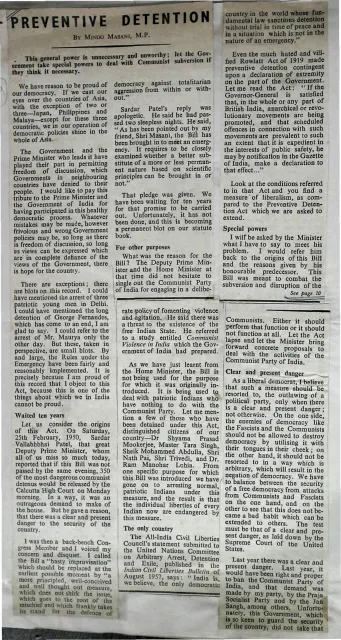 Primary workPREVENTIVE DETENTION
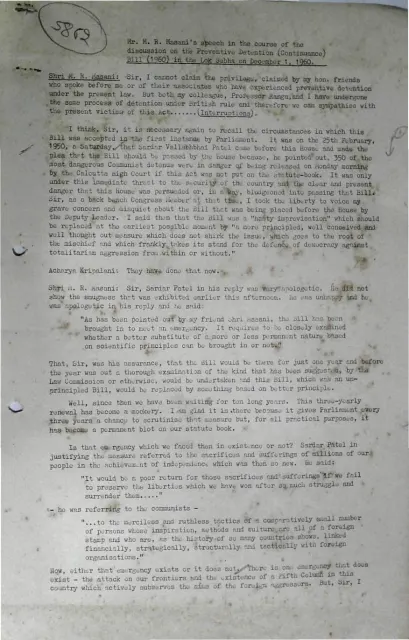 Primary workMr. M. R. Masani's speech in the course of the discussion on the Preventive Detention (Continuance) Bill (1960) in the Lok Sabha on December 1, 1960.
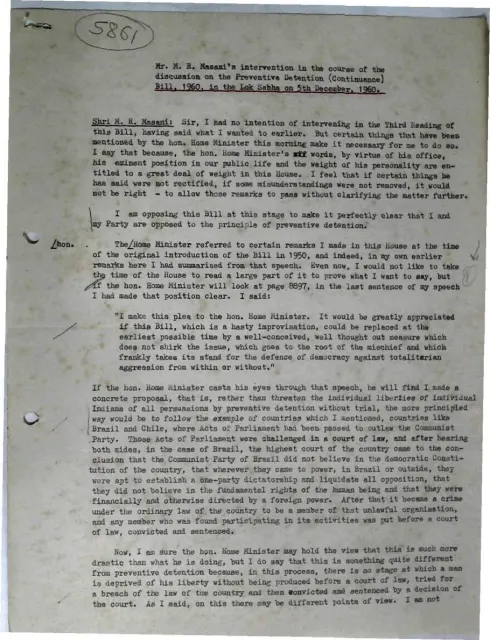 Primary workMr. M. R. Masani's intervention in the course of the discussion on the Preventive Detention (Continuance) Bill, 1960, in the Lok Sabha on 5th December, 1960.
 OpinionJustice H.R. Khanna and the Art of Speaking Truth to Power
 ExcerptDemocracy and Liberalism : Contrasting Ideals