
speech · parliamentary
Mr. M. R. Masani's speech in the course of the discussion on the Preventive Detention (Continuance) Bill (1960) in the Lok Sabha on December 1, 1960.
By Minoo Masani
1960
4 pages
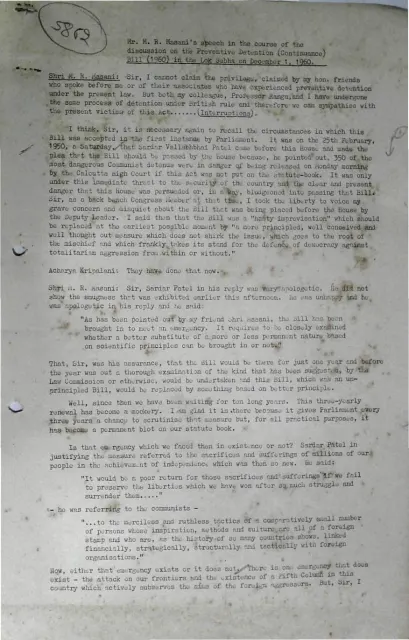
Summary
In this four-page Lok Sabha speech of 1 December 1960, M. R. Masani opposes the Preventive Detention (Continuance) Bill, arguing that the emergency justification originally offered for the measure has long since disappeared. He recalls that the bill was presented in 1950 amid fears that Communist detainees might be released by the Calcutta High Court, but says that the promised temporary renewal and review have instead become a permanent feature of the statute book. Masani describes this as a threat to democracy and insists that any restriction of liberty must rest on a clear and present danger rather than administrative convenience.
Masani distinguishes opposition to Communism from support for preventive detention. He accepts that the state may legislate directly against subversive organisations, but condemns the use of the Act against individuals who are exercising political, trade-union, or territorial rights. Citing the detention of Sheikh Abdullah, the arrest of strike supporters, and an exile notice served on a citizen in Bastar, he argues that the law has been used against patriotic Indians and that its operation violates the rule of law. He concludes by calling for uniformity of fundamental rights in Kashmir and throughout India and states that he will vote against the bill.
Key points
- Masani recalls that the Preventive Detention Bill was originally justified in 1950 by an alleged immediate danger of Communist detainees being released.
- He argues that the emergency rationale has lapsed and that repeated three-year renewals have made the measure a permanent blot on the statute book.
- He separates opposition to Communism from opposition to the bill, saying that restrictions should target subversive activity directly rather than curtail individual liberty through preventive detention.
- He presents the detention of Sheikh Abdullah as an example of a patriotic Indian being held without a demonstrated need for detention.
- He criticises the use of preventive detention against trade-unionists and people involved in strikes, arguing that a strike may be unlawful but remains a fundamental civil liberty unless prosecuted under ordinary law.
- He cites an exile notice issued to a citizen in Bastar as evidence that the Act is being used to deprive Indians of residence and movement rights.
- He argues that citizens must be presumed innocent until convicted and that Kashmiris should receive uniform fundamental rights as Indian citizens.
Metadata and summary are AI-extracted from the source PDF and reviewed for editorial accuracy. The original work is available via the Read PDF tab above (where present); paragraph-level citation inside the PDF is deferred to a future engagement.
People in this work
Related across the archive
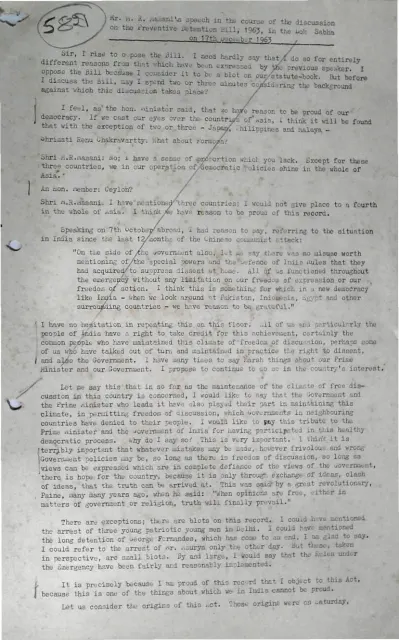 Primary workMr. M. R. Masani's speech in the course of the discussion on the Preventive Detention Bill, 1963, in the Lok Sabha on 17th December 1963
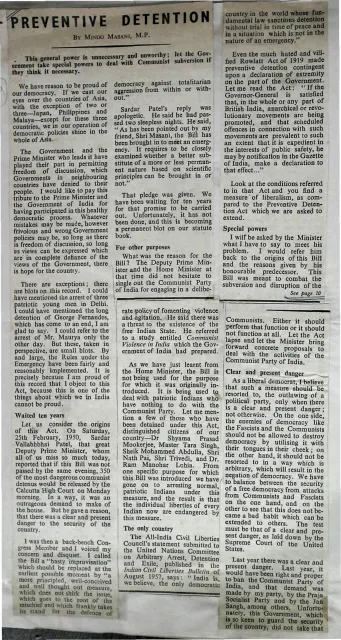 Primary workPREVENTIVE DETENTION
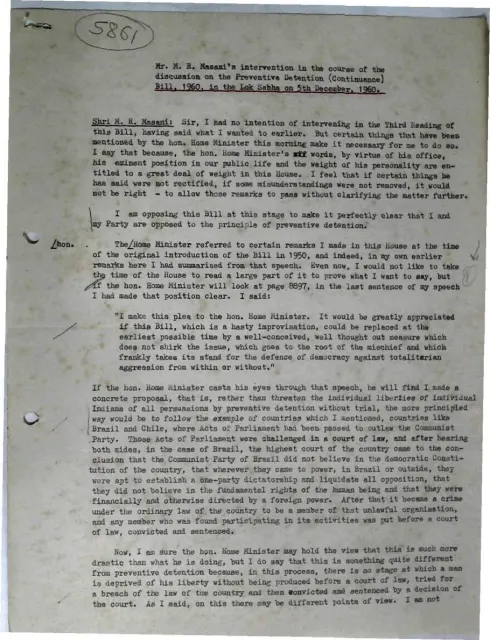 Primary workMr. M. R. Masani's intervention in the course of the discussion on the Preventive Detention (Continuance) Bill, 1960, in the Lok Sabha on 5th December, 1960.
 OpinionJustice H.R. Khanna and the Art of Speaking Truth to Power
 ExcerptThe Light of the Constitution