
essay
PREVENTIVE DETENTION
2 pages
Summary
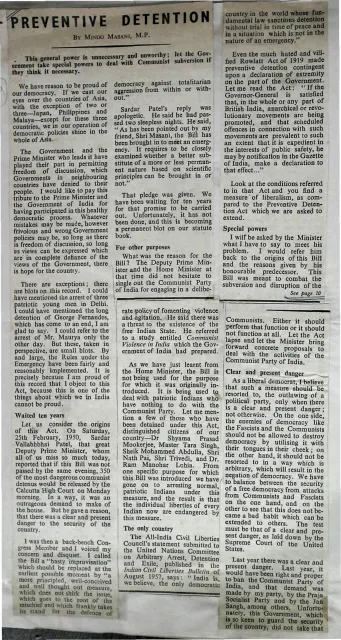
In the rendered pages, Minoo Masani argues that the Preventive Detention Bill is unnecessary, constitutionally dangerous, and unworthy of a democratic India. He acknowledges the Government’s record of resisting totalitarianism and accepts that genuine Communist subversion could require special powers, but contends that the Bill is being used for broader political purposes than the emergency originally invoked. He cites the detention of patriotic Indians with no connection to the Communist Party and warns that the measure places the liberty of ordinary citizens at risk.
In the rendered pages, Masani develops three principal objections: the Act is vague and arbitrary; it establishes a precedent that may make preventive detention a habitual instrument of government; and it divides democratic parties by allowing opponents to be treated as enemies. He compares the measure unfavourably with the more limited safeguards of the 1919 Rowlatt Act, invokes West German constitutional practice to argue that anti-democratic parties need not be granted constitutional protection, and concludes that a straightforward ban on the Communist Party would be preferable if the Government believes there is a clear and present danger. The clipping visibly directs readers to “See page 20,” so the supplied pages do not include the article’s continuation.
Key points
- Masani accepts the possibility of special powers against genuine Communist subversion but rejects the Bill’s broad preventive-detention framework.
- He argues that the measure is being used against patriotic Indians who have no connection with the Communist Party.
- He presents the Act as vague, arbitrary, and more sweeping than the emergency conditions used to justify it.
- He warns that preventive detention can become a habit-forming instrument of government.
- He argues that the Act damages democratic cooperation by placing democratic parties on opposing sides.
- He invokes West German constitutional law and the Rowlatt Act as comparative examples of more limited approaches.
- He proposes a direct ban on the Communist Party if the Government can demonstrate a genuine and present danger.
Metadata and summary are AI-extracted from the source PDF and reviewed for editorial accuracy. The original work is available via the Read PDF tab above (where present); paragraph-level citation inside the PDF is deferred to a future engagement.
Related across the archive
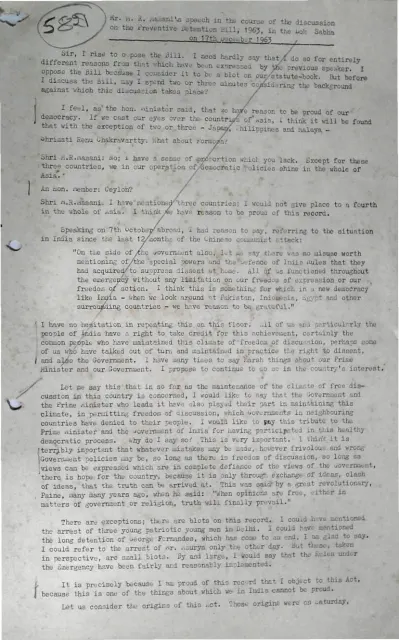 Primary workMr. M. R. Masani's speech in the course of the discussion on the Preventive Detention Bill, 1963, in the Lok Sabha on 17th December 1963
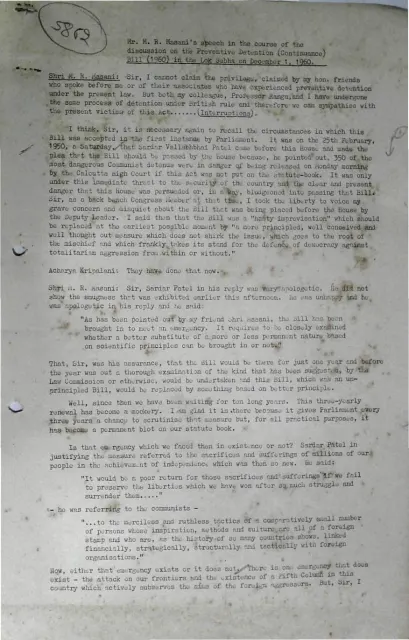 Primary workMr. M. R. Masani's speech in the course of the discussion on the Preventive Detention (Continuance) Bill (1960) in the Lok Sabha on December 1, 1960.
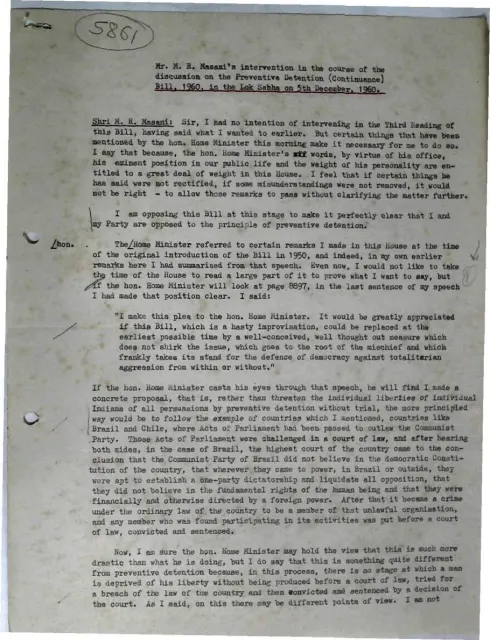 Primary workMr. M. R. Masani's intervention in the course of the discussion on the Preventive Detention (Continuance) Bill, 1960, in the Lok Sabha on 5th December, 1960.
 ExcerptThe Light of the Constitution
 ExcerptThe Individual and Indian Constitution