
speech · parliamentary
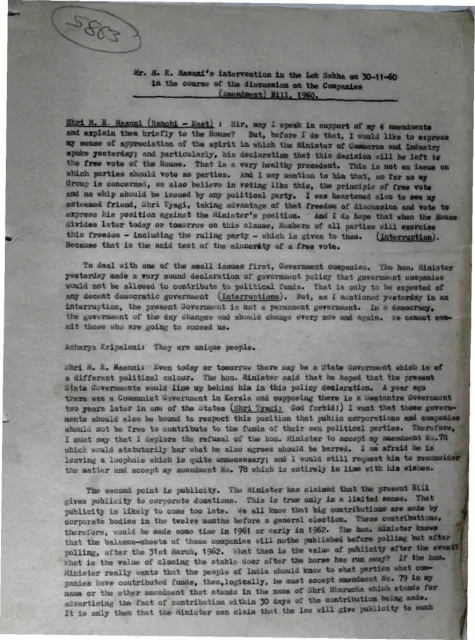
Mr. M. R. Masani's intervention in the Lok Sabha on 30-11-60
in the course of the discussion on the Companies (Amendment) Bill, 1960.
By Minoo Masani
1960
8 pages
Summary
In this Lok Sabha intervention on the Companies (Amendment) Bill, 1960, M. R. Masani supports amendments intended to prevent companies and their boards of directors from contributing funds to political parties or political funds. He welcomes limits on corporate donations but argues that merely capping contributions does not address the underlying danger: the coercive use of company resources and the conversion of political access into administrative favours. He also challenges the Government’s claim that the Bill would provide timely publicity about corporate donations, noting that contributions made before a general election might become public only after polling or even after the relevant political moment has passed.
Masani’s central argument is that corporate donations can join economic power to political power, concentrating influence in a small number of hands and undermining liberty and democratic checks and balances. He distinguishes ideological support for a party from donations motivated by fear, retaliation, licences, permits, priorities, and other governmental decisions. Drawing on the LIC Inquiry Commission and judgments attributed to Justices Vivian Bose and Tendulkar, he argues that the real issue is not whether contributions are formally voluntary, but whether companies are pressured to finance the ruling party. The supplied scan contains the complete four-page speech transcript, duplicated in the eight-page PDF.
Key points
- Masani supports amendments Nos. 1 and 14 to prohibit companies and boards of directors from making political contributions.
- He argues that a ceiling on corporate donations is insufficient if companies remain free to contribute within that limit.
- He questions whether the Bill’s publicity provisions would disclose donations early enough to inform voters before an election.
- He links corporate political donations to the concentration of economic and political power and the erosion of democratic checks and balances.
- He distinguishes genuine ideological support from contributions made to secure licences, permits, contracts, priorities, or protection from government retaliation.
- He argues that the practical issue is coercion and political misuse of company funds, not simply whether donations are legally labelled voluntary.
- He contends that the Government’s claim that regulation will make company administration clean is inconsistent with its argument that legislation cannot prevent malpractice.
Metadata and summary are AI-extracted from the source PDF and reviewed for editorial accuracy. The original work is available via the Read PDF tab above (where present); paragraph-level citation inside the PDF is deferred to a future engagement.
People in this work
Related across the archive
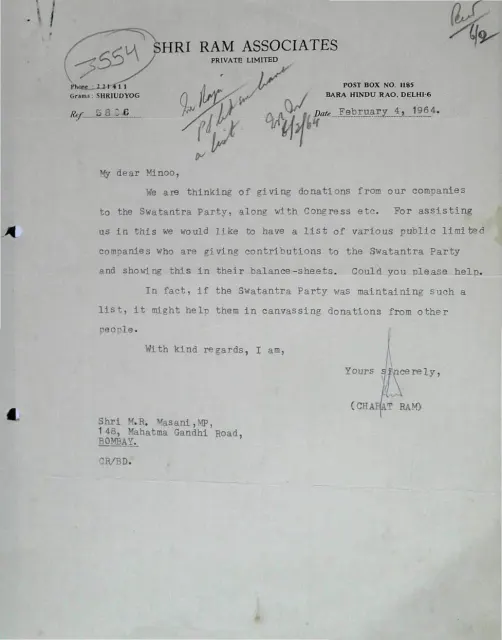 Primary workLetter to Mr Minoo Masani
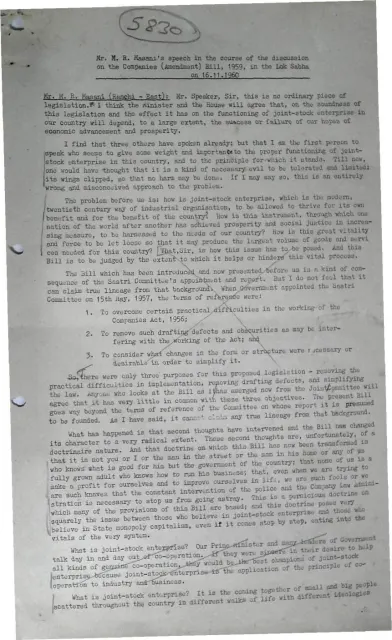 Primary workMr. M. R. Masani's speech in the course of the discussion on the Companies (Amendment) Bill, 1959, in the Lok Sabha on 16.11.1960
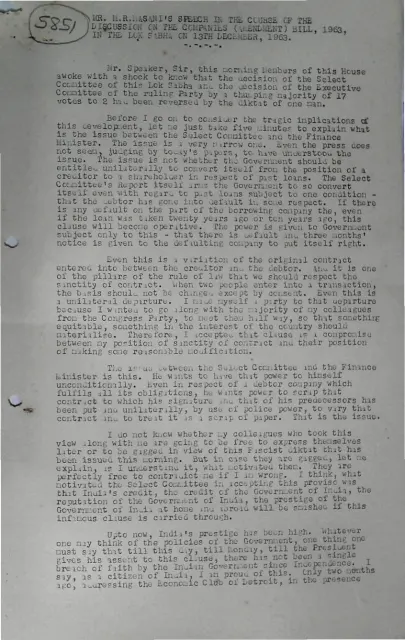 Primary workMR. M.R. MASANI'S SPEECH IN THE COURSE OF THE DISCUSSION ON THE COMPANIES (AMENDMENT) BILL, 1963, IN THE LOK SABHA ON 13TH DECEMBER, 1963.
 ExcerptSTATE MONOPOLIES AND THE CITIZEN IN A DEMOCRACY
 ThePrintPrivate enterprise built India’s industries. Now it’s strangled by Gods in Delhi