speech · parliamentary
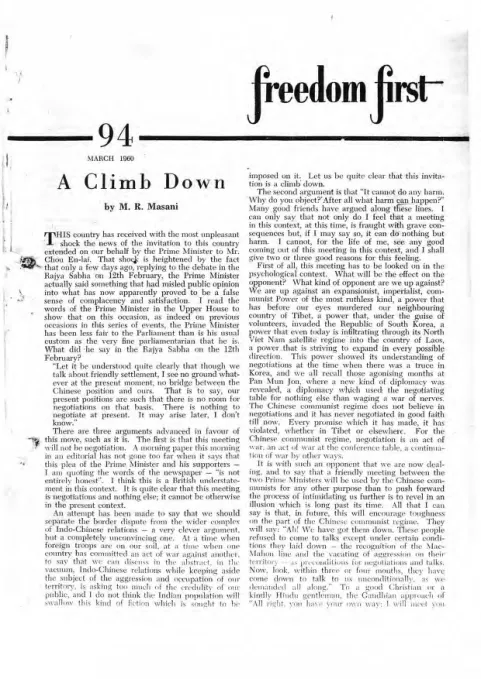
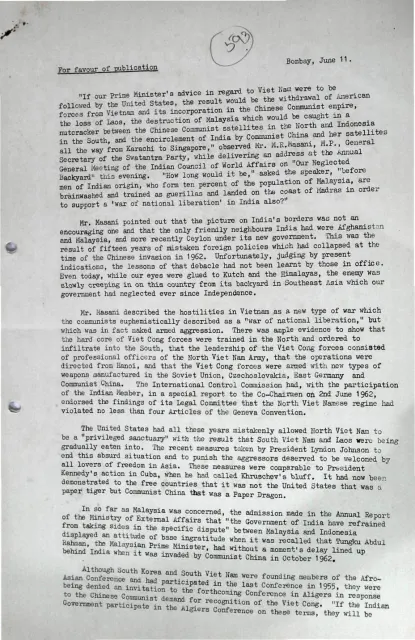
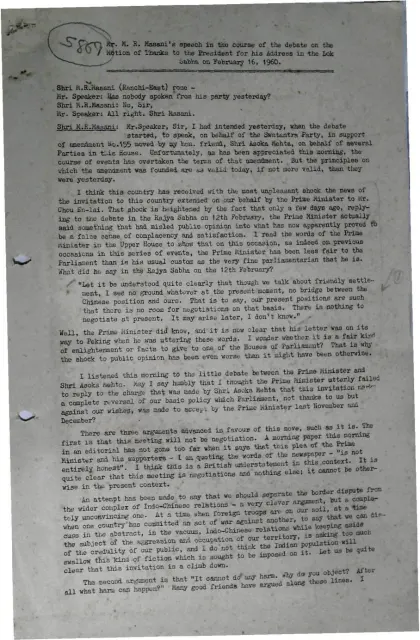
Mr. M. R. Masani's speech in the course of the debate on the Motion of Thanks to the President for his Address in the Lok Sabha on February 16, 1960.
By Minoo Masani
1960
5 pages
Summary
In this speech in the Lok Sabha debate on the Motion of Thanks, M. R. Masani attacks the Prime Minister’s invitation to Chou En-lai against the background of Chinese occupation of Indian territory and the Sino-Indian border dispute. He argues that the invitation contradicts the government’s earlier position that there was no basis for negotiations and has created a false impression of conciliation without any corresponding Chinese concession.
Masani rejects three defenses of the invitation: that the proposed meeting will not constitute negotiation, that it cannot do harm, and that there is no alternative. He portrays the Chinese Communist regime as expansionist and untrustworthy, and contends that a meeting would damage India’s psychological position, demoralize its armed forces, and encourage further pressure. The alternatives he proposes include expelling the aggressor if India has the military capacity, refusing to concede the occupied territory, improving military preparedness, breaking diplomatic relations, and convening a regional organization of South and Southeast Asian countries for collective security without surrendering non-alignment.
Key points
- Masani criticizes the invitation to Chou En-lai as a reversal of India’s stated policy toward Chinese aggression.
- He argues that the Prime Minister’s public statements misled Parliament and public opinion about the basis for the proposed meeting.
- He presents the Chinese Communist regime as expansionist, coercive, and unwilling to negotiate in good faith.
- He contends that a friendly meeting would have harmful psychological effects on India and would encourage further Chinese intimidation.
- He rejects the argument that India has no alternative to negotiation and calls for an assessment of military capability.
- He distinguishes defensive action to recover occupied territory from initiating a war.
- He recommends stronger armed forces, broader diplomatic coordination, and a regional security organization for South and Southeast Asia.
- He concludes that Chou En-lai should not be treated as an honoured guest of the Indian people.
Metadata and summary are AI-extracted from the source PDF and reviewed for editorial accuracy. The original work is available via the Read PDF tab above (where present); paragraph-level citation inside the PDF is deferred to a future engagement.