speech · convention address
ICCF Meeting on "Human Freedom And the Berlin Wall" at Sunderbai Hall on 13th August, 1962
1962
15 pages
Summary
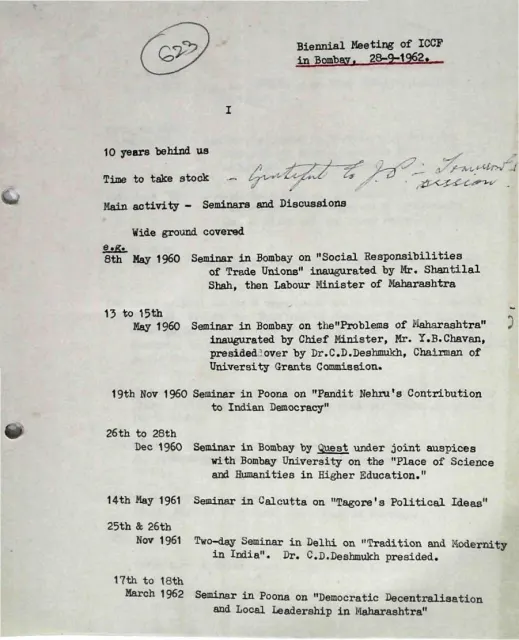
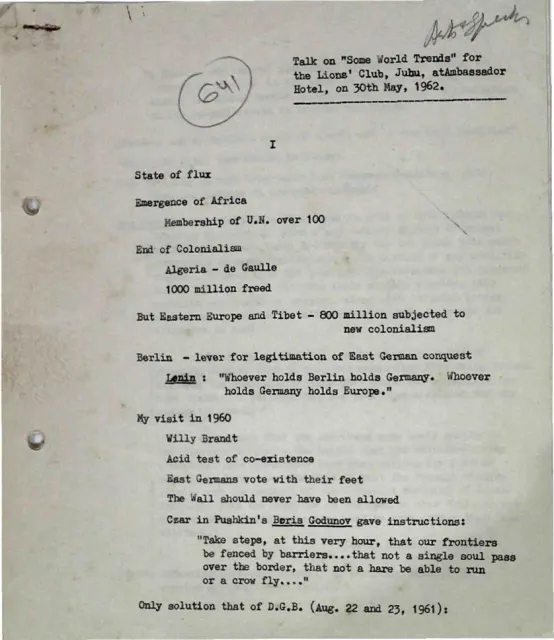
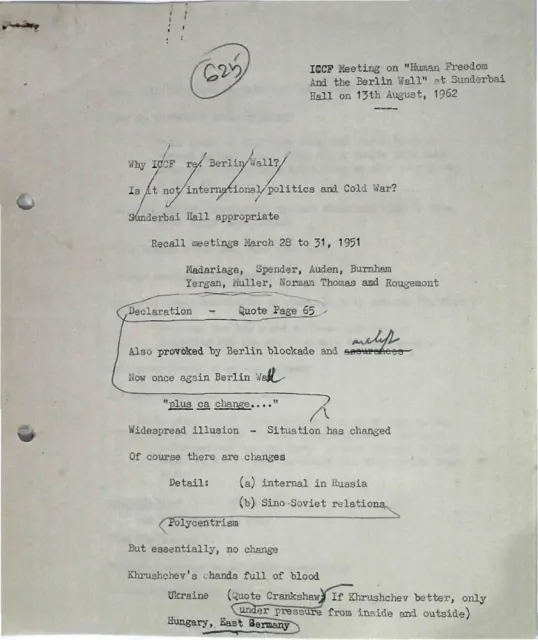
The document contains typed notes for an ICCF meeting on “Human Freedom And the Berlin Wall” held at Sunderbai Hall on 13 August 1962. The argument treats the Berlin Wall not simply as a Cold War or international-politics issue, but as an assault on human freedom and the individual’s right to leave and return to a country. The notes contrast the Wall with the earlier Berlin blockade, recall the 1951 meetings of writers and political thinkers, and argue that changes within Russia and in Sino-Soviet relations have not altered the coercive character of the communist system. References to Ukraine, Hungary, and East Germany are used to emphasize continuing internal and external pressure on Khrushchev.
The notes invoke the Universal Declaration of Human Rights, Article 13(2), and describe the Wall as an “outrage against human rights.” They present the Wall as evidence that communism cannot tolerate political competition, while also acknowledging that democratic states may resist or restrict freedom in other ways. The final typed page argues that Berlin is a hostage used to secure the legitimacy of East Germany’s conquest, and that the Berlin problem belongs within the wider German and East-West questions. Pages 4–15 are predominantly handwritten political notes, apparently related to the same archival file but not clearly part of the typed speech; they address India, democracy, communism, neutrality, foreign policy, defence, and economic development, but much of this material is difficult to read.
Key points
- The meeting frames the Berlin Wall as a human-freedom and civil-liberties issue, not merely a Cold War dispute.
- The notes argue that the Wall prevents people from exercising the right to leave and return to their country.
- Changes inside Russia and in Sino-Soviet relations are acknowledged, but the underlying coercive structure is said to remain unchanged.
- Ukraine, Hungary, and East Germany are cited as examples of pressure on the Soviet leadership and its subjects.
- The Wall is presented as a barrier against people who wish to “vote with their feet,” rather than simply as a defence against enemies.
- The Universal Declaration of Human Rights, Article 13(2), is used as the document’s principal normative reference.
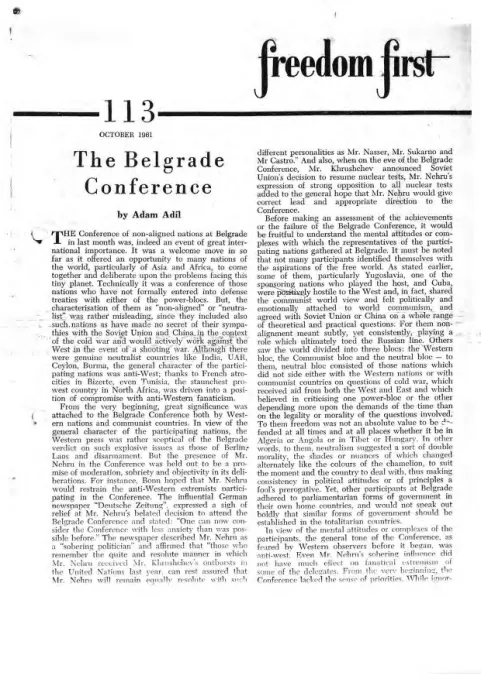
- The later handwritten pages broaden the file’s concerns to Indian democracy, neutrality, communism, defence, and economic development, though their connection to the typed speech is uncertain.
Metadata and summary are AI-extracted from the source PDF and reviewed for editorial accuracy. The original work is available via the Read PDF tab above (where present); paragraph-level citation inside the PDF is deferred to a future engagement.