Summary
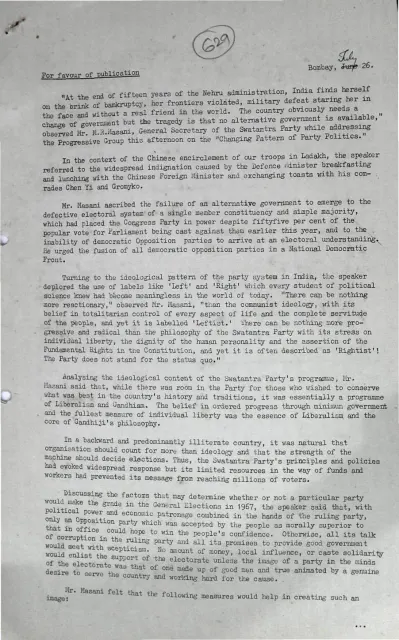
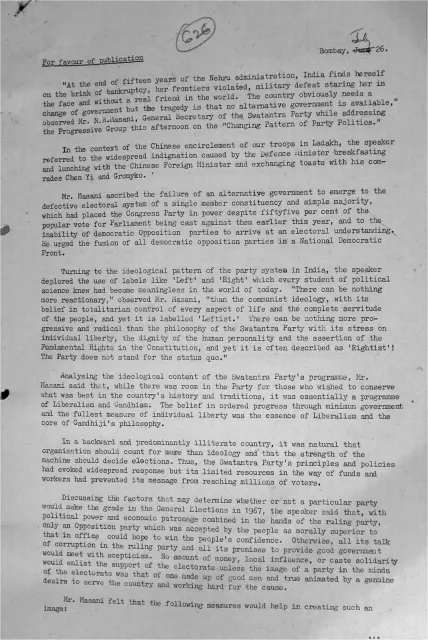
This two-page English press statement, issued from Bombay on July 26 and attributed to M. R. Masani, assesses India’s political situation after fifteen years of Nehru’s administration. Masani argues that India needs a change of government but lacks an effective alternative, attributing this failure to the single-member, simple-majority electoral system and the inability of democratic opposition parties to cooperate. He proposes the fusion of opposition parties into a National Democratic Front and questions the usefulness of conventional “Left” and “Right” labels.
Masani presents the Swatantra Party as a programme rooted in liberalism and Gandhism, emphasizing minimum government, individual liberty, human dignity, and Fundamental Rights. He argues that the party’s electoral prospects depend less on money, caste, or local influence than on credible candidates, disciplined grassroots organization, broad social representation, clean funding, and a morally superior public image. The statement concludes that parties are instruments rather than ends in themselves, rejecting unconditional partisan loyalty. The document is headed “For favour of publication” and ends with a separate “Not for publication” section.
Key points
- Masani describes India as facing economic, military, and political crisis while lacking a viable alternative government.
- He blames the absence of an opposition alternative partly on the single-member, simple-majority electoral system and opposition disunity.
- He calls for the fusion of democratic opposition parties into a National Democratic Front.
- He rejects conventional Left–Right labels and defines Swatantra as a party of individual liberty, Fundamental Rights, minimum government, liberalism, and Gandhism.
- He identifies candidate integrity, grassroots organization, broad social reach, discipline, and small-donor funding as prerequisites for electoral credibility.
- He argues that moral authority and public confidence are more important than money, caste solidarity, or local influence.
- He concludes that a political party is a means to an end and that “my party right or wrong” is an illegitimate attitude.
Metadata and summary are AI-extracted from the source PDF and reviewed for editorial accuracy. The original work is available via the Read PDF tab above (where present); paragraph-level citation inside the PDF is deferred to a future engagement.