speech
Chairman's Address to the Shareholders
The Tata Iron and Steel Company Limited · 1954
10 pages

Summary
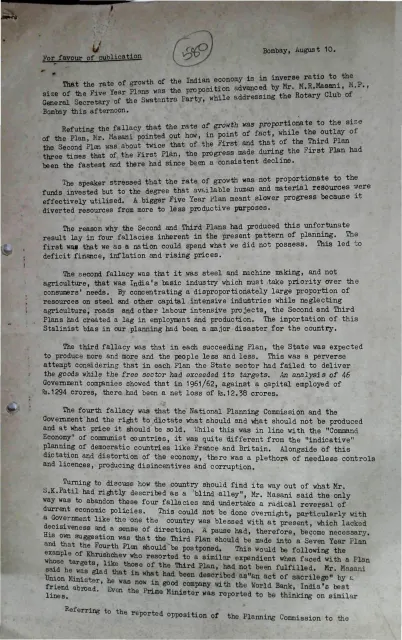
In this 26 August 1954 address to Tata Iron and Steel shareholders, J. R. D. Tata reviews international tensions, India’s post-war economic position, and the country’s developing Five Year Plan. He welcomes improvements in food production and industrial output but argues that private enterprise has been prevented from making its full contribution by official discouragement, excessive controls, and uncertainty. Tata defends a mixed economy in which the state provides essential services and safeguards the disadvantaged while allowing private industry access to savings, incentives, and room for initiative. He also challenges the assumption that profit is inherently exploitative and warns against treating nationalisation and centralised management as automatic substitutes for productive enterprise.
The central portion of the address is a sustained defence of mechanisation and industrial modernisation against the claim that machines necessarily destroy employment. Drawing on historical examples from Britain, the United States, and the automobile industry, Tata argues that modern methods lower costs, expand demand, increase production, and create employment across interconnected industries. He acknowledges that mechanisation can cause temporary disruption, but calls for advance planning, retraining, compensation, and cooperation with labour. The closing pages discuss a planned government steel works, Tata Steel’s deferred-share conversion, taxation, production constraints, and the company’s prospects for expanding output. The address is presented here in full, with printed pagination running from 1 to 16.
Key points
- Tata assesses international conflict in East Asia and India’s neutral, non-aligned position.
- He describes India’s economic improvement since the war while criticising the private sector’s limited role under the First Five Year Plan.
- He argues that a mixed economy should not become a temporary stage toward full state capitalism or socialism.
- He calls for a change in official attitudes toward profit, private enterprise, and industrial initiative.
- He presents mechanisation as a long-term creator of employment rather than an automatic cause of unemployment.
- He insists that modernisation must be accompanied by retraining, compensation, labour cooperation, and careful planning.
- He welcomes expansion of India’s steel capacity but criticises the government’s failure to consult established private steel producers.
- He forecasts increased Tata Steel output and argues that efficient, up-to-date production is essential to India’s economic future.
Metadata and summary are AI-extracted from the source PDF and reviewed for editorial accuracy. The original work is available via the Read PDF tab above (where present); paragraph-level citation inside the PDF is deferred to a future engagement.