
speech
Tata Personnel Officers Conference
1961
4 pages

Summary
This four-page English typescript, headed “IV Tata Personnel Officers’ Conference” and dated 27 September 1961, presents productivity as the relationship between input and output, an economy of means in relation to given ends, and a measure of technological progress. It argues that increased production is meaningful only when linked to higher productivity—producing more with less capital, raw material, physical effort, and working time.
The paper treats productivity as an urgent economic and organisational concern for India. It attributes low productivity to historical and institutional factors including education, invention and innovation, capital investment, managerial and technical development, and weaknesses in distribution and retailing. It argues that mechanisation need not cause unemployment, provided management adopts policies concerning retrenchment, retraining, and compensation. The final section considers how productivity gains should be shared among workers, investors, consumers, and the community, while assigning government a leadership role through incentives, statistical provision, workers’ education, consultation, and state enterprises.
Key points
- Productivity is defined through the relation between inputs and outputs and through the efficient use of resources.
- The paper presents productivity as a priority for economic planning because competition for resources is becoming more acute.
- It links Indian productivity problems to education, innovation, capital investment, management, technical development, and distribution.
- It rejects the assumption that mechanisation necessarily produces unemployment, citing employment growth associated with mechanisation in the United States.
- It calls for enlightened management policies involving retrenchment, training, and generous compensation.
- Productivity gains are presented as potentially benefiting workers, investors, consumers, and the wider community.
- Government is urged to act as a leader and pace-setter, including through state enterprises, tax relief, financial assistance, consultation, workers’ education, and statistical data.
Metadata and summary are AI-extracted from the source PDF and reviewed for editorial accuracy. The original work is available via the Read PDF tab above (where present); paragraph-level citation inside the PDF is deferred to a future engagement.
Related across the archive
 Primary workChairman's Address to the Shareholders
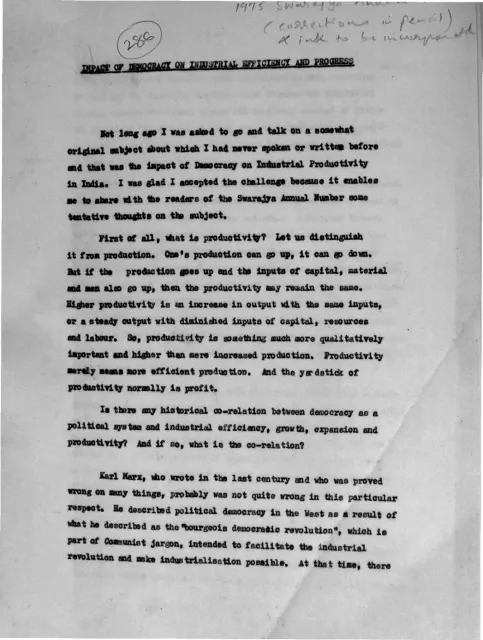 Primary workIMPACT OF DEMOCRACY ON INDUSTRIAL EFFICIENCY AND PROGRESS
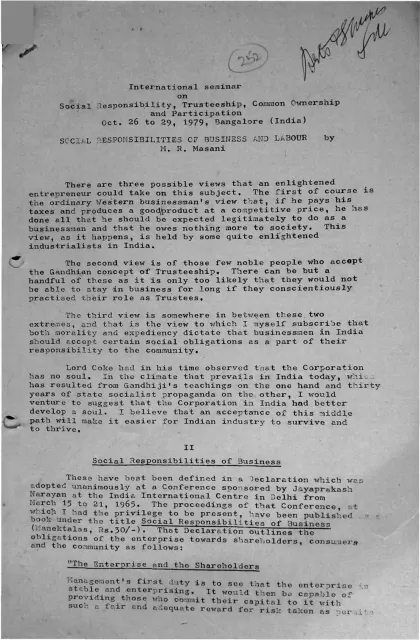 Primary workSOCIAL RESPONSIBILITIES OF BUSINESS AND LABOUR
 ExcerptOBSTACLES TO LIBERALISATION AND MARKET ECONOMY
 ThePrintCapitalism isn’t responsible for mass unemployment. Look at Japan, Singapore: BS Iyer