Summary
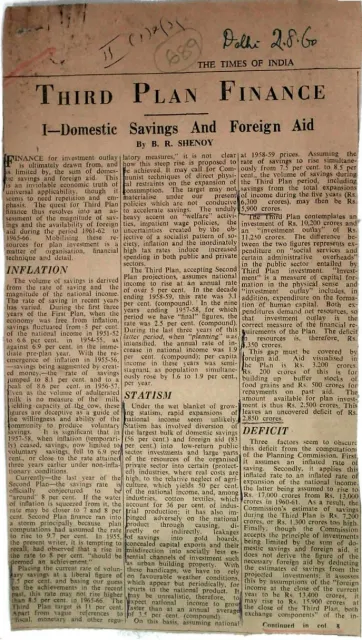
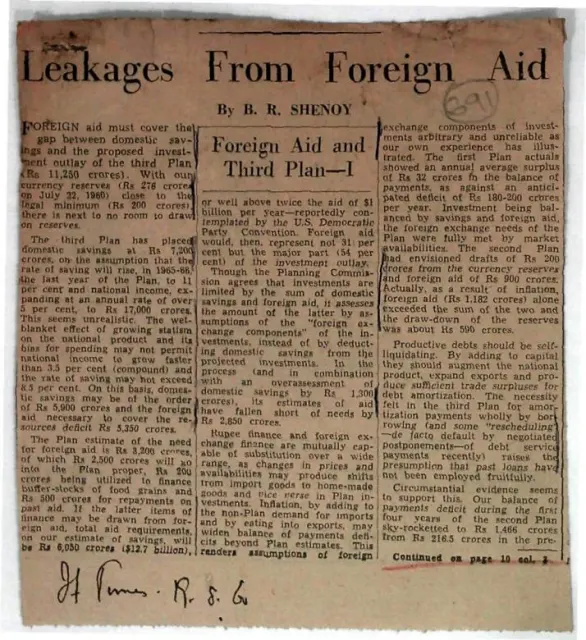
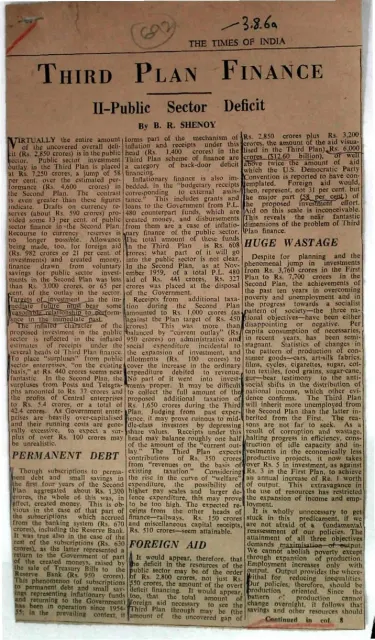
In the rendered pages, B. R. Shenoy argues that the proposed Third Plan places an excessive burden on public-sector investment and relies on inflationary deficit finance. He contrasts the proposed public-sector outlay of Rs. 7,250 crores with estimated receipts of Rs. 4,600 crores, identifying a deficit of roughly Rs. 2,850 crores. The article contends that drawing on currency reserves, accumulated small savings, taxation, and foreign aid would not provide a sound or sustainable basis for financing the plan. Shenoy also warns that public-sector investment has been wasteful and that several enterprises are over-capitalised and loss-making.
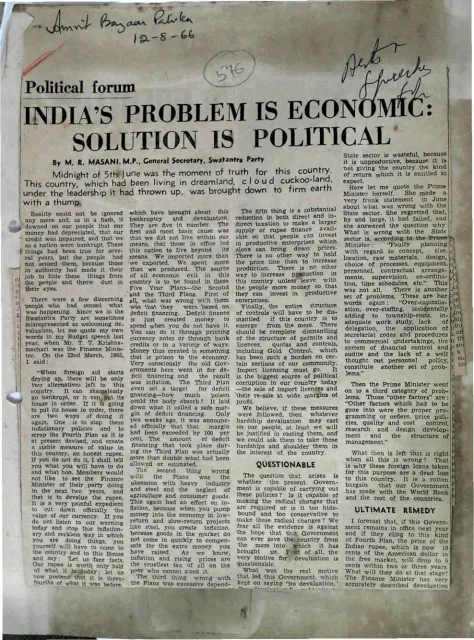
In the rendered pages, Shenoy links the financing problem to broader criticisms of planning priorities. He calls for abandoning the pursuit of heavy industrialisation at the expense of agriculture and light industry, reducing wasteful expenditure, and redirecting resources toward agricultural development and consumer needs. The continuation on page 3 proposes greater reliance on private savings and foreign aid, a more restrained public-sector programme, and policies designed to increase agricultural yields, national income, employment, and consumption. The article closes by presenting monetary stability and a larger volume of productive investment as prerequisites for economic progress; page 2 contains unrelated newspaper material and advertising rather than the essay.
Key points
- The proposed Third Plan public-sector programme is presented as requiring a large deficit, estimated at about Rs. 2,850 crores.
- Shenoy argues that financing the deficit through currency reserves, small savings, taxation, and foreign aid would generate inflationary pressures.
- The article criticises the public sector for waste, over-capitalisation, loss-making enterprises, and investment in economically less productive projects.
- It challenges the priority given to heavy industry and argues that agricultural and light-industrial development should precede or accompany industrialisation.
- The proposed remedy includes abandoning extravagant expenditure, increasing private savings, and redirecting investment toward productive uses.
- Shenoy argues that agricultural improvement is essential to higher national income, employment, consumption, and the expansion of industry.
Metadata and summary are AI-extracted from the source PDF and reviewed for editorial accuracy. The original work is available via the Read PDF tab above (where present); paragraph-level citation inside the PDF is deferred to a future engagement.