
essay
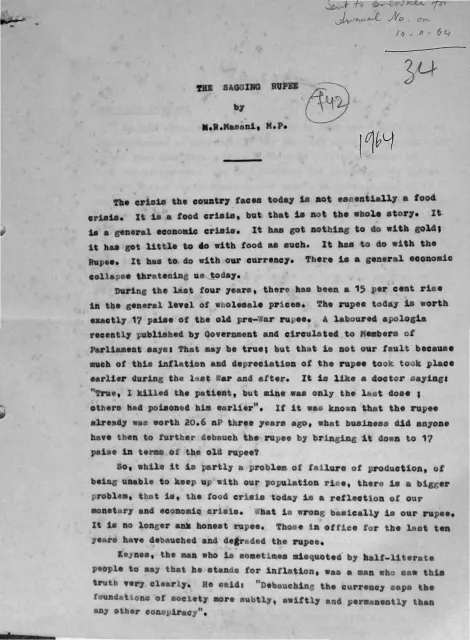
THE SAGGING RUPEE
1964
8 pages
Summary
In this eight-page essay, M. R. Masani argues that India’s food crisis is fundamentally a monetary and general economic crisis. The rupee’s loss of purchasing power, inflation, and the government’s planning priorities have, in his view, weakened production and undermined confidence in the currency. Masani rejects attempts to blame peasants, traders, hoarders, or profiteers for conditions that he treats as effects of deeper policy failures. He also criticizes controlled procurement and unequal price policies for forcing peasants to sell grain cheaply while industrial prices rise.
Masani opposes comprehensive price controls, arguing that they cannot defeat supply and demand and will distort production, generate shortages, and encourage black markets. He similarly criticizes gold-control measures, maintaining that people hold gold because the rupee is not trusted and that an “honest rupee” would be a better remedy. The essay attributes worsening inflation and deficits to the Second and Third Five Year Plans, excessive emphasis on heavy industry, deficit finance, and heavy taxation. It calls instead for balanced development that gives agriculture, consumer goods, infrastructure, and heavy industry their proper priorities, together with reduced deficit finance and taxation.
Key points
- The food crisis is presented as a symptom of a broader monetary and economic crisis centred on the rupee.
- Masani attributes inflation and currency depreciation primarily to government policy over the preceding eight years.
- He rejects scapegoating peasants, traders, hoarders, and profiteers, arguing that shortages and currency debasement produce those behaviours.
- The essay criticizes price controls as economically self-defeating because they distort production and create shortages in uncontrolled goods.
- Gold is described as a store of savings and a source of rural credit in response to weak confidence in the rupee and inadequate banking facilities.
- Masani argues for balanced development rather than disproportionate investment in heavy industry.
- He links deficit finance, excessive taxation, and rapid monetary expansion to a developing crisis of confidence and recommends fiscal restraint.
Metadata and summary are AI-extracted from the source PDF and reviewed for editorial accuracy. The original work is available via the Read PDF tab above (where present); paragraph-level citation inside the PDF is deferred to a future engagement.
Related across the archive
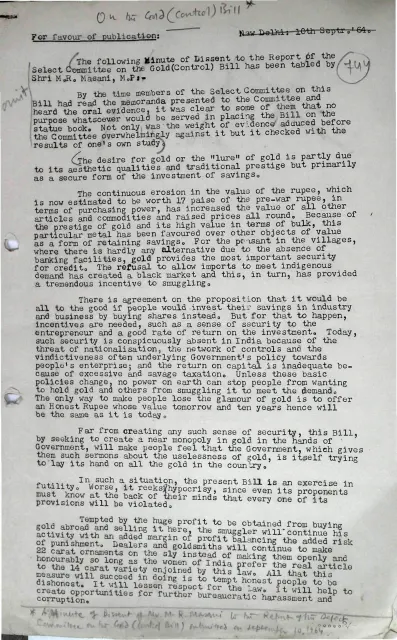 Primary workFor Favour of Publication
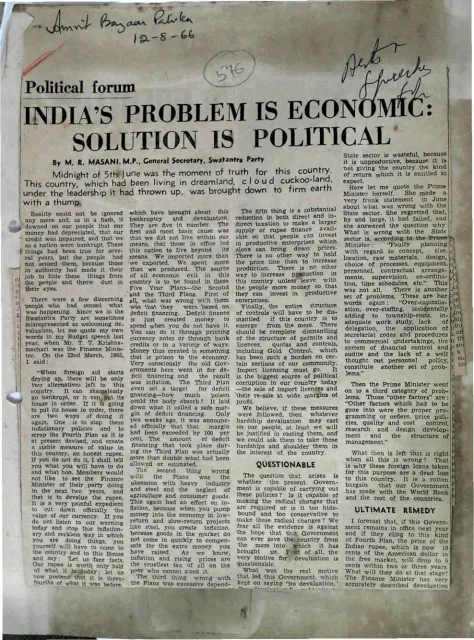 Primary workINDIA'S PROBLEM IS ECONOMIC: SOLUTION IS POLITICAL
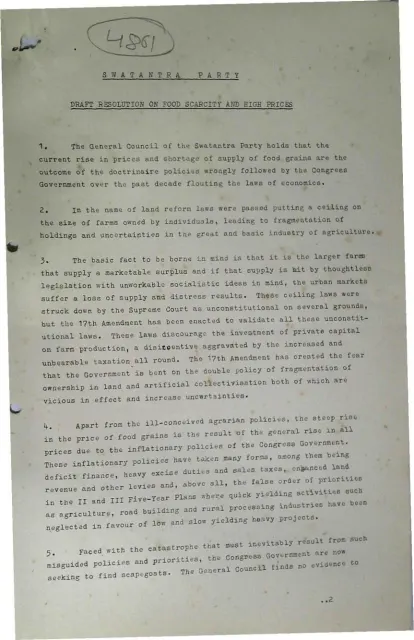 Primary workDRAFT RESOLUTION ON FOOD SCARCITY AND HIGH PRICES
 ThePrintDemonetisation is a wild hit at the bull’s eye. It will not hurt the guilty: BP Adarkar
 ExcerptStatement of the Principles of Swatantra Party