minutes
For Favour of Publication
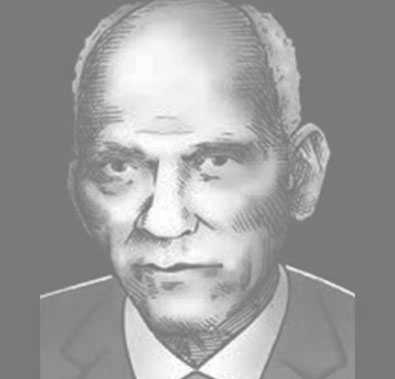
By Minoo Masani
Swatantra Party Parliamentary Office 63, North Avenue NEW DELHI-1. · New Delhi · 1964
2 pages
Summary
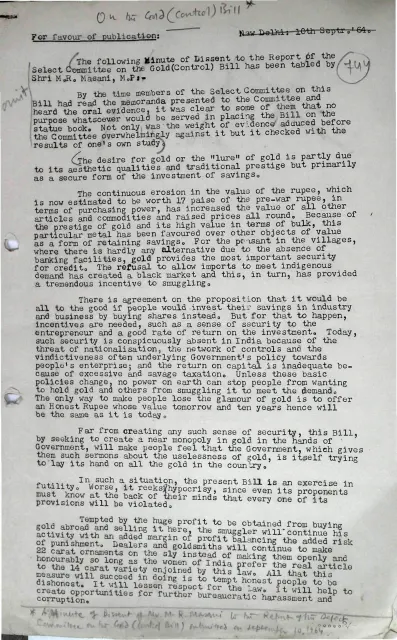
This two-page minute of dissent by M. R. Masani argues that the Gold (Control) Bill should not be enacted. Masani maintains that the demand for gold reflects not merely aesthetic preference or traditional prestige but the need for a secure store of savings in an economy where the rupee has lost purchasing power. He points to the absence of banking facilities in villages, the black market created by restrictions on imports, and the resulting incentive to smuggle gold.
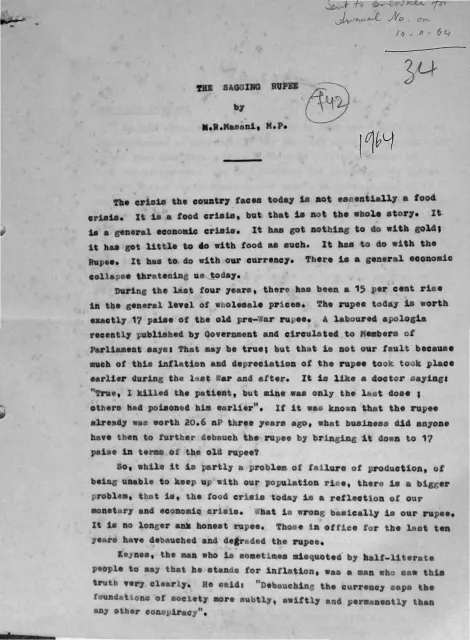
Masani argues that the Bill attacks a symptom rather than the underlying economic disease. In his view, excessive taxation, deficit finance, state controls, nationalisation threats, and inadequate returns on investment make productive investment unattractive. The Bill would therefore encourage smuggling, dishonesty, bureaucratic harassment, and the substitution of savings into other commodities rather than redirecting them into industry. He concludes that the government should permit imports sufficient to meet indigenous demand, preferably through export-promotion schemes, while pursuing more fundamental changes in monetary and fiscal policy. The document is dated 10 September 1964 and is marked “Not for publication.”
Key points
- Masani records dissent from the Select Committee report on the Gold (Control) Bill.
- Gold is presented as a form of savings protection in response to the rupee’s loss of purchasing power.
- Restrictions on gold imports are said to produce black-market activity and smuggling.
- The Bill is criticized for imposing controls without creating security or adequate returns for productive investment.
- Masani predicts that the law would encourage concealment, dishonesty, and bureaucratic corruption.
- The document calls for changes to deficit finance, excise duties, development priorities, and investment policy.
- It recommends allowing limited gold imports through export-promotion schemes at international prices.
Metadata and summary are AI-extracted from the source PDF and reviewed for editorial accuracy. The original work is available via the Read PDF tab above (where present); paragraph-level citation inside the PDF is deferred to a future engagement.