Summary
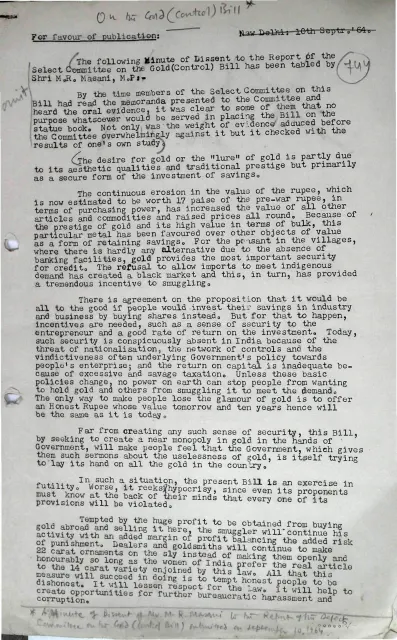
In this article, M. R. Masani argues that India’s Gold Control Act is a misconceived intervention that concentrates gold, economic power, and political authority in the hands of the state. Invoking Mahatma Gandhi’s reported preference for distributing gold among India’s villages, Masani presents the Act as a betrayal of Gandhi’s decentralising ideal and as a government monopoly rather than an anti-monopoly measure. He identifies the policy’s stated objectives as reducing hoarding, lowering the Indian price of gold, and stopping smuggling, then argues that it has achieved none of them: gold prices remained more than twice the international price, while smuggling increased as profit margins widened.
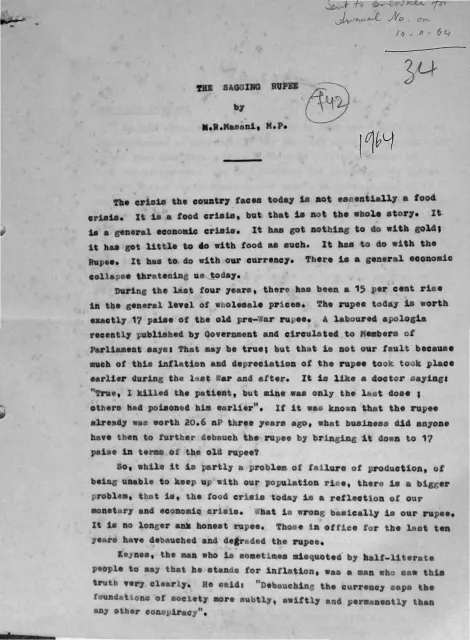
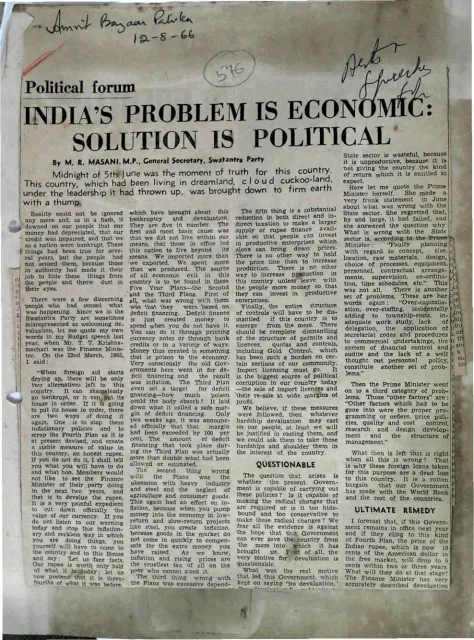
Masani attributes the demand for gold to the debasement of the rupee and to inflationary economic policy, not to an irrational attachment to gold. He links inflation to the priorities of the Second and Third Plans, wasteful public-sector investment, foreign indebtedness, deficit financing, and taxation. The article’s account of the Act’s effects includes higher prices for other assets and commodities, the destruction of rural credit, the movement of gold dealing into underground markets, new bureaucracy and corruption, and lost tax revenue. It concludes that the government’s monetary and regulatory policies—not gold itself—are the central problem.
Key points
- Masani contrasts the Gold Control Act with Mahatma Gandhi’s reported proposal to decentralise gold and economic power among India’s villages.
- He identifies three official objectives of gold control: reducing hoarding, lowering gold prices, and stopping smuggling.
- He argues that after fifteen to eighteen months the policy had neither lowered gold prices nor reduced smuggling.
- The article attributes India’s high gold price to the debasement of the rupee and broader inflation rather than to irrational hoarding.
- Masani criticises heavy-industry priorities, state-sector investment, foreign indebtedness, deficit financing, and taxation as causes of inflation.
- He argues that gold control raised prices of other assets and commodities, destroyed rural credit, and drove trade underground.
- The article presents state control as a new monopoly that creates bureaucracy, corruption, expenditure, and lost public revenue.
Metadata and summary are AI-extracted from the source PDF and reviewed for editorial accuracy. The original work is available via the Read PDF tab above (where present); paragraph-level citation inside the PDF is deferred to a future engagement.