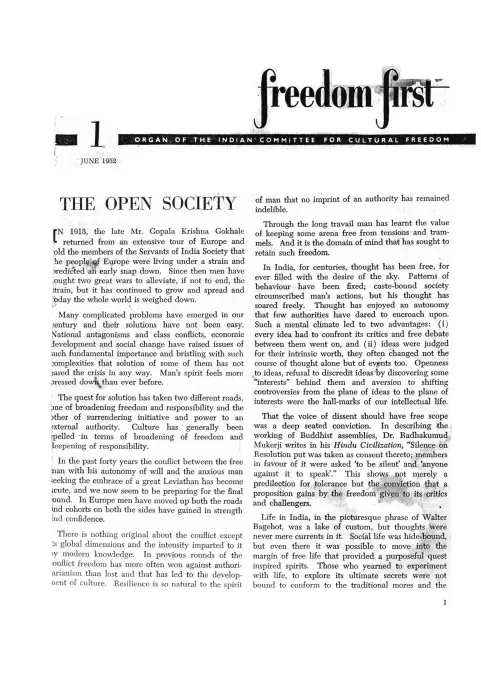
periodical issue
Freedom First
By SIDNEY HOOK, L. F., Ka. Naa. SUBRAMANIAM, P. Y. DESHPANDE, P. SPRATT, A. B.
PRINTED & PUBLISHED BY DINKAR SAKRIKAR AT THE KANADA PRESS, PODAR CHAMBERS, 109, PARSI BAZAAR ST., FORT BOMBAY · Bombay · 1952
12 pages
Freedom First
Summary
This is the July 1952 issue (No. 2) of Freedom First, the monthly bulletin of the Indian Committee for Cultural Freedom (affiliated to the Congress for Cultural Freedom / World Movement for Cultural Freedom), printed in Bombay. The issue is anchored by Sidney Hook’s memorial tribute to John Dewey, who had recently died, tracing Dewey’s philosophy of experience, his opposition to totalitarianism (including his chairmanship of the 1937 inquiry into the Moscow trials), and closing with a full bibliography of Dewey’s works. The unsigned editorial ‘Notes’ section takes anti-communist positions on several fronts: criticising an Indian goodwill delegation’s credulous reporting from Communist China, defending the UN’s refusal to forcibly repatriate Chinese POWs from Korea, praising anti-communist demonstrations in Delhi and Guatemala, criticising Finance Minister C. D. Deshmukh’s evasiveness on Soviet and Chinese claims, commenting on a Hindu-Muslim intermarriage controversy in Delhi, supporting the South African satyagraha against apartheid while flagging communist infiltration of its leadership, and expressing concern over Owen Lattimore’s possible visiting position at Delhi University. Other contributions cover a proposed Yusuf Meherally memorial library, a report by Ka. Naa. Subramaniam on the International Exposition of the Arts and literary/anti-totalitarian debates at the 1952 Congress for Cultural Freedom gathering in Paris, an essay by P. Y. Deshpande (delivered as an address at that same Paris exposition) arguing that the modern spirit of revolt is compatible with, not opposed to, human fellowship, P. Spratt’s review of Michael Polanyi’s ‘The Logic of Liberty’, and a short piece on a Bombay Child Art Exhibition. The volume’s overall center is a Cold War-era defence of intellectual and political freedom against totalitarianism of both left and right, combined with Indian liberal commentary on contemporary politics.
Key points
-
Sidney Hook’s tribute “Salute To John Dewey” recalls Dewey’s philosophy of experience, his 1937 chairmanship of the international commission that cleared Trotsky of the Moscow trial charges, and calls his thought the most distinctive expression of the American liberal faith.
-
The “Notes” section criticises an Indian goodwill delegation’s naive reporting from Communist China, defends the UN’s refusal to forcibly repatriate Korean War POWs, criticises Finance Minister C. D. Deshmukh’s evasiveness on Soviet claims, and condemns Indian law requiring inter-communal marriage partners to renounce their religion.
-
Ka. Naa. Subramaniam’s “Freedom and the Arts” reports on the Paris International Exposition of the Arts, arguing that a decade of Soviet experience dispelled the illusion that artistic experimentation was akin to the communist social revolution, and calls for an All-Asian writers’ conference.
-
P. Y. Deshpande’s “Revolt and Human Fellowship,” delivered at the same Paris exposition, argues that the modern spirit of revolt against blind tradition is compatible with, not opposed to, human fellowship, distinguishing it sharply from Marxist dogma.
-
Philip Spratt reviews Michael Polanyi’s “The Logic of Liberty,” summarising Polanyi’s argument that liberty cannot be defended as an absolute in itself but must flow from other absolutes such as truth, justice and tolerance.
-
A notice proposes a Yusuf Meherally memorial library built from his own book collection, and a short piece praises a Bombay Child Art Exhibition for the spontaneity and freedom of children’s creative work.
Essays
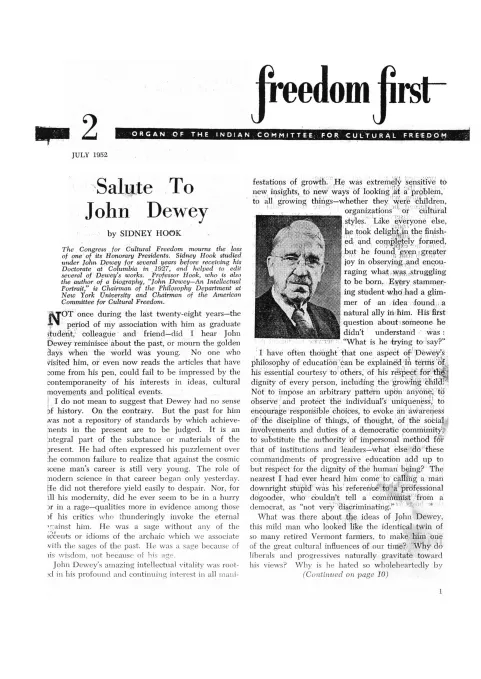
Salute To John Dewey
By SIDNEY HOOK
Sidney Hook’s tribute to John Dewey, written on the occasion of the Congress for Cultural Freedom mourning the loss of one of its Honorary Presidents. Hook, who studied under Dewey and later chaired the Philosophy Department at NYU and the American Committee for Cultural Freedom, recalls Dewey’s intellectual vitality, his lack of nostalgia, and his respect for the individuality of every person, including children. The piece (continued from page 1 to pages 10-11) explains Dewey’s theory of experience, his belief that scientific method and freedom are mutually supportive, and the fierce hostility he drew from communists (including denunciations in the Moscow ‘Bolshevik’) for his work chairing the 1937 committee of inquiry into the Moscow trials, which found Trotsky innocent. Hook closes by calling Dewey’s philosophy the most distinctive expression of the American liberal faith. The piece ends with a two-page selected bibliography of works by and about Dewey.
- Dewey showed no nostalgia for the past and remained intensely engaged with contemporary ideas and events until his death.
- Dewey’s philosophy of education rested on respect for the individual’s uniqueness and dignity, including that of children.
- Dewey’s theory of experience was shaped by findings in biology/psychology, anthropology, and the study of instruments (language, the body) in the growth of knowledge.
- Dewey held that scientific inquiry, not ecclesiastical or political authority, is the only legitimate test of the validity of human ends and means.
- Communist critics attacked Dewey venomously, comparing his views to ‘imperialistic warmongering’ for proposing that even Stalin’s and Franco’s ideals be judged by the actual consequences of the means used to achieve them.
- In 1937 Dewey chaired an international commission of inquiry (sessions in New York and Mexico City) that concluded Trotsky was innocent of the charges made against him at the Moscow trials.
- Non-communist critics like Bertrand Russell and George Santayana separately charged Dewey with a ‘cosmic impiety’ that gave insufficient place to play, resignation, or man’s place in the universe.
- Hook concludes that Dewey’s philosophy is the most distinctive expression of the American liberal faith, articulating its goodwill, hard-headedness, and imaginative daring.
Notes (Operation Cross-Eyed; Volunteering Out; Delhi and Gautemala; Obligations of Friendship; Delhi Marriage; South African Satyagraha; Lattimore in India?)
The unsigned editorial ‘Notes’ section runs across pages 2-4 and covers seven short items reflecting the Committee’s anti-communist, pro-democratic stance: (1) ‘Operation Cross-eyed’ criticises an official Indian goodwill delegation to Communist China (including Prof. V.K.R.V. Rao) for naive, uncritical reporting, and cites the low repatriation rate among Chinese POWs in Korea as proof of disaffection with Mao’s regime; (2) ‘Volunteering Out’ extends this point about POWs not wishing to return to Communist China and endorses the UN’s refusal to force repatriation as a matter of principle, quoting the socialist weekly Tribune; (3) ‘Delhi and Gautemala’ praises anti-communist demonstrations in front of Parliament House in Delhi and in Guatemala City; (4) ‘Obligations of Friendship’ criticises Union Finance Minister C. D. Deshmukh for evasiveness in Parliament about Soviet and Chinese claims, and notes an Indian scientist’s refusal to join a call for Red Cross investigation of alleged US germ warfare in Korea because he was a government official; (5) ‘Delhi Marriage’ criticises an incident in which public pressure forced a Hindu bride to abandon her intention to marry a Muslim, and criticises Indian law requiring both parties to an inter-communal marriage to formally renounce their religious beliefs, holding up Switzerland’s constitutional protection of inter-religious marriage as a model; (6) ‘South African Satyagraha’ supports the passive resistance campaign launched by Africans and Indians against apartheid on 26 June, while cautioning that communists have infiltrated its leadership; (7) ‘Lattimore in India?’ expresses concern over reports that Owen Lattimore, under US Congressional investigation over Soviet/Chinese sympathies, might take a year’s lecturing post at Delhi University.
- Criticises the official Indian goodwill delegation to Communist China for naive and misleading reporting, contrasting it with the low (24%) rate of Chinese POWs in Korea agreeing to repatriation.
- Supports the UN’s refusal to forcibly repatriate unwilling POWs as a moral stand consistent with the UN Charter and Declaration of Human Rights.
- Praises anti-communist demonstrations in Delhi (calling for banning the Communist Party of India) and in Guatemala City.
- Criticises Finance Minister C. D. Deshmukh’s evasive parliamentary answers on Soviet/Chinese achievements as unworthy of a government that invokes Gandhi’s name.
- Criticises Indian law requiring inter-communal marriage partners to renounce their religious beliefs, citing an incident where a Hindu-Muslim marriage in Delhi was blocked by public pressure, and holds up the Swiss constitutional model.
- Supports the South African satyagraha against apartheid while noting communist infiltration of the movement’s leadership.
- Expresses concern that Owen Lattimore, under US investigation for pro-Soviet/Chinese sympathies, may take a lecturing post at Delhi University.
Yusuf Meherally Memorial Library
By L. F.
A short unsigned notice (initialled ‘L.F.’) proposing a Yusuf Meherally memorial library, built around Meherally’s own book collection, to be run as a lending library circulating batches of books to other libraries, colleges, universities, and students’ unions. It invites donations of books or money to be sent to Mr. Kantilal Shah, Honorary Secretary of the Yusuf Meherally Memorial Committee.
- Yusuf Meherally is described as combining intellectual greatness with a genius for friendship, and as a bibliophile who constantly gave away and lent his books.
- A memorial library is proposed using Meherally’s own collection as its nucleus, supplemented by donations, including from friends at Mount Holyoke College in the USA.
- The library is proposed to operate as a mobile lending institution, circulating book batches to other libraries, colleges, universities, and students’ unions.
- Donations of books or money are to be sent to Mr. Kantilal Shah, c/o S. C. Sheth & Co., Bombay.
Freedom and the Arts
By Ka. Naa. SUBRAMANIAM
Ka. Naa. Subramaniam reports on the International Exposition of the Arts held in Paris in May 1952 under the auspices of the Congress for Cultural Freedom. He opens by arguing that twentieth-century artistic experimentation (Joyce, Eliot, Picasso, the Surrealists, Hindemith, Schoenburg) was hailed by many Western intellectuals as continuous with communism as an experimental social revolution, but that a decade of Soviet experience revealed the opposite: Stalin became ‘the greatest artist of Russia’ and all art was subordinated to shifting party lines. The Exposition presented, in retrospect, the best artistic, musical, and literary work of the first half of the twentieth century (naming numerous painters, orchestras, conductors, and literary figures who attended or were discussed), together with parallel literary discussions on the theme of freedom and creativity, and a session of the Association ‘Les Amis de la Liberté’. Subramaniam closes by reporting his own remarks on the Indian writer’s ambivalent awareness of communism, and calls for the Indian Committee for Cultural Freedom to sponsor an All-Asian writers’ conference.
- Argues that 20th-century artistic experimentation was initially seen by Western intellectuals as akin to the communist political-social experiment, but the reality of Soviet artistic control (Stalin as ‘the greatest artist of Russia’) dispelled that illusion.
- Reports on the International Exposition of the Arts (Paris, May 1952), which presented retrospectively the finest Western achievements in music, ballet, painting, sculpture, and literature from the first half of the 20th century.
- Named participants in the literary discussions included William Faulkner, Andre Malraux, Denis de Rougemont, Salvador de Madariaga, W. H. Auden, Herbert Read, Ignazio Silone, Stephen Spender, and others; Indian delegates Philip Spratt and P. Y. Deshpande stressed Indian perspectives, including Gandhi’s technique of communication through love and sacrifice.
- Describes an International session of ‘Les Amis de la Liberté’ (Friends of Freedom), with roughly 200 delegates from many countries debating totalitarianism versus liberty, the working class, letters and arts, and freedom.
- Subramaniam reports his own remarks that the Indian writer today is aware of communism as a potent idea and humane ideal, but not yet aware of it as a conspiracy or political plot in practice.
- Calls on the Indian Committee for Cultural Freedom to sponsor an All-Asian Conference of writers, extending the work of the international cultural freedom movement into Asia.
Revolt and Human Fellowship
By P. Y. DESHPANDE
P. Y. Deshpande’s essay, based on an address delivered during the literary discussions at the Paris International Exposition of the Arts, argues against the assumption that there is an inherent conflict between the values of revolt and those of human fellowship. Tracing a historical arc from J. H. Rob’s account (in the Encyclopaedia Britannica) of humanity’s slow, unpremeditated cultural evolution, through Bacon’s ‘aggressive search for the hitherto unknown’, to the last three centuries’ spirit of revolt in science, art, literature and philosophy, Deshpande contends that this revolt was never a revolt of man against man but of individual consciousness against traditional blind faith, exemplified by Galileo’s demonstration against Aristotelian authority and by the storm of criticism Deshpande’s own 1927 Marathi novel ‘Beyond Bondage’ provoked. He distinguishes this genuine spirit of revolt sharply from the totalitarian doctrines of Marx and Engels, arguing that dialectical materialism and class war denied the reality of the individual and demanded total, dogmatic acceptance on pain of death, whereas true revolt was always an appeal to conscience that could be accepted or rejected freely. He concludes that all who value freedom, truth, and progressive human fellowship must revolt against totalitarian doctrine, out of which a new human fellowship will emerge.
- Rejects the premise that revolt and human fellowship are inherently in conflict.
- Traces the ‘spirit of revolt’ in science, art, literature and philosophy to the last three centuries, contrasting it with humanity’s age-long conservatism before that.
- Cites Galileo’s Leaning Tower of Pisa experiment against Aristotelian authority as the paradigm case of individual consciousness challenging established social consciousness.
- Uses his own experience publishing the Marathi novel ‘Beyond Bondage’ (1927), which provoked calls for it to be publicly burnt, as a personal illustration of this pattern.
- Distinguishes the genuine spirit of revolt (individual conscience appealing to others, ‘take it or leave it’) from totalitarian doctrines of Marx and Engels, which he says demanded total dogmatic acceptance on pain of death and denied the reality of the individual.
- Concludes that a worldwide revolt against totalitarianism will produce a new and significant human fellowship.
Review: The Logic of Liberty by M. Polanyi
By P. SPRATT
P. Spratt reviews Michael Polanyi’s ‘The Logic of Liberty’ (Routledge, 1951). Spratt situates Polanyi as a Continental refugee from totalitarianism who examines intellectual and political liberty through the lens of scientific thought. He summarises Polanyi’s argument that traditional liberalism’s doctrine of complete absence of restraint in thought provides no principled defence against totalitarianism and tends toward scepticism, which does not destroy but only suppresses the passion for ethical values, letting it reassert itself through belief in a mechanical, brutal process claimed to produce an earthly paradise. Polanyi argues liberty cannot be defended as an absolute but must flow from other absolutes (truth, justice, kindness, tolerance, loyalty, beauty), using the position of the scientist — free to pursue problems but bound by scientific method and established results — as an analogy for the citizen’s freedom within a community bound by transcendent values. Spratt notes the book’s later argument against economic planning of complex activities on efficiency grounds, recommending it especially to economists.
- Polanyi is described as a Continental refugee from totalitarianism whose personal experience gives urgency to his analysis of intellectual and political liberty.
- Polanyi argues traditional liberalism’s ideal of complete freedom of thought cannot justify effective resistance to totalitarianism and tends to collapse into scepticism.
- Totalitarianism is characterised as ‘the child of unbelief’, arising when scepticism suppresses (without destroying) the passion for ethical values, which then reasserts itself through a mechanical, brutal doctrine promising an earthly paradise.
- Polanyi concludes liberty cannot be defended as an absolute in itself but must flow from other absolutes such as truth, justice, kindness, tolerance, loyalty and beauty.
- Uses the position of the scientist, free within the discipline of scientific method, as an analogy for the citizen’s freedom within a community bound by shared transcendent values.
- The book’s later sections argue against planning of complex activities on grounds of efficiency, which Spratt recommends especially to economists.
A Selected Bibliography of and by John Dewey
A short unsigned piece (initialled ‘A.B.’) on a Child Art Exhibition recently held in Bombay, celebrating the spontaneity, joy, and freedom of expression in children’s art compared with the more constrained, controlled work of older children and adults. The piece closes by invoking Pulin Dutt’s dictum that Child Art is eternal art, and calls on adults to reconnect with the joy, love, and freedom of childhood creation.
- The writer describes the Bombay Child Art Exhibition as a treat after witnessing so little real art, praising the spontaneity and simplicity of children’s work.
- Argues that the innocent child, unspoilt by rigid adult discipline, lives nearer to Nature and creation.
- Notes that as children get older, their art shows more adult control, pattern, order and rigidity, losing much of its charm.
- Draws a comparison in the exhibition between Child Art and the work of great modern painters, noting the child merely gives vent to joy while the adult artist must consciously strive to break away from bondage.
- Closes by citing Pulin Dutt’s view that Child Art is eternal art, urging adults to rejoin that state of joy, love and freedom.
Generated by the v1.5 extraction pipeline. Awaiting editorial review.
Metadata and summary are AI-extracted from the source PDF and reviewed for editorial accuracy. The original work is available via the Read PDF tab above (where present); paragraph-level citation inside the PDF is deferred to a future engagement.