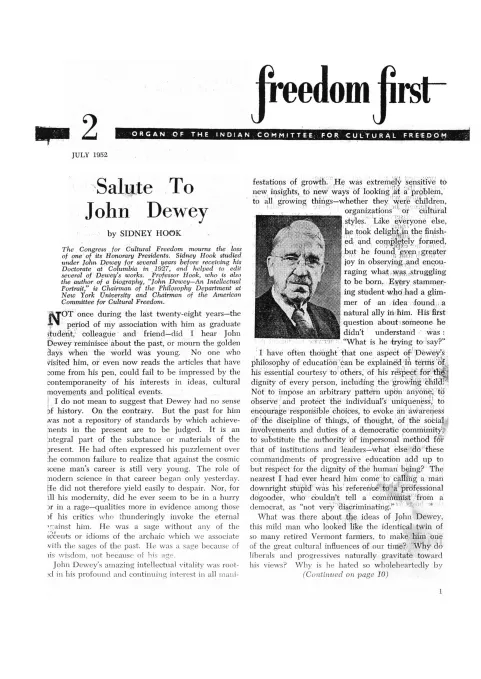
periodical issue
Freedom First
By PHILIP SPRATT, TAMBIMUTTU, Ka. Naa. Subramaniam, L.F., SAGITTARIUS
Printed & Published by Dinkar Sakrikar at the Kanada Press, Podar Chambers, 109, Parsi Bazaar St., Fort Bombay. · Bombay · 1952
12 pages
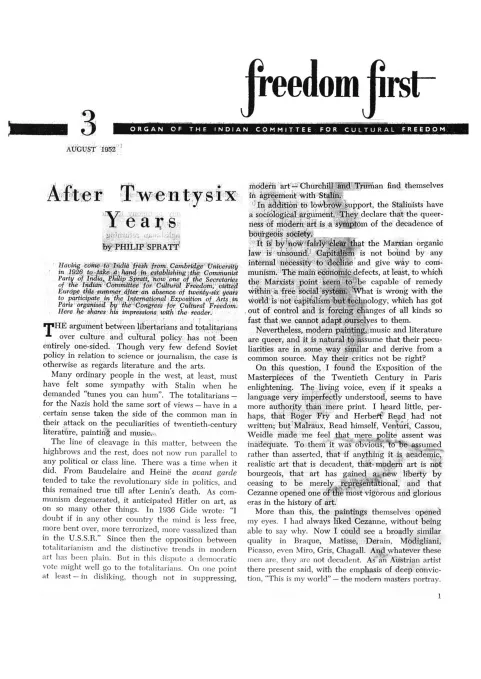
Freedom First
Summary
This is the August 1952 issue (No. 3) of Freedom First, the monthly bulletin of the Indian Committee for Cultural Freedom (affiliated to the Congress for Cultural Freedom’s World Movement for Cultural Freedom). The issue opens with Philip Spratt’s travelogue-essay “After Twentysix Years,” recounting his return to Europe after a 26-year absence to attend the Congress for Cultural Freedom’s International Exposition of Arts in Paris, and defending modern art and music against both Stalinist and “lowbrow” charges of decadence. A “Notes” section covers Cold War-inflected items: US visa policy under the McCarran Act, V. K. Krishna Menon’s remarks on forced labour in Communist China (rebutted with documentary evidence of Chinese slave-labour camps), the Tunisia self-determination question at the UN, and a controversy over Indian film censorship touching on J. B. H. Wadia’s warnings about government control of the film industry. Tambimuttu, former editor of Poetry London, contributes a substantial essay, “The Poet and the Challenge of the Times,” defending the autonomy of the modern poet against Marxist/historical-materialist literary criticism. A letters page (“To the Editor”) carries reader responses on Hindu social reform, secularism, and the earlier article “The Open Society.” A book review section covers Robert Guillain’s Revolution in China and Edward Hunter’s Brain Washing in Red China, both read as exposés of Chinese Communist terror methods; a film review covers the Japanese film Yukiwarisoo. “With Many Voices” is a compilation of quoted press clippings on Cold War and Indian topics (Ana Pauker’s fall, Owen Lattimore, Jai Prakash Narayan’s fast, M. C. Chagla on academic freedom, Chinese Stalin Prize winners), and the issue closes with short notes (theatre entertainment-tax exemption, an art exhibition review, the Artists’ Aid Fund) and a satirical poem, “The Green Dean,” reprinted from the New Statesman and Nation.
Key points
-
Philip Spratt’s “After Twentysix Years” recounts his return to Europe after 26 years to attend the Paris arts exposition, defending modern art and music against both Stalinist and “lowbrow” charges of decadence.
-
The “Notes” section criticises the US McCarran Act’s exclusion of former Communist trade unionist Raja Kulkarni, rebuts V. K. Krishna Menon’s dismissal of Chinese forced labour with Chinese Communist press evidence, and opens coverage of J. B. H. Wadia’s warning that government film censorship could extend to direct state control of production.
-
Tambimuttu’s “The Poet and the Challenge of the Times” rejects Marxist literary criticism that reads the modern poet’s individualism as bourgeois decadence, citing Lorca, Yessenin and Mayakovsky as poets destroyed by state pressure on artistic freedom.
-
A reader’s letter from Raman K. Desai praises the debut issue’s “The Open Society” and criticises state deference to religious sentiment in an ostensibly secular India.
-
Ka. Naa. Subramaniam reviews Robert Guillain’s “Revolution in China” and Edward Hunter’s “Brain Washing in Red China,” comparing the latter favourably to Orwell’s 1984 as documentary rather than fiction.
-
M. R. Masani appeals for entertainment-tax exemption for amateur theatre, and a note criticises judging standards at a child-art exhibition.
-
“The Green Dean,” a satirical poem by Sagittarius reprinted from the New Statesman and Nation, mocks Cold War alarmism about Chinese “germ warfare” claims.
Essays
After Twentysix Years
By PHILIP SPRATT
Philip Spratt, a Secretary of the Indian Committee for Cultural Freedom who had helped found the Communist Party of India in 1926, recounts his first return to Europe in twenty-six years, prompted by the Congress for Cultural Freedom’s International Exposition of Arts (“Masterpieces of the Twentieth Century”) in Paris. He argues that the modern-art debate does not split cleanly along political lines: totalitarians (Nazi and Stalinist alike) have historically sided with lowbrow taste against avant-garde art, using a claim that its “queerness” reflects bourgeois decadence. Spratt rejects the Marxist “organic law” of capitalist decline, attributing modern art’s strangeness instead to disorientating technological change, and describes being persuaded in person by critics and artists (Malraux, Herbert Read, Venturi, Cassou) that modern art represents a new liberty rather than decadence, with Cezanne’s innovation opening a vigorous era. He extends the same defence to modern music (Britten, Hindemith, Shostakovich) and modern literature (Joyce, Eliot, Auden), while acknowledging that appreciating difficult art requires cultivated training, as Europeans have received and few others have. The essay closes with observations on postwar Britain: rising living standards and a maturing public, but also anxiety that Western prosperity, only partly owing to colonial exploitation, will need real sacrifice from Britain and France if they are to retain Asian and African goodwill.
- Spratt returns to Europe after 26 years to attend the Congress for Cultural Freedom’s Paris art exposition.
- Argues totalitarians (Nazi and Soviet alike) have historically opposed modern art’s individualism, unlike genuine libertarians.
- Rejects the Marxist claim that capitalism is organically bound to decline; blames technological dislocation for modern art’s ‘queerness’ instead.
- Describes being persuaded by Malraux, Herbert Read, Venturi, Cassou and Weidel that Cezanne and his successors (Braque, Matisse, Picasso, Chagall) opened a genuinely new, non-decadent artistic era.
- Extends the same defence to modern British music (Britten, Hindemith, Shostakovich) and modern literature (Joyce, Eliot, Auden).
- Notes that appreciating modern art, like other complex cultural goods, requires training that much of Europe already possesses.
- Observes rising prosperity and maturing public taste in postwar Britain, alongside fears the economic levelling of the upper and middle classes could cause cultural decline.
- Warns that Western prosperity owes something to colonial exploitation, and that Britain and France must make further sacrifices to retain Asian and African friendship.
Notes (How Not To Keep Friends / Proof of Slave Labour in China / Aid to Tunisia / The Right to Make Films)
An unsigned “Notes” section covering several items. “How Not to Keep Friends” discusses the US McCarran Act barring entry to anyone who has ever held Communist Party membership, using the case of Indian trade unionist Raja Kulkarni (a former 1930s/40s CPI member, now anti-Communist and a Hind Mazdoor Sabha organiser) who was denied a timely US visa to attend a Harvard seminar, arguing the law’s rigidity undermines America’s own anti-Communist friendships. “Proof of Slave Labour in China” rebuts V. K. Krishna Menon’s dismissive remarks (as outgoing Indian High Commissioner in London) about forced labour under Chinese Communism, countering with Chinese Communist press sources themselves documenting slave-labour camps, production quotas, and inhumane conditions. “Aid Tunisia” reports on the failed push for a special UN General Assembly session on Tunisian self-determination against French colonial rule, criticising French pressure on US allies and noting a Bombay public meeting (chaired by M. R. Masani) where the Democratic Research Service and Asoka Mehta backed an ‘Aid Tunisia’ campaign. “The Right to Make Films” begins a discussion of Dr. Keskar’s controversial address to the Film Federation of India threatening stricter government censorship, and quotes J. B. H. Wadia’s Screen article warning that government control of documentary and newsreel production could extend to direct control of the film industry, citing Poland as a cautionary example.
- Criticises the US McCarran Act’s rigid exclusion of former Communist Party members, illustrated by the case of trade unionist Raja Kulkarni, denied a timely US visa despite decades of anti-Communist activism.
- Rebuts V. K. Krishna Menon’s dismissive comments on Chinese forced labour, citing Chinese Communist newspapers (Sen Min Jih Pao, Ta Kung Pao) themselves documenting slave-labour production quotas and camps.
- Reports UN discussion of Tunisian self-determination stalling for lack of the 31 member-state threshold, and criticises French pressure on the US within NATO to withhold support.
- Notes a Bombay ‘Aid Tunisia’ campaign meeting chaired by M. R. Masani with Margaret Pope and Asoka Mehta.
- Opens coverage of Dr. Keskar’s threat of stricter film censorship and J. B. H. Wadia’s warning that government control of documentaries could extend to direct control of feature-film production, citing Poland’s state-directed film industry as a warning.
The Poet and the Challenge of the Times
By TAMBIMUTTU (Former Editor of Poetry, London)
Continuing from the Notes item begun on page 4-5, J. B. H. Wadia — a pioneer of Indian talkies and twice President of the Indian Motion Picture Producers’ Association — is quoted extensively warning that the government’s already-existing virtual monopoly over documentary and newsreel production could expand into direct control of all feature-film production in India, disguised as help to improve production standards; he notes no democratic country (Britain or the US) has precedent for state-produced feature films.
- J. B. H. Wadia warns that government’s monopoly on documentaries and newsreels could be a first step toward direct control of feature-film production.
- Argues the ‘help the industry produce better-class films’ rationale is a ‘seductive argument’ masking creeping state control.
- Notes that no democratic country like Britain or the United States has a precedent for government-produced feature films for a ruling party in power.
To the Editor (letter re: ‘The Open Society’)
By Raman K. Desai
Tambimuttu, former editor of Poetry, London, argues against Marxist/historical-materialist literary criticism (citing David Daiches, Christopher Caudwell, George Orwell) which reads the modern poet’s individualism and ‘ivory tower’ withdrawal as a symptom of bourgeois decadence. He traces this deterministic mode of criticism through English literary history (Shakespeare, the metaphysical poets, Milton, the Romantics, the Victorians) to show its capacity to ‘explain away’ any period, and describes his own founding of Poetry, London as an attempt to encourage a catholic, pluralistic range of poetic voices (Marxists, ex-fascists, Catholics, Objective Reporters, romantic myth-makers) against both totalitarian aesthetics and the New Verse group’s own narrow, mechanistic ‘Objective Reporting’ doctrine. He surveys English poets of his time (Walter de la Mare, Dylan Thomas, T. S. Eliot, W. H. Davies) and international examples of poets destroyed by state pressure (Lorca in Spain, Yessenin and Mayakovsky in the USSR) as evidence that state control kills, rather than liberates, poetic potential. He closes by rejecting purely economic explanations of literary change, arguing that individual talent, the state of language, and the influence of prior poetry all matter more, and criticising both Soviet-style state literary criticism and Pravda’s misreadings of Eliot, Lawrence, and Joyce.
- Rejects Marxist/historical-materialist literary criticism (Daiches, Caudwell, Orwell) that treats the modern poet’s individualism as bourgeois decadence.
- Traces this deterministic reading across English literary history — Shakespeare, the metaphysical poets, Milton, Romantics, Victorians — to show it can ‘explain away’ any era.
- Describes founding Poetry, London as a pluralist venture publishing Marxists, ex-fascists, Catholics and Objective Reporters alike.
- Criticises the New Verse group (Auden, Spender, MacNeice) for imposing its own ‘totalitarian,’ mechanistic Objective Reporting doctrine on poetry.
- Cites Lorca (Spain), Yessenin and Mayakovsky (USSR) as poets destroyed by state pressure on artistic freedom.
- Notes the paradox that Soviet state-subsidised poets enjoy huge circulations while English poets sell only a few hundred copies, arguing circulation is not the measure of poetic worth.
- Argues individual talent, the state of language, and prior poetic tradition — not economics alone — explain literary change.
- Concludes that Marxism’s reduction of poetry to economic/emotional class factors is ‘truly terrifying, unreal and intolerable,’ citing Pravda’s misreading of Eliot, Lawrence and Joyce.
International Congress of Jurists / New Secretary of I.C.C.F. (Notes)
A letters page headed ‘To the Editor.’ Raman K. Desai of Calcutta praises the bulletin’s first issue and its article ‘The Open Society,’ invokes Justice Madgavkar’s view that Hindu society survives through periodic reform led by reformist Acharyas rather than rigid structure, and criticises state deference to religious sentiment on matters like homeopathy, Ayurveda and birth control policy in a secular state, closing with an anecdote about a Roman Catholic acquaintance and the poet-critic Malinowsky’s tragic suicide as illustrating the danger of demanding that all art serve a social purpose. Short notes follow: Purshottam Trikamdas representing India at the World Congress of Jurists in West Berlin, and Ka. Naa. Subramaniam’s appointment as a new Secretary of the Indian Committee for Cultural Freedom.
- Reader Raman K. Desai (Calcutta) praises the debut article ‘The Open Society’ and quotes Justice Madgavkar’s argument that Hindu society survives via periodic reform by great Acharyas, not rigid structure.
- Desai criticises State deference to religious sentiment in matters like homeopathy/Ayurveda recognition and birth-control policy in an ostensibly secular state.
- Desai recounts the Russian poet Malinowsky’s suicide as a warning against demanding that all art serve social/political purpose.
- Purshottam Trikamdas, a Bombay lawyer and Committee member, represents India at the World Congress of Jurists in West Berlin (25-31 July), examining Fundamental Rights and rule of law including behind the Iron Curtain.
- Ka. Naa. Subramaniam, the Tamil writer, is co-opted to the Committee’s Executive and named a Secretary of the ICCF.
Review: Revolution in China (Robert Guillain) and Brain Washing in Red China (Edward Hunter)
By Ka. Naa. Subramaniam
An unsigned review (signed ‘I’ at the opening and later attributed to Ka. Naa. Subramaniam) of two books on Communist China: Robert Guillain’s Revolution in China and Edward Hunter’s Brain Washing in Red China. The reviewer opens by criticising fashionable Indian pro-Chinese sentiment (naming Nehru and unnamed ‘eminent Gandhian’ commentators) and argues both books expose the terror underlying Chinese Communist rule. Guillain, a French journalist who witnessed the Communist occupation of Shanghai, is praised for documenting systematic terror, public confessions, executions and mass mobilised denunciation as deliberate policy rather than excess. Hunter’s book, an account of psychological ‘brain washing’ methods used on individuals (illustrated by the story of a student named Chi), is called even more disturbing, compared favourably to Orwell’s 1984 as documentary rather than fiction, and recommended as essential reading against the illusion that Communism can be contained by economic goodwill alone.
- Opens by criticising fashionable Indian pro-China sentiment, including remarks attributed to Nehru and to an unnamed ‘eminent Gandhian.’
- Robert Guillain’s Revolution in China (five newspaper articles collected into a book) documents systematic terror, public confessions/executions and manufactured ‘liquidation’ figures under Chinese Communism, based on his time in occupied Shanghai.
- Guillain concludes Chinese Communist terror is a cold-blooded, deliberate policy to destroy ‘unassimilable’ social categories, not an accident of revolution.
- Edward Hunter’s Brain Washing in Red China documents the ‘calculated destruction of men’s minds’ via psychological methods previously used only on the insane, told through first-person accounts including a student named Chi sent to the North China People’s Revolutionary University for reeducation.
- The reviewer compares Hunter’s book favourably to Orwell’s 1984, arguing Orwell’s fiction ‘seems to have become reality in a decade’ in China.
- Concludes that no amount of Western economic progress or goodwork can by itself contain communism, per an unnamed cited authority.
Films: Yukiwarisoo
By L.F.
A film review, signed ‘L.F.’, of the Japanese film Yukiwarisoo, viewed without English captions. The critic recounts the plot — a wife’s resentment and eventual love for her husband’s illegitimate son, and a climactic scene where the fleeing boy is nearly hit by a train — and praises the film’s emotional restraint, subtlety and lack of overt ‘scenes,’ arguing its power comes from camera angle, shadow and small gesture rather than dialogue or spectacle.
- Reviews the Japanese film Yukiwarisoo, watched without English captions.
- Plot: a wife’s resentment toward her husband’s illegitimate son turns to attachment, then anger, resolved after a near-fatal train-track chase scene.
- Praises the film’s Japanese ‘virtue of restraint’ — no melodramatic love scenes or quarrels despite an emotionally charged plot.
- Credits camera angle, shadow and small movement, rather than speech, with carrying the film’s emotional effect.
With Many Voices
‘With Many Voices’ is a compilation of short quoted excerpts from other publications (Daily Herald, Times of India, Hindustan Times, Free Press Bulletin, New China News Agency) on Cold War and Indian public affairs: the fall of Romanian Communist Ana Pauker; Pakistan’s rule change allowing married women in the Central Superior Services; John Steinbeck’s rebuke of Italian Communist claims of American ‘germ warfare’ in Korea; the US Senate Judiciary Committee’s finding that Owen Lattimore was an ‘articulate instrument of Soviet conspiracy’; commentary by Pyarelal and others on Jai Prakash Narayan’s fast as an authentic use of Gandhian satyagraha; M. C. Chagla’s denunciation of a reported Bombay government directive silencing academics on the medium-of-instruction question; and Chinese Stalin Prize awards to writers Ting Ling and Chou Li-po.
- Quotes W. N. Ewer on the fall of Romanian Communist leader Ana Pauker, comparing any Communist’s position to ‘there but for the grace of God go I’ under Stalin’s whims.
- Notes Pakistan permitting Central Superior Services women to marry/remarry without resignation, contrasted with prior rules.
- Quotes John Steinbeck rebutting Italian Communist newspaper L’Unita’s claim of American ‘germ warfare’ in Korea, calling UN leaflets ‘the most dangerous…germs…the truth.’
- Reports the US Senate Judiciary Committee finding Owen Lattimore an ‘articulate instrument of Soviet conspiracy,’ noted as vindicating an earlier Freedom First warning.
- Quotes Pyarelal on Jai Prakash Narayan’s fast as a pure, rightly-used instance of Gandhian satyagraha, self-directed and not aimed against anybody.
- Quotes Bombay Chief Justice M. C. Chagla denouncing a reported directive silencing Bombay University academics on the medium-of-instruction controversy.
- Reports Stalin Prizes awarded to Chinese writers Ting Ling and Chou Li-po, with Ting Ling’s acceptance speech on Soviet recognition quoted.
Artists’ Aid Fund
By F. S. M.
Closing miscellany of the issue: continued notes on M. R. Masani’s appeal for entertainment-tax exemption for amateur theatre and a similar deputation (led by Mrs. Kamladevi Chattopadhyaya) to Delhi Chief Minister Brahm Perkash; a critical note (signed F.S.M.) on judging standards at a child-art exhibition, questioning the top prizes awarded to evidently trained (not naive) child artists including 16-year-old Russian entrant Marina Voskaniynz; a note on Chinese-American philosopher-novelist Lin Yutang’s new high-speed Chinese-character typewriter, withheld from the Chinese government pending patent payment; a Stockholm cabaret quip about Stalin’s widow; a description of the Artists’ Aid Fund, a Bombay self-help body founded in 1948 by the Leyden family providing studio facilities and a sales centre for needy artists; and ‘The Green Dean,’ a satirical poem by ‘Sagittarius’ reprinted from the New Statesman and Nation, mocking a clergyman’s alarmist claims about Chinese ‘germ warfare’ evidence. The issue closes with its registration number and printer’s colophon (Dinkar Sakrikar, Kanada Press, Bombay).
- M. R. Masani appeals for entertainment-tax exemption for bona-fide amateur theatre groups; a similar Delhi deputation is led by Mrs. Kamladevi Chattopadhyaya to Chief Minister Brahm Perkash.
- A note (signed F.S.M.) criticises a child-art exhibition’s top prizes going to evidently trained, not naive, child artists, questioning the win of 16-year-old Russian entrant Marina Voskaniynz.
- Reports Lin Yutang’s invention of a fast Chinese-character typewriter, withheld from the Chinese government pending patent payment.
- Describes the Artists’ Aid Fund, founded 1948 by the Leyden family, a Bombay self-help body offering studio facilities, a sales centre, and a members’ library for needy artists.
- ‘The Green Dean,’ a satirical poem by Sagittarius reprinted from the New Statesman and Nation, mocks Cold War-era alarmism about Chinese ‘germ warfare’ claims.
- The issue closes with its Registered No. B-6354 and printer’s colophon: printed and published by Dinkar Sakrikar at the Kanada Press, Bombay.
Generated by the v1.5 extraction pipeline. Awaiting editorial review.
Metadata and summary are AI-extracted from the source PDF and reviewed for editorial accuracy. The original work is available via the Read PDF tab above (where present); paragraph-level citation inside the PDF is deferred to a future engagement.