periodical issue
Freedom First
Printed & Published by Dinkar Sakrikar at the Kanada Press, Podar Chambers, 109, Parsi Bazaar St., Fort Bombay. · Bombay · 1952
12 pages
Freedom First
Summary
This is the September 1952 issue (No. 4) of Freedom First, the monthly bulletin of the Indian Committee for Cultural Freedom, affiliated to the World Movement for Cultural Freedom. In the rendered pages, the issue opens with Jayaprakash Narayan’s essay “Incentives For Goodness,” arguing that materialist philosophy (including the dialectical materialism he says he once embraced) cannot supply a rational incentive for individual goodness, and that social reconstruction requires a return to non-material, quasi-spiritual grounding for ethics. The issue then carries a “Notes” section covering the McCarran Act’s exclusion of anti-Communist figures (Raja Kulkarni, Alberto Moravia), an item on ancient Athenian anti-dictatorship law versus India’s Preventive Detention Bill, a report on Soviet “LitAg” (literary agent) propaganda methods and the case of journalist Iqbal Singh, and a note on Persia/the Persian Gulf as a target of Soviet expansion citing captured Nazi-Soviet cables. K. D. Sethna’s tribute “Sri Aurobindo and Man’s Future” and Frank Moraes’s tribute “Ananda Coomaraswamy” follow, both occasioned by the Indian Committee for Cultural Freedom’s commemorations of the two figures’ birthdays. Michael Padev reviews David Mitrany’s book Marx Against the Peasant, framing Marxism as historically and structurally hostile to peasant interests. A “Review” section covers Herbert Philbrick’s I Led 3 Lives and Matyas Rakosi’s How We Took Over Hungary (with an introduction by Jayaprakash Narayan), plus Sidney Hook’s booklet Heresy, Yes — Conspiracy, No! An unsigned piece, “Russia At The Olympics,” contrasts Olympic ideals with alleged Soviet manipulation of medal counts at the 1952 Helsinki games. The issue closes with a “With Many Voices” digest of press quotations on Cold War politics, race, and Indian foreign policy, followed by a membership order form and further press-quotation notes on Nehru’s foreign policy and Indian neutrality.
Key points
-
Jayaprakash Narayan’s “Incentives For Goodness” argues that materialist philosophy, including the dialectical materialism he once embraced, cannot supply a rational incentive for individual goodness, and that social reconstruction requires non-material grounding for ethics.
-
The “Notes” section cites a rediscovered Athenian law against dictatorship to criticise India’s Preventive Detention Bill, reports the McCarran Act’s exclusion of Raja Kulkarni and Alberto Moravia from the US, and describes Soviet “LitAg” propaganda tactics operating through Indian journalism.
-
K. D. Sethna’s “Sri Aurobindo and Man’s Future” surveys Aurobindo’s life and his concept of the “Supermind,” while Frank Moraes’s tribute to Ananda Coomaraswamy praises his synthesis of East and West across many disciplines.
-
Michael Padev reviews David Mitrany’s “Marx Against the Peasant,” summarising its thesis that Marxist theory has waged a consistent ideological war against peasant interests despite tactical alliances during revolution.
-
A review section covers Herbert Philbrick’s “I Led 3 Lives,” Matyas Rakosi’s “How We Took Over Hungary” (introduced by Jayaprakash Narayan while fasting in Poona), and J. B. H. Wadia’s review of Sidney Hook’s “Heresy, Yes — Conspiracy, No!,” which distinguishes Communism-as-heresy from Communism-as-conspiracy and criticises McCarthyist excess.
-
“Russia At The Olympics” recounts alleged Soviet manipulation of medal counts at the 1952 Helsinki games and quotes sports critic A. F. S. Talyarkhan questioning Soviet amateurism.
Essays
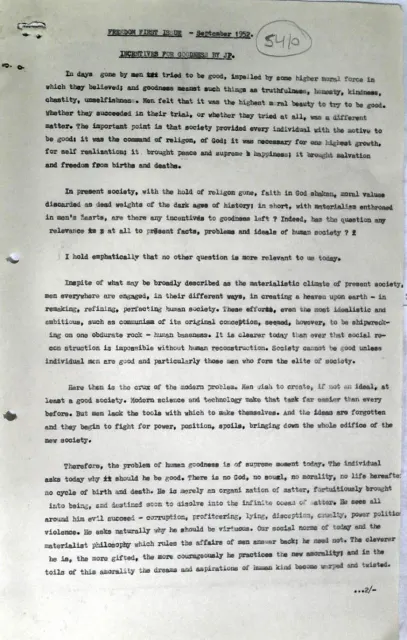
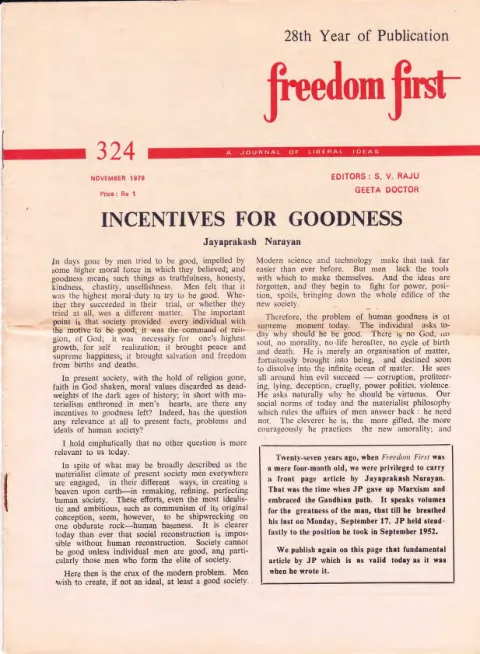
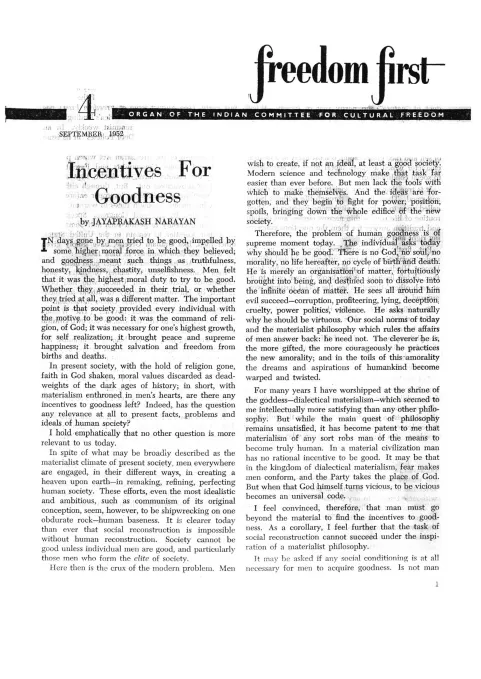
Incentives For Goodness
By Jayaprakash Narayan
In “Incentives For Goodness,” Jayaprakash Narayan argues that the collapse of religious and moral certainties has stripped modern man of any rational incentive to be good, since a purely materialist worldview offers no logical reason to practise virtue over vice. He contends that the fate of society hinges on the moral character of its elite rather than the mass of ordinarily decent people, who can nonetheless turn suddenly vicious under social pressure. Narayan discloses that he was long drawn to dialectical materialism but has come to believe that any materialist philosophy robs man of the means to become truly human, and that social reconstruction cannot succeed under a materialist inspiration; he concludes that man must find incentives to goodness beyond the material.
- Argues modern materialist society has removed traditional (religious) incentives to be good, leaving individuals asking why they should be virtuous at all.
- Holds that the character of a society’s elite, not just its ordinary decent members, determines whether evil or good prevails.
- Describes decent, harmless people as capable of turning suddenly vicious under communal or political passions.
- Reveals his own long attachment to dialectical materialism as an intellectually satisfying philosophy, now judged inadequate.
- Concludes materialism of any kind cannot ground a rational incentive to goodness, and social reconstruction requires going beyond the material.
s criticism of this
The unsigned “Notes” section (pages 3-4) covers several short items: an ancient Athenian anti-dictatorship law contrasted with India’s Preventive Detention Bill; the barring of Raja Kulkarni and Alberto Moravia from the United States under the McCarran Act and the New Leader’s criticism of this “swinging-door” policy; Soviet “LitAg” (literary agent) propaganda tactics, with journalist Iqbal Singh cited as an example operating in India; and a note on Persia/the Persian Gulf as a historic target of Russian and Soviet imperial ambition, citing a captured 1940 Nazi-Soviet diplomatic cable.
- Cites a rediscovered ancient Athenian law making it lawful to kill anyone attempting to establish a dictatorship, contrasting it with India’s Preventive Detention Bill.
- Criticises the Preventive Detention Act for granting the Executive powers that impinge on fundamental rights rather than narrowly targeting anti-democratic conspirators.
- Reports the McCarran Act’s exclusion of Raja Kulkarni (Socialist trade union leader) and Alberto Moravia (Italian novelist) from the U.S., quoting the New Leader’s editorial criticism.
- Describes the Soviet ‘LitAg’ (Literary Agent) apparatus and names Iqbal Singh as a journalist allegedly serving pro-Soviet propaganda ends in Indian publications.
- Cites a captured Nazi-Soviet cable (Nov. 1940) showing Soviet ambitions toward the Persian Gulf, linking historic Tsarist and Soviet imperial goals.
Sri Aurobindo and Man’s Future
By K. D. SETHNA
K. D. Sethna’s essay “Sri Aurobindo and Man’s Future” was written on the occasion of the Indian Committee for Cultural Freedom’s commemoration of Sri Aurobindo’s birthday (which falls on India’s Independence Day). Sethna surveys Sri Aurobindo’s life as a synthesis of East and West — his Cambridge education, early nationalist politics, and turn to yoga and philosophy — and explains his concept of the ‘Supermind’ as the source and secret of earthly evolution, requiring humanity’s ‘conscious co-operation’ to be realised. The essay describes the Pondicherry Ashram and a planned international university intended to spread this teaching, closing with lines from Sri Aurobindo’s poem Savitri on freedom and universal solidarity.
- Frames Sri Aurobindo’s birthday as coinciding symbolically with India’s Independence Day.
- Describes Sri Aurobindo’s biography: Tamil-lineage upbringing is not mentioned, but Cambridge education, early nationalist politics, and turn to yoga and philosophy are covered.
- Explains the concept of the Supermind as the top of a gradation of being that must be attained through humanity’s conscious co-operation.
- Describes the Pondicherry Ashram and a proposed international university meant to spread the Aurobindonian teaching across nations.
- Closes on lines from Sri Aurobindo’s poem Savitri emphasising universal freedom and solidarity.
Ananda Coomaraswamy
By FRANK MORAES
Frank Moraes’s tribute “Ananda Coomaraswamy,” written for the Indian Committee for Cultural Freedom’s commemoration of Coomaraswamy’s 75th birthday, celebrates him as a synthesis of East and West — born to a Tamil father and English mother, once Director of the Mineralogical Survey of Ceylon before turning to Indian art and philosophy. Moraes praises Coomaraswamy’s wide-ranging intellect across sociology, philology, politics, economics, anthropology, archaeology, music, and the sciences, and quotes Eric Gill’s comparison of him to Michelangelo in versatility.
- Describes Coomaraswamy as a synthesis of East and West, claimed by both Ceylon (birthplace) and India (cultural roots).
- Notes his early career as Director of the Mineralogical Survey of Ceylon before his turn to Indian art and philosophy.
- Praises his interpretive gifts and wide intellectual range across many disciplines.
- Cites Eric Gill’s tribute comparing Coomaraswamy to Michelangelo in versatility of genius.
- Frames Coomaraswamy’s own philosophy of life as grounded in the ‘anarchy within ourselves’ leading to anarchy outside if unresolved.
Marxist Crusade Against The Peasant
By MICHAEL PADEV
In “Marxist Crusade Against The Peasant,” Michael Padev reviews David Mitrany’s book Marx Against the Peasant (George Weidenfeld & Nicolson), which he calls a monumental, thirty-years’-research study of the conflict between Communism and peasantries worldwide. Padev summarises Mitrany’s argument that Marxist theory has been consistently and dogmatically hostile to peasants, that Communist support for peasant land demands is purely tactical, and that once in power Communists turn to liquidating the peasantry in favour of collectivised, industrial-style production. He highlights Mitrany’s point that the peasant’s power is one of passive resistance rather than action, and notes Soviet difficulties collectivising agriculture even after decades of the ‘proletarian revolution.’
- Frames Western diplomatic and journalistic circles as chronically under-informed about peasant life behind the Iron Curtain.
- Summarises Mitrany’s central thesis that Marxism has waged an ideological ‘holy war’ against the peasant despite tactical alliances during revolution.
- Contrasts the Marxist view of land as mere production input with the peasant’s view of land as a living organism bound to a way of life.
- Notes that Communist power over peasants rests on organized coercion (‘they have all the guns’), while peasant power is passive resistance capable of enduring decades.
- Cites continuing Soviet difficulty with agricultural collectivisation and ‘super’ collective farms/Agro cities into the late 1940s as evidence of ongoing peasant resistance.
Review: I Led 3 Lives (Herbert Philbrick)
By A.B.J.B.
No summary was extracted for this article. Listed for completeness.
Review: How We Took Over Hungary (Matyas Rakosi, intro. by Jayaprakash Narayan)
By M. R. M.
No summary was extracted for this article. Listed for completeness.
Heresy, Yes—Conspiracy, No! (Sidney Hook)
By J. B. H. WADIA
The “Review” section (pages 8-9) carries four short book/pamphlet reviews. A.B.J.B. reviews Herbert Philbrick’s I Led 3 Lives, praising its unembellished account of nine years as an FBI informant inside American Communist front organisations. An unsigned note covers Matyas Rakosi’s How We Took Over Hungary, with an introduction by Jayaprakash Narayan written while fasting in Poona, describing Communist united-front tactics used to destroy political rivals in Hungary. M.R.M. reviews an unnamed sixteen-page pamphlet critical of Indian delegations to China. J. B. H. Wadia reviews Sidney Hook’s Heresy, Yes — Conspiracy, No!, praising its distinction between Communism as heresy (which liberals need not fear) and Communism as conspiracy (which must be resisted through safeguards against infiltration, not McCarthyist vigilantism).
- A.B.J.B. praises Philbrick’s I Led 3 Lives as a well-documented, unembellished account of infiltrating Communist front organisations for the FBI over nine years.
- Notes Matyas Rakosi’s pamphlet How We Took Over Hungary carries an introduction by Jayaprakash Narayan, written from his sickbed while fasting in Poona.
- M.R.M.’s brief note criticises Indian educationists and delegation members to China for not having read a pamphlet exposing Communist tactics.
- J. B. H. Wadia’s review of Sidney Hook’s Heresy, Yes — Conspiracy, No! stresses the liberal’s need to distinguish Communism-as-heresy from Communism-as-conspiracy.
- Wadia’s review also covers Hook’s second essay, ‘The Dangers of Cultural Vigilantism,’ criticising McCarthyist excesses as counter-productive to anti-Communist goals.
Russia At The Olympics
By “CROEBOS”
The unsigned article “Russia At The Olympics,” bylined at the end as “Croebos,” traces the Olympic Games from their ancient Greek origins through Baron Pierre de Coubertin’s revival in 1896, then describes the Soviet Union’s first participation at the 1952 Helsinki games. It recounts alleged Soviet manipulation of medal-count computations, including erasing a scoreboard once the U.S. took the lead, and quotes sports critic A. F. S. Talyarkhan questioning the credibility of Soviet amateurism and suggesting political favouritism toward Soviet athletes.
- Recounts the Olympic Games’ ancient Greek origin (776 B.C.) and their modern revival in 1896 following Baron Pierre de Coubertin’s idea.
- Notes the Soviet Union entered the Olympics for the first time in 1952 at Helsinki after years of prior non-participation.
- Describes Soviet insistence on their own points-computation method and the erasure of a scoreboard once American athletes took the lead.
- Reports a later Soviet claim of having ‘won’ the Olympics, contradicted by Romanov (Soviet team leader), who acknowledged a tie, though the article states the American team actually won by a handsome margin.
- Quotes sports critic A. F. S. Talyarkhan casting doubt on Soviet amateurism, citing state support and preferential treatment for star athletes.
With Many Voices
“With Many Voices” is a digest of quotations from newspapers, magazines, and public figures on themes of Cold War politics, race, and Indian foreign policy, framed by an epigraph from Tennyson. Items include David Low’s satirical comparison of Eastern, American, and British notions of democracy; Ram Manohar Lohia’s remark on Congress as the lesser evil to Communism; anthropological comment on human ancestry and racial equality; commentary on the Schuman Coal and Steel Pool; a South African doctor’s statement against racial segregation in blood transfusion; and criticism of Shankar’s Weekly for failing to live up to its inspiration as an Indian Punch. This continues (unpaginated as a distinct byline) into further quotations on pages 11-12 concerning Nehru’s foreign policy of neutrality, the Preventive Detention Bill debate, Rajendra Prasad’s literary award, and warnings about the dangers of Indian neutrality in the Cold War from various commentators including Dr. Taraknath Das.
- Opens with a Tennyson epigraph and David Low’s satirical taxonomy of Eastern, American, and British ‘kinds’ of democracy.
- Quotes Ram Manohar Lohia calling the Congress the lesser evil compared to the Communist Party.
- Includes an anthropologist’s claim that mankind descended from a Black ancestor, and a South African doctor’s statement rejecting racial segregation in blood transfusion.
- Notes the opening of the Schuman Coal and Steel Pool’s high authority as the first instance of European diplomats swearing allegiance to a supranational parliament.
- Closes (via continuation onto later pages) with quotations on Nehru’s neutrality policy, the Preventive Detention Bill debate naming Communism, communalism, terrorism and Jagirdari as threats to India, and warnings from Dr. Taraknath Das that Indian neutrality could benefit Soviet and Chinese expansion.
Generated by the v1.5 extraction pipeline. Awaiting editorial review.
Metadata and summary are AI-extracted from the source PDF and reviewed for editorial accuracy. The original work is available via the Read PDF tab above (where present); paragraph-level citation inside the PDF is deferred to a future engagement.