periodical issue
Freedom First
THE INDIAN COMMITTEE FOR CULTURAL FREEDOM, 127, MAHATMA GANDHI ROAD, BOMBAY 1. · Bombay · 1953
12 pages
Freedom First
Summary
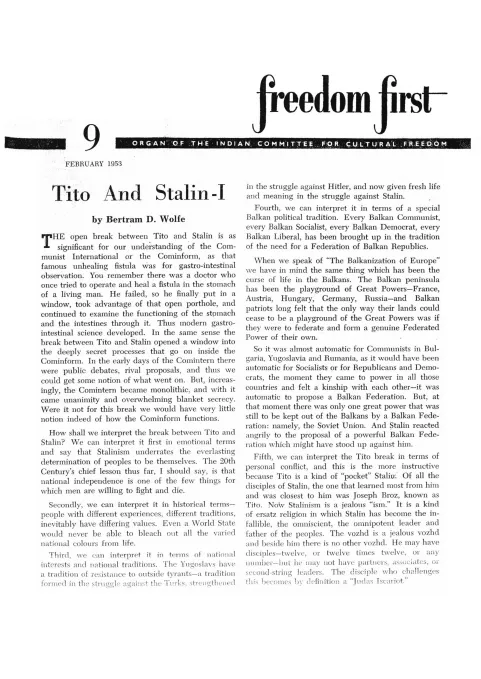
This is issue No. 9 of Freedom First (February 1953), the monthly bulletin of the Indian Committee for Cultural Freedom, edited by Aziz Madni. The issue opens with the first installment of a two-part article by Bertram D. Wolfe, ‘Tito And Stalin-I,’ analysing the Tito-Stalin split through multiple interpretive lenses (emotional, historical, national-interest, Balkan-federalist, personal-rivalry, and ideological) and giving a short biography of Tito. This is followed by an unsigned ‘Notes’ section with several short editorial items on Cold War and domestic politics: Clement Attlee’s claim that Europe rather than Asia is the world’s centre of gravity, Pakistan’s possible adhesion to a Middle East defence pact, the Rawalpindi Conspiracy trial, a Bombay Bar Association dispute over D. N. Pritt, the Gandhian Seminar inaugurated by Nehru, Saifuddin Kitchlew’s Stalin Peace Prize, and Vijayalakshmi Pandit’s remarks on Cold War power blocs. Sampurnanand, UP Minister for Home and Labour, contributes ‘The Tasks Of Our Leadership,’ a reflection (reprinted from the Hindustan Times Congress Supplement) on corruption in Indian public life and the absence of a unifying philosophy or ‘new values’ to replace faded religious and nationalist sanctions. Zafar Futehally writes ‘An Unrepentent Spy’ on the case of British atomic scientist Alan Nunn May, convicted of passing nuclear secrets to the Soviets. Prof. Edwin D. Dickinson of the University of Pennsylvania Law School contributes ‘Geneva Convention And U.N. Stand,’ a legal analysis defending the right of states to grant asylum to prisoners of war who do not wish to be repatriated, discussed against the backdrop of the Korean War POW question. A brief note announces the XXth Century Music Award instituted by the Congress for Cultural Freedom. A ‘Reviews’ section (initialled A.S.P.) covers Whittaker Chambers’ Witness, focusing on Chambers’ testimony against Alger Hiss and his account of what it meant to be a communist. Two ‘To The Editor’ letters follow: one from ‘A Scientist’ criticizing Major-General S. S. Sokhey for pro-Soviet statements on germ warfare and Soviet economic development, and one from D. G. Sakrikar of the Democratic Research Service, Bombay, warning that the Cominform is using a ‘Doctors for Peace’ campaign to recruit Indian medical professionals. The issue closes with ‘With Many Voices,’ a compilation of quoted remarks from Eisenhower, Truman, Rajagopalachari, Krishna Menon, Sampurnanand, and others, plus a membership enrolment form for the Indian Committee for Cultural Freedom.
Key points
-
Bertram D. Wolfe’s “Tito And Stalin—I” analyses the 1948 Tito-Stalin split through six interpretive frames, from Stalin’s fear of an independent Balkan Federation to Titoism as a heresy claiming a return to “primitive Leninism.”
-
The “Notes” section disputes Attlee’s claim that Europe rather than Asia is the Cold War’s centre of gravity, criticises the in-camera Rawalpindi Conspiracy trial verdict, and criticises the near-boycott of Nehru’s Gandhian Seminar by communist states.
-
Sampurnanand’s “The Tasks Of Our Leadership” attributes Indian corruption to the abrupt, unassimilated transplant of Western democratic institutions onto an unreformed caste-based society, and calls for reinterpreted spiritual values as the basis for moral education.
-
Zafar Futehally’s “An Unrepentent Spy” examines British scientist Alan Nunn May’s 1946 conviction for passing atomic secrets to the USSR, quoting May’s own claim that he still believed he had “acted rightly.”
-
Prof. Edwin D. Dickinson’s “Geneva Convention And U.N. Stand” argues, from precedent including Vyshinsky’s own legal writing, that states retain unlimited competence to grant asylum to unwilling Korean War POWs.
-
A.S.P. reviews Whittaker Chambers’s “Witness,” framing it as testimony that vindicates Chambers’s decision to testify against Alger Hiss.
-
Letters to the editor criticise Major-General S. S. Sokhey’s pro-Soviet public statements and warn that a Cominform “Doctors for Peace” campaign is recruiting Indian medical professionals.
Essays
Tito And Stalin-I
By Bertram D. Wolfe
Bertram D. Wolfe analyses the causes and meaning of the 1948 Tito-Stalin break, offering six successive interpretive frames: an emotional reading (the enduring force of national self-determination), a historical reading (divergent national traditions resisting homogenization), a national-interest reading (Stalin’s fear of a Balkan Federation strong enough to exclude Soviet influence), a personal-rivalry reading (Tito as the ablest and most dangerous of Stalin’s former disciples, given Stalinism’s need for total, jealous loyalty), a geopolitical reading (Yugoslavia’s peculiar wartime self-liberation and geographic distance from the USSR), and an ideological reading (Titoism as a heresy that claims to be a return to ‘primitive Leninism’ against Stalin’s ‘betrayals’). Wolfe also traces Tito’s biography from his birth as Josip Broz in 1892 through his indoctrination as a Russian POW, his Comintern work in the Spanish Civil War purges, and his rise to lead a party that grew from 3,000 wartime survivors to 470,000 members by 1948. The piece ends ‘To be continued,’ with Part II to follow in a subsequent issue.
- Wolfe frames the Tito-Stalin split as an accidental ‘window’ into normally secretive Cominform processes.
- Argues Stalinism is inherently jealous, tolerating disciples but not partners or associates.
- Identifies Stalin’s fear of a strong, independent Balkan Federation as a key strategic motive for the break.
- Notes Yugoslavia was the only East European state to self-liberate without Red Army occupation.
- Provides Tito’s biographical arc from WWI POW to Comintern operative in Spain to Yugoslav party chief.
- States Titoism appeals variously to national patriots, doctrinal purists, and ‘fellow travellers’ seeking to exit orthodox Communism without losing revolutionary credentials.
- Personally states preference for Tito as ‘more useful as a Communist than he would be as a Democrat’ from a Cold War standpoint.
Notes (The Centre of Gravity; Much Ado; Why the Secrecy?; Justice — Two kinds; Gandhian Seminar; About Blocs)
An unsigned editorial ‘Notes’ section comprising several short items. ‘The Centre of Gravity’ disputes Clement Attlee’s claim (echoing Churchill) that the world’s centre of gravity lies in Europe rather than Asia, arguing that Korea, Tibet, and Indo-China are the Kremlin’s current primary zones of expansion and that Asia lacks Europe’s NATO-style military and ideological defences. ‘Much Ado’ criticizes hysterical Indian press reaction to unconfirmed reports of Pakistan joining a Middle East Defence Organisation, arguing Indian commentary appeared ‘officially inspired’ per the London Times, while noting the much greater and less-remarked threat from Chinese action in Tibet. ‘Why the Secrecy?’ discusses the Rawalpindi Conspiracy Case verdict against Sajjad Zaheer and Faiz Ahmed Faiz, criticizing the Pakistani government’s in-camera trial procedure while accepting the substance of the conspiracy charge. ‘Justice — Two kinds’ praises the Bombay Bar Association’s refusal to congratulate D. N. Pritt over a contempt-of-court matter, criticizing Comintern-linked lawyer Daniel Latifi. ‘Gandhian Seminar’ reports on Nehru’s inauguration of a seminar on Gandhian methods for resolving international tensions, noting the conspicuous absence of Soviet and Chinese delegates and criticizing Maulana Azad’s naiveté in expressing regret at that absence. ‘Requiescat’ criticizes Dr. Saifuddin Kitchlew’s Stalin Peace Prize and Ambassador K. P. S. Menon’s attendance at the award ceremony as compromising India’s professed neutrality. ‘About Blocs’ mocks Vijayalakshmi Pandit’s objection to the word ‘bloc’ regarding the Asian-African group, arguing the Soviet bloc is the only genuinely rigid power bloc in the U.N.
- Challenges Attlee’s Europe-centric reading of Cold War geography, pointing to Korea, Tibet, and Indo-China as active Soviet/Chinese expansion zones.
- Criticizes Indian press hysteria over a Pakistan-Middle East Defence Organisation report as possibly ‘officially inspired.’
- Accepts the substance of the Rawalpindi Conspiracy verdict but condemns the in-camera trial procedure as an executive overreach.
- Praises the Bombay Bar Association’s stance against D. N. Pritt and criticizes lawyer Daniel Latifi’s Comintern links.
- Criticizes the near-boycott of Nehru’s Gandhian Seminar by communist states and Maulana Azad’s naive regret over their absence.
- Criticizes Saifuddin Kitchlew’s Stalin Peace Prize and Ambassador Menon’s participation in the award ceremony.
- Argues the Soviet bloc, not the Asian-African group, is the only truly rigid power bloc in the U.N.
The Tasks Of Our Leadership
By Sampurnanand
Sampurnanand, Minister for Home and Labour in Uttar Pradesh, argues that India’s leadership diagnoses corruption and moral decline in the country but offers only sermonizing rather than a workable remedy. He contends that leaders who condemn followers from a position of self-assumed moral superiority achieve nothing, and that real reform requires leaders to descend among the people with sympathetic understanding. He traces the roots of the corruption crisis to India’s abrupt, unassimilated adoption of Western democratic institutions atop an unreformed caste hierarchy and a decaying religious/social sanction system, producing widespread psychological and material strain. Sampurnanand’s central argument is that India lacks any unifying philosophy or ‘concept’ comparable to Marxism or capitalism to give its constitution and mixed economy coherent meaning; ‘secularism,’ he argues, is merely negative and cannot substitute for such a vision. He calls for a ‘re-interpreted’ set of spiritual values, grounded in either religion or a philosophical substitute, arguing that moral education without such a basis is futile, and that the root of “all evil” is the absence of any ideal that compels sacrifice and self-restraint.
- Criticizes Congress leaders for condemning corruption in dramatic rhetoric without offering remedies or leading by example.
- Argues moral self-righteousness from leaders alienates rather than reforms followers.
- Attributes national corruption to the abrupt, unassimilated transplant of Western democratic institutions onto an unreformed caste-based society.
- Notes India has adopted a ‘mixed economy’ without any unifying philosophic vision, unlike Marxism or capitalism.
- Argues secularism is a negative concept that cannot itself inspire a vision of national life.
- Calls for reinterpreted spiritual values, rooted in religion or an equivalent philosophy, as the basis for genuine moral education.
- Identifies the absence of any ideal demanding sacrifice and self-restraint as the root of all evil in Indian public life.
An Unrepentent Spy
By Dr. Alan Nunn May
Zafar Futehally examines the case of Dr. Alan Nunn May, a British scientist convicted in 1946 of passing atomic secrets to the Soviet Union, who on release from prison declared he still believed he had acted rightly. Futehally recounts how May was recruited into a Soviet spy network in Canada around 1945, exposed via Igor Gouzenko’s defection, and details the telegrams sent to Moscow via his handler ‘Alec’ describing the Trinity test, the Uranium-235 bomb dropped on Japan, and production rates at the Clinton plant, including a physical sample of Uranium-233 flown to Moscow. The piece quotes at length from May’s own written statement and from Mr. Justice Oliver’s sentencing remarks condemning May’s betrayal of a knowingly-undertaken secrecy pledge. Futehally closes by generalizing from the case to warn about communists worldwide keeping Moscow informed and being ‘systematically removed’ from key positions in the U.S. and the U.N.
- Recounts Alan Nunn May’s 1946 conviction for passing atomic secrets to the USSR while working in Canada.
- Details specific technical information passed via telegram to Moscow, including bomb test data and uranium production rates.
- Quotes May’s own claim that he still believed he ‘acted rightly’ after completing his prison term.
- Quotes Mr. Justice Oliver’s sentencing remarks condemning May’s breach of his secrecy undertaking.
- Generalizes the case into a broader warning about communist infiltration and the ongoing removal of communists from Western institutions.
Geneva Convention And U. N. Stand
By Prof. Edwin D. Dickinson
Prof. Edwin D. Dickinson of the University of Pennsylvania Law School argues against ‘false notions’ circulating in the debate over Korean War POW repatriation. He holds that in the absence of treaty, states have unlimited competence to grant asylum to political refugees — a principle he traces through historical precedent (the Treaty of Paris 1783, Versailles, Trianon, St. Germain, Soviet agreements after WWI) and affirms even in Soviet legal writing (Andrei Vyshinsky’s The Law of the Soviet State). He reviews the 1947 and 1949 Geneva Conference negotiating history on POW repatriation, including the rejected Austrian amendment and Soviet objections from General Sklyarov, and concludes that Article 118 of the 1949 Geneva Convention was never intended to strip a detaining power of its power to grant asylum. Dickinson concludes that the U.N. Command’s position at Panmunjom — refusing unconditional forced repatriation while not permitting indefinite retention of POWs — is consistent with both the Geneva Convention and established international law.
- Argues the competence of states to grant asylum to political refugees, absent treaty, is legally unlimited.
- Cites Andrei Vyshinsky’s The Law of the Soviet State as itself acknowledging this principle.
- Traces historical precedents including the 1783 Treaty of Paris, Versailles, Trianon, St. Germain, and post-WWI Soviet agreements.
- Reviews the negotiating history of Geneva Convention Articles 109 and 118 at the 1947 and 1949 conferences, including the rejected Austrian amendment and Soviet General Sklyarov’s objection.
- Concludes Article 118 was not intended to deprive detaining powers of the power to grant asylum to unwilling POWs.
- Concludes the U.N. Command position at Panmunjom is consistent with the Geneva Convention and international law precedent.
THE XXTH CENTURY MUSIC AWARD
A short unsigned notice announces the XXth Century Music Award, a new annual award for young composers instituted by the Congress for Cultural Freedom in cooperation with the European Cultural Centre in Geneva, funded through the generosity of Mr. Julius Fleischman, intended to promote modern compositions and broaden public familiarity with contemporary music. A suitable award procedure is described as still under consideration.
- Announces a new annual XXth Century Music Award for young composers.
- Instituted by the Congress for Cultural Freedom with the European Cultural Centre, Geneva.
- Funded by Mr. Julius Fleischman.
- Aims to acquaint the public with modern works and expand the repertory of contemporary music.
- Award procedure still under consideration at time of publication.
Reviews: Witness by Whittaker Chambers
By A. S. P.
A book review, initialled A.S.P., of Whittaker Chambers’ Witness (Random House, 808 pp., $5). The reviewer frames the book as a testament of personal faith that led Chambers to testify against Alger Hiss, comparing Chambers favourably to Judas by arguing his self-crucifying revelation of the truth vindicates rather than betrays. The review summarizes the autobiographical first part of the book, describing how WWI-era privations drew Chambers toward Communism’s promise of an end to historical crisis, and recounts Chambers’ vignettes of his three communist ‘heroes’ — Felix Dzerzhinsky, Eugen Levine, and Ivan Kalyaev (misremembered by Chambers as Sazonov) — as illustrations of what it meant to be a communist, willing to accept death, humiliation, and self-immolation for the cause. The review then covers the book’s second part, describing Chambers’ gradual, agonized break with Communism and his turn toward a religious framework in which God, not Stalin, is the answer to man’s need for organizing society and soul. The reviewer concludes the book’s importance lies in its being a personal document warning against communist infiltration of institutions, and in affirming the individual’s right to repudiate a former faith.
- Reviews Whittaker Chambers’ Witness, framing it as testimony that vindicates rather than betrays, unlike Judas’s betrayal.
- Summarizes Chambers’ account of being drawn to Communism amid WWI-era privation and crisis.
- Recounts Chambers’ three communist ‘heroes’ — Dzerzhinsky, Levine, and Kalyaev (misnamed Sazonov) — as parables of communist self-sacrifice and fanaticism.
- Covers Chambers’ agonized break with communism and turn to religious faith, with God substituting for Stalin as the organizing principle of society.
- Concludes the book’s value lies in warning against communist infiltration and affirming a right to repudiate one’s former faith.
To The Editor: A General Gone Astray
By “A Scientist”
A letter to the editor signed ‘A Scientist,’ titled ‘A General Gone Astray,’ criticizes Major-General S. S. Sokhey for a pattern of pro-Soviet public statements over two decades, focusing on his recent remarks alleging germ warfare in Korea and praising Soviet economic development and the Five-Year Plan, and calling for ‘fundamental, political, economic, social and administrative changes’ in India. The letter connects Sokhey’s statements to Communist Party organs (Cross Roads) and fellow-traveller committees, and questions the judgment behind his nomination to the Council of States.
- Criticizes Major-General S. S. Sokhey’s public statements alleging germ warfare use in Korea.
- Notes Sokhey’s praise for Soviet economic development and the Five-Year Plan.
- Links Sokhey’s rhetoric to Communist Party publications (Cross Roads) and fellow-traveller organisations.
- Questions the wisdom of Sokhey’s nomination to the Council of States given his stated views.
To The Editor: Doctor’s Dilemma
By D. G. Sakrikar, Executive Secretary, Democratic Research Service, Bombay
A letter to the editor from D. G. Sakrikar, Executive Secretary of the Democratic Research Service, Bombay, titled ‘Doctor’s Dilemma,’ argues that a 1950 Cominform directive made ‘the peace movement’ the pivot of Indian Communist Party activity, and that a campaign is underway to enlist Indian doctors through ‘Conference of Doctors for Peace’ events, citing a Bihar State Conference in Patna and remarks by Dr. U. B. Narayan Rao suggesting India could host an International Doctors’ Congress. The letter recounts how Dr. R. N. Cooper resigned from a preparatory committee for an International Doctors’ Congress after the Democratic Research Service exposed its Cominform links, and warns that accusations against Soviet doctors of murdering Andrei Zhdanov and Alexander Sergeivitch Scherbekov should not be allowed to smear the medical profession or be exploited by pro-Soviet organisers in India.
- Cites a 1950 Cominform directive making the ‘peace movement’ central to Indian Communist Party activity.
- Describes a campaign to recruit Indian doctors via ‘Conference of Doctors for Peace’ meetings, including one in Patna.
- Reports Dr. U. B. Narayan Rao’s suggestion that supporting the peace movement could bring the International Doctors’ Congress to India.
- Recounts Dr. R. N. Cooper’s resignation from a preparatory committee after Democratic Research Service exposed its Cominform ties.
- Warns against the exploitation of the ‘doctors’ murder’ accusations in Soviet purges to recruit Indian medical professionals.
With Many Voices
‘With Many Voices,’ a closing compilation of quoted remarks and news items under a Tennyson epigraph, drawing from Eisenhower’s Inaugural Address, Truman’s message to Stalin in the New York Times, C. Rajagopalachari’s Congress speech on fear of the atomic bomb replacing fear of God, Krishna Menon’s self-deprecating comment on arrival in Bombay, Sampurnanand’s remark on Purushottam Das Tandon’s carelessness with punctuality, Daniel Brewster’s comment on U.S. foreign policy, and brief international news items including a Czechoslovak chess champion’s asylum request and a Soviet/Chinese boycott of a Burmese National Day function. The issue closes with a membership enrolment form for the Indian Committee for Cultural Freedom and a publication statement naming Aziz Madni as editor and Name Oliaji as printer/publisher.
- Compiles quotations from Eisenhower’s Inaugural Address on the burdens of war and peace.
- Quotes Truman’s message to Stalin arguing nuclear war cannot be a viable ‘stage’ toward communism.
- Quotes C. Rajagopalachari on nations acting from fear of the atomic bomb rather than fear of God.
- Includes Krishna Menon’s remark that he is ‘only a mouthpiece’ for the Government of India.
- Reports a Czechoslovak chess champion’s asylum request in Switzerland and a Soviet/Chinese diplomatic boycott in Burma.
- Closes with the Indian Committee for Cultural Freedom’s membership enrolment form; masthead names Aziz Madni as editor.
Generated by the v1.5 extraction pipeline. Awaiting editorial review.
Metadata and summary are AI-extracted from the source PDF and reviewed for editorial accuracy. The original work is available via the Read PDF tab above (where present); paragraph-level citation inside the PDF is deferred to a future engagement.