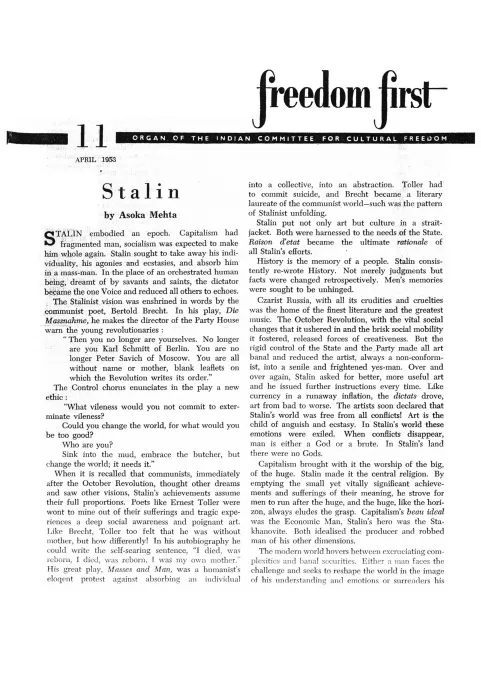
periodical issue
Freedom First
By Prof. G. D. Parikh, J. B. H. Wadia, Bertram D. Wolfe, K. D. Sethna
Edited by Aziz Madni; printed & published by Narie Oljaji at Kanada Press, 109 Parsi Bazaar Street, Bombay 1. · Bombay · 1953
12 pages
Freedom First
Summary
This is the complete March 1953 issue (No. 10) of Freedom First, the monthly bulletin of the Indian Committee for Cultural Freedom, edited by Aziz Madni. The issue opens with Prof. G. D. Parikh’s essay on academic freedom in Indian universities, arguing that autonomy of higher-education institutions and improvement of academic standards are compatible goals rather than opposing ones. An unsigned editorial ‘Notes’ section addresses Reinhold Niebuhr’s election as honorary president of the Congress for Cultural Freedom, defends Eisenhower’s Formosa ‘liberation’ policy against Communist China, criticizes Aneurin Bevan’s and Rammanohar Lohia’s neutralist foreign-policy statements abroad, praises the seizure of Communist literature from P. C. Joshi and Romesh Chandra, and discusses the Praja Parishad agitation in Kashmir. J. B. H. Wadia contributes a rejoinder to Sampurnanand’s article on secularism and moral education, arguing for ‘liberal secularism’ as the proper safeguard of individual liberty against both religious and state authoritarianism. Bertram D. Wolfe’s two-part analysis ‘Tito And Stalin’ (part II) documents Soviet economic exploitation of Yugoslavia and the ideological logic of the Tito-Stalin split as a crack in the Cominform’s authority. A short piece titled ‘Demosthenes’ Reproach’ uses a Toynbee anecdote about Minoo Masani’s warnings on Soviet imperialism. The issue closes with a book review by K. D. Sethna of two Arthur Goodfriend photo-essay books on anti-Communist democratic values, and a ‘With Many Voices’ column of press quotations on Cold War politics, plus a subscription coupon for the Indian Committee for Cultural Freedom and an advertisement for the French-language review Preuves.
Key points
-
Prof. G. D. Parikh’s essay on academic freedom argues that institutional autonomy and improved academic standards are compatible goals, recommending an Inter-University Board and University Grants Commission over direct state control.
-
The “Notes” section profiles Reinhold Niebuhr’s election as honorary president of the Congress for Cultural Freedom, defends Eisenhower’s Formosa “liberation” policy, and treats the Kashmir Praja Parishad agitation with qualified sympathy despite its communal composition.
-
J. B. H. Wadia’s rejoinder to Sampurnanand argues that once a secular state allies with an authoritative religion the alliance inevitably drifts toward authoritarianism, proposing “liberal secularism” as the safeguard for individual liberty.
-
“Demosthenes’ Reproach” recalls Toynbee’s and Minoo Masani’s shared use of Demosthenes’s warning against Athenian complacency as an analogy for democracies unprepared against Hitler and, now, Soviet Communism.
-
Bertram D. Wolfe’s “Tito And Stalin—II” documents Soviet economic exploitation of Yugoslavia through unequal joint-stock companies and argues Tito’s defiance cracked the myth of Kremlin infallibility.
-
K. D. Sethna reviews two Arthur Goodfriend photo-essay books, praising their attempt to counter Communism’s pseudo-religious appeal with wisdom drawn from the Upanishads, Buddha, and other traditions.
Essays
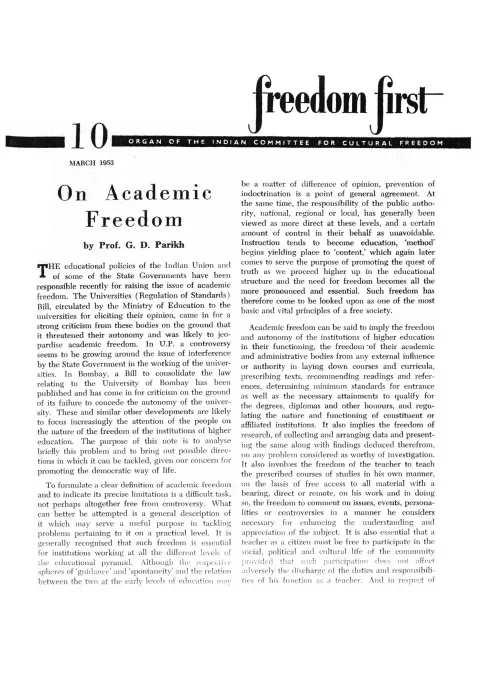
On Academic Freedom
By Prof. G. D. Parikh
Prof. G. D. Parikh’s essay responds to controversies over the Universities (Regulation of Standards) Bill and state interference in university governance in Bombay and Uttar Pradesh. He defines academic freedom as institutional autonomy from external political authority in curricula, research, and teaching, paired with a teacher’s freedom to comment on public issues. He argues that India’s low educational standards and colonial-era utilitarian attitudes toward education create a peculiar problem: universities must simultaneously win greater freedom and improve functional efficiency. Rejecting the view that state control is necessary for quality, Parikh sides with the University Education Commission and the Inter-University Board in holding that autonomy is a precondition for improvement, proposing coordination mechanisms like the Inter-University Board and a University Grants Commission rather than direct state control.
- Universities (Regulation of Standards) Bill and Bombay/U.P. university legislation prompted the essay’s concern about threats to institutional autonomy.
- Academic freedom is defined as freedom of institutions from external political control over curricula, degrees, and research, plus freedom of teachers to comment on public issues.
- India’s formal democratic constitution lacks deep-rooted democratic traditions, making the autonomy problem distinct from that in other countries.
- Two views are contrasted: external control as necessary for standards versus institutional freedom as precondition for improvement.
- Parikh recommends the Inter-University Board and a University Grants Commission (on UK lines) as coordination mechanisms instead of direct state control.
- He warns that external control risks producing ‘dull lifeless uniformity’ rather than improved standards.
Notes (Our New Honorary President; Onwards to Liberation; Well Done!; Praja Parishad Agitation; No Shaking Hands with Murder; To the Editor)
The unsigned ‘Notes’ section is a set of short editorial commentaries. It profiles Reinhold Niebuhr on his election as honorary president of the Congress for Cultural Freedom, tracing his biography and theological break from liberal Protestantism. ‘Onwards to Liberation’ defends President Eisenhower’s decision to de-neutralize Formosa against Indian and British press criticism, framing the policy as consistent with a strategy of active ‘liberation’ rather than mere containment of Communist China and Soviet imperialism. ‘Well Done!’ praises Bombay customs for seizing Communist literature brought by P. C. Joshi and Romesh Chandra. ‘Bevan and Lohia’ criticizes Aneurin Bevan’s and Rammanohar Lohia’s neutralist statements made on foreign soil, comparing double standards applied to Indian versus British/American critics abroad. ‘No Shaking Hands with Murder’ praises Henry Cabot Lodge’s refusal to shake hands with Vyshinsky. ‘Praja Parishad Agitation’ expresses qualified sympathy for the Kashmir Praja Parishad’s aims despite its communal composition, criticizing the Congress-Communist alliance against it. A reader’s letter (‘To The Editor’) quotes a Mysindia passage likening Communist infiltration fears under Nehru to 1930s-40s Washington under Roosevelt.
- Reinhold Niebuhr is profiled as the new honorary president of the Congress for Cultural Freedom, noted for his critique of liberal Protestant theology and his political activity with Americans for Democratic Action.
- The ‘Onwards to Liberation’ item defends Eisenhower’s Formosa policy and the U.S. shift from containment to ‘liberation’ of peoples under Soviet/Chinese Communist control.
- Aneurin Bevan and Rammanohar Lohia are criticized (though Bevan is defended as within his democratic rights) for airing neutralist or critical foreign-policy views abroad, with a charge of double standards against Indian critics of their own government.
- Bombay customs’ seizure of Communist literature from P. C. Joshi and Romesh Chandra is praised as a minor but symbolically useful action.
- The Kashmir Praja Parishad agitation is treated sympathetically despite its communal composition, with criticism of the Congress-Communist alliance against it and of the Preventive Detention Act’s use against Parishad supporters.
- A reader’s letter draws a parallel between Communist infiltration fears in Nehru’s Delhi and Roosevelt-era Washington, citing Whittaker Chambers’ ‘Witness’.
The Tasks Of Our Leadership
By J. B. H. Wadia
J. B. H. Wadia responds to Sampurnanand’s article ‘The Tasks Of Our Leaders’ on the crisis of culture and the need for moral education grounded in religion or a philosophic substitute. Wadia argues that once a secular state allies itself with an authoritative religion, that alliance inevitably drifts toward authoritarianism, citing historical examples from Augustan Rome, the Reformation, Hindu Brahmanic priestcraft, Islam, Zoroastrianism, and Communism as a secular religion-substitute. He contends that the abuse of religion is inherent in religion’s demand for abject subservience to a ‘Supreme of Supremes,’ and that the proper task of India’s leaders is not loose secularism but ‘liberal secularism’ — practising secularism in the best traditions of liberalism, respecting individual liberty and giving citizens the choice to accept or discard religion.
- Wadia is responding directly to Sampurnanand’s essay ‘The Tasks Of Our Leaders’ on cultural crisis and moral education.
- He argues religious education and secular education are ‘irreconcilables’ today and that no combination can let a state keep religious authority in check if it courts it.
- Historical examples (Rome, Reformation, Brahmanic priestcraft, Jainism, Buddhism, Islam, Zoroastrianism, Communism) illustrate how religious or quasi-religious authority tends toward tyranny.
- He locates the danger in religion’s own demand for subservience to a ‘postulated Supreme of Supremes,’ not merely in its abuse.
- Wadia proposes ‘liberal secularism’ — secularism practiced in the tradition of liberal philosophy — as the safeguard for individual liberty against both religious and state authoritarianism.
- He frames Sampurnanand’s reliance on religion for moral revival as ‘rank opportunism’ if pursued by state leaders.
Demosthenes’ Reproach
This short piece opens with a preface noting it was written before Eisenhower’s inaugural address. It recounts historian Arnold Toynbee’s use of Demosthenes’ 351 B.C. reproach to the Athenians (for failing to plan against Philip of Macedon and reacting only after crises hit) as an analogy for democracies’ fecklessness in the face of Hitler in 1938-39. The piece then recalls Indian politician Minoo Masani (identified in text as ‘Masani’) invoking the same Demosthenes speech in a 1952 address to Canadian audiences in Ottawa, warning that Western democracies were similarly unprepared for the ‘slow but inevitable motion’ of Soviet Communism.
- The piece uses Demosthenes’ 351 B.C. speech against Athenian complacency toward Philip of Macedon as a recurring historical analogy.
- Arnold Toynbee applied the Demosthenes quote to describe democracies’ failure to prepare against Hitler in 1938-39.
- Indian politician Minoo Masani applied the same Demosthenes quote in a 1952 Ottawa address warning of Soviet imperialism’s threat to Asia.
- The piece frames a triple parallel: Athens in 351 BC, the democracies in 1938-39, and the free world confronting Soviet Communism ‘now’.
Tito And Stalin—II
By Bertram D. Wolfe
Bertram D. Wolfe’s essay, the second installment of a two-part series, chronicles the Tito-Stalin split from Tito’s 1945 and 1946 visits to Moscow through the 1948 Cominform break. Wolfe documents how the Soviet economic plan subordinated Yugoslavia to a raw-material role, imposed unequal joint-stock companies (juspad and justa), extracted metals at below-market prices, and sought pro-consular rights for Soviet agents. He argues Tito’s defiance cracked the myth of Kremlin infallibility because criticisms of Soviet imperialism carried more weight coming from within the Communist camp. Wolfe analyzes the ‘logic’ of both Tito’s and Stalin’s positions — Tito forced to re-examine Leninism itself and to seek Western aid without dismantling his own Stalinist state apparatus, and Stalin forced after 1948 to tighten control over satellite states through purges (naming Rajk, Kostov, Clementis, Gomulka, and Jan Masaryk) rather than loosen them, a strategy Wolfe contrasts with Britain’s gradual, successful loosening of empire into Commonwealth.
- Tito’s 1945 and 1946 Moscow visits revealed Soviet plans to subordinate Yugoslavia as a raw-material colony and to control its army and industry.
- Soviet economic exploitation is documented via unequal joint-stock companies, below-market metal prices, and freight-rate disparities.
- The 1948 Cominform-Tito break (Comniform blast of June 29, 1948) made the rift public after failed Soviet pressure via Kardelj’s mission and troop withdrawals.
- Wolfe argues Tito’s crack in Cominform authority matters because anti-Soviet truths carry more weight from inside the Communist camp than from non-Communists.
- Both Tito and Stalin face internal ‘logics’: Tito must re-examine Leninism and seek Western allies without dismantling his own authoritarian structures; Stalin must tighten (not loosen) control over satellites, provoking purges of nationally-rooted Communists like Rajk, Kostov, Clementis, Gomulka, and Jan Masaryk.
- Wolfe contrasts Stalin’s tightening strategy unfavorably with Britain’s post-1776, post-imperial loosening into the Commonwealth.
Review: What Can A Man Believe? / The Only War We Seek
By K. D. Sethna
K. D. Sethna reviews two books by Arthur Goodfriend — ‘The Only War We Seek’ (with a foreword by Chester Bowles, published for Americans for Democratic Action) and ‘What Can A Man Believe?’ Both are photo-essay books pairing effective photographs with pointed commentary to make an anti-Communist democratic argument aimed at the ‘common man of Asia.’ Sethna praises the first book for exposing America’s past mistake in supporting the wrong methods in China, and welcomes Chester Bowles’ foreword as a sign of a shift from government-level diplomacy toward engaging ordinary people’s aspirations. He commends the second book for touching the religious level of the Asian mind, addressing Communism’s pseudo-religious appeal (the classless society as an earthly heaven, Marxism as absolute revealed truth) and countering it with wisdom drawn from the Upanishads, Buddha, Lao-Tse, Mahavira, Mohammed, and Christ, though he notes Goodfriend does not probe religious consciousness very deeply.
- Sethna reviews Arthur Goodfriend’s ‘What Can A Man Believe?’ (1952) and ‘The Only War We Seek’ (1951, foreword by Chester Bowles).
- Both books use photographs plus commentary to make a pro-democracy, anti-Communist argument aimed at ordinary Asians.
- Sethna welcomes Bowles’ foreword as signaling a shift from U.S. government-level diplomacy in India toward engaging common people’s needs directly.
- He argues Communism succeeds by usurping religion’s place, presenting the classless state as ‘earthly heaven’ and Marxism as absolute revealed truth.
- Goodfriend’s second book is praised for engaging the religious level of the Asian mind using Upanishadic, Buddhist, Taoist, Jain, Islamic, and Christian wisdom, though not probing religious consciousness deeply.
- Sethna recommends the book be translated into Asian languages for wider reach.
With Many Voices
The closing ‘With Many Voices’ column, prefaced with a Tennyson epigraph, compiles short press quotations from Indian and international sources on Cold War politics — including Eisenhower on winning the cold war, a comparison of Krishna Menon’s role to Nehru with Nehru’s own role to Gandhi, Jayaprakash Narayan on Russian expansionism as Asia’s new danger, an anecdote about Churchill and Bevan, a quip from Yugoslav diplomat Bebler on Burmese Communists, and commentary on Nehru’s use of the term ‘communal.’ The page also carries a subscription coupon for the Indian Committee for Cultural Freedom, an advertisement for the French monthly review Preuves (published by the Congress for Cultural Freedom’s International Secretariat), and the issue’s colophon naming editor Aziz Madni and printer/publisher Narie Oliaji.
- The ‘With Many Voices’ column collects short press quotations on Cold War and Indian politics from January-February 1953 sources.
- Eisenhower is quoted on winning the cold war as the sole way to avoid total war.
- Jayaprakash Narayan is quoted describing Russian expansionism, not colonialism, as Asia’s new danger.
- An anecdote contrasts Krishna Menon’s rationalizing role for Nehru with Nehru’s own historical role rationalizing Gandhi’s teachings.
- The page includes a subscription coupon for the Indian Committee for Cultural Freedom and an advertisement for the French review Preuves.
- The issue’s colophon identifies Aziz Madni as editor and Narie Oliaji as printer/publisher at Kanada Press, Bombay.
Generated by the v1.5 extraction pipeline. Awaiting editorial review.
Metadata and summary are AI-extracted from the source PDF and reviewed for editorial accuracy. The original work is available via the Read PDF tab above (where present); paragraph-level citation inside the PDF is deferred to a future engagement.