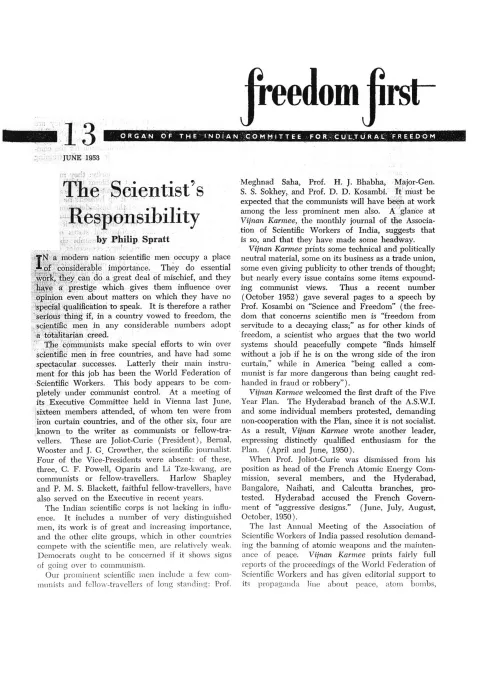
periodical issue
Freedom First
Edited by Aziz Madni; printed & published by Narie Oliaji at Kanada Press, 109 Parsi Bazaar Street, Bombay 1. · Bombay · 1953
12 pages
Freedom First
Summary
This is the July 1953 issue (No. 14) of Freedom First, the monthly bulletin of the Indian Committee for Cultural Freedom, published in Bombay and affiliated with the Congress for Cultural Freedom. In the rendered pages, the issue opens with P. Kodanda Rao’s essay “Bilingualism For India,” arguing against treating English as a “foreign” language and for a policy of vertical bilingualism (regional language plus English) in Indian education and administration, contra views attributed to P. V. Kane and in partial agreement with C. Rajagopalachari. This is followed by an unsigned “Notes” column covering the East German and Czechoslovak workers’ riots, criticism of Nehru’s stance on China and Russia, the Copenhagen Women’s Congress, King Norodom Sihanouk of Cambodia, and Health Minister Rajkumari Amrit Kaur’s praise of Soviet medicine. A long unsigned editorial, “Cutting The Gordian Knot,” defends Syngman Rhee’s position on Korean POW repatriation against U.N./Eisenhower policy. Bertram D. Wolfe contributes a personal memoir, “Memories of Yusuf Meherally,” marking the third anniversary of Meherally’s death and recalling their friendship in the late 1940s, Meherally’s relationships with Jinnah and Gandhi, and his softened view of British rule over time. An unsigned piece, “Is Krishna Menon Pro-Communist?”, lays out V. K. Krishna Menon’s political record (Theosophist beginnings, India League, ties to British Communist-front figures, wartime line-shifts, and U.N. conduct) inviting the reader to judge for themselves. Philip Spratt reviews James Burnham’s book Containment or Liberation? under the title “Containment Or Liberation?”, endorsing Burnham’s argument that mere containment cannot defeat Soviet expansionism and that a political offensive of liberation is required. A book review section follows: Prabhakar Padhye reviews George Fischer’s Soviet Opposition to Stalin (on the Vlasov movement and Soviet “inertness”), and an author identified only as “R.H.” reviews John Steinbeck’s East of Eden. A “Book Notes” column previews forthcoming titles on Soviet affairs (works by Czeslaw Milosz, Ignazio Silone, Robert Magidoff, Isaac Deutscher, Marc Slonim, Hugh Seton-Watson, and a Nineteenth Congress documents volume from Frederick A. Praeger). The issue closes with a “To The Editor” letters section (on communist-front organisations proscribed by the British Labour Party, and on a prior review of Perspectives), a “C.C.F. News” section reporting a solidarity message to Berlin’s mayor Ernst Reuter and recent Indian Committee talks by Herbert Passin, Joseph Murumbi, and Dnyaneshwar Nadkarni, and a closing page of press quotations titled “With Many Voices” on Cold War and Korea themes.
Key points
-
P. Kodanda Rao’s “Bilingualism For India” argues English should not be treated as a “foreign” language, proposing “vertical bilingualism” — the regional language for arts and administration, English for sciences and higher and international purposes.
-
The “Notes” section reads the East German and Czechoslovak workers’ riots as exposing the falsity of Soviet propaganda, and criticises Health Minister Rajkumari Amrit Kaur for praising Soviet medicine uncritically.
-
An unsigned editorial, “Cutting The Gordian Knot,” defends Syngman Rhee’s unilateral release of Korean War POWs as consistent with the voluntary-repatriation principle the UN itself had endorsed.
-
Bertram D. Wolfe’s memoir “Memories Of Yusuf Meherally” recalls Meherally’s relationships with Jinnah and Gandhi and his softening view of British rule over time.
-
An unsigned survey, “Is Krishna Menon Pro-Communist?,” traces Menon’s political trajectory from Theosophist India League founder through the 1935 Comintern United Front shift to his controversial UN conduct, inviting readers to judge for themselves.
-
Philip Spratt reviews James Burnham’s “Containment Or Liberation?,” endorsing Burnham’s argument that mere containment cannot defeat Soviet expansionism and that a political offensive focused on Europe is required.
-
Prabhakar Padhye reviews George Fischer’s “Soviet Opposition to Stalin” on the Vlasov movement, and R.H. reviews Steinbeck’s “East of Eden” as an explicit rejection of moral relativism.
Essays
Bilingualism For India
By P. Kodanda Rao
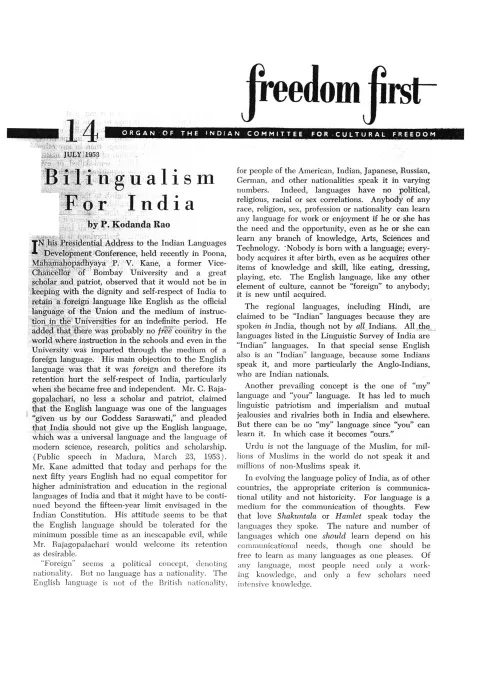
P. Kodanda Rao argues that English should not be regarded as a “foreign” language disqualified from a permanent role in Indian public life, contending that no language has an inherent nationality and that communicational utility, not historicity, should guide India’s language policy. He proposes “vertical bilingualism”: the regional language for arts subjects and daily administration, English for sciences, technology, higher education, and international purposes, with every pupil required to gain a working knowledge of both.
- Responds to P. V. Kane’s view (given in a Presidential Address at the Indian Languages Development Conference, Poona) that retaining English as official/university language indefinitely offends India’s self-respect.
- Cites C. Rajagopalachari’s public position (Madura, 23 March 1953) that English is a gift ‘given us by our Goddess Saraswati’ and should be retained.
- Argues ‘foreign’ is a political, not linguistic, concept and that no language belongs to a nationality, religion, or race.
- Claims Urdu is not intrinsically the language of Muslims, since millions of Muslims do not speak it and millions of non-Muslims do.
- Proposes vertical bilingualism: regional language for arts and lower administration, English for sciences/technology and higher/international administration.
- Argues English delivers more practical economic value to ordinary workers than Hindi does, since more current knowledge circulates in English.
- Uses the Switzerland/England-America contrast to argue common language is not required for national unity, but that English would serve unity better than any alternative if one were needed.
Notes (Riots in Slave Land; Ignoring Facts; The Copenhagen Fiasco; Not the Satellite Way; Physician, Heal Thyself)
An unsigned editorial ‘Notes’ column covers several current-affairs items: the East German and Czechoslovak workers’ riots as a rebuke to Soviet propaganda; criticism of Nehru’s televised remarks on China and Russia as inconsistent with his own recent warnings about border security; the Copenhagen ‘World Congress of Democratic Women’ turned embarrassing by the defection of Bulgarian delegate Sophie Ivanenko; a note distinguishing King Norodom Sihanouk’s self-exile strategy from a pro-satellite path; and a sharp rebuke of Health Minister Rajkumari Amrit Kaur for praising Soviet medicine and birth-control policy uncritically.
- The East German/Czechoslovak riots are read as exposing the falsity of Soviet propaganda about worker contentment.
- Nehru is criticized for contradicting his own recent warnings about border infiltration by claiming China and Russia now desire peace.
- The Copenhagen Women’s Congress is mocked as backfiring when a Bulgarian delegate, Sophie Ivanenko, defected to freedom.
- Sihanouk’s flight to Bangkok and return is praised as distinct from following ‘the satellite way’ of Ho Chi Minh.
- Rajkumari Amrit Kaur is criticized for praising Soviet medicine and approving of Soviet attitudes to birth control without scrutinizing Soviet ‘statistics’ or intellectuals’ ‘confessions.‘
Cutting The Gordian Knot
An unsigned editorial, ‘Cutting The Gordian Knot,’ takes the side of South Korean President Syngman Rhee in his conflict with the U.N. and the Eisenhower administration over the terms of the Korean armistice, particularly the treatment of prisoners of war. It recounts the history of the U.N. resolution recognizing Rhee’s government, the outbreak of the war, and the dispute over voluntary versus enforced repatriation of POWs, defending Rhee’s unilateral release of prisoners as consistent with the principle of voluntary repatriation that the U.N. itself had endorsed. The piece criticizes the U.N.’s compromise as a betrayal of Korean interests under pressure from weaker member states and invokes the 1935 Abyssinia crisis as a cautionary historical parallel.
- Frames the Korean crisis as a tragedy of ‘good versus good’ rather than good versus evil, given the rift between South Korea and its U.N. allies.
- Defends Syngman Rhee’s release of prisoners as consistent with the voluntary-repatriation principle the U.N. itself had proposed.
- Criticizes President Eisenhower’s letter to Rhee and the U.N.’s armistice terms as effectively sacrificing Korean interests for a show of Western solidarity.
- Notes that General James Van Fleet conceded the armistice terms served U.S. rather than Korean interests, and that ‘President Rhee had no alternative.’
- Criticizes Indian commentators (naming Dr. Radhakrishnan) for condemning Rhee while not applying the same standard to Sheikh Abdullah’s stance on Kashmir.
- Draws an analogy to the League of Nations’ failure over Abyssinia in 1935 as a precedent for the danger of appeasement.
Memories Of Yusuf Meherally
By Bertram D. Wolfe
Bertram D. Wolfe, author of Three Who Made A Revolution, offers a personal memoir on the third anniversary of Yusuf Meherally’s death. He recalls first meeting Meherally in 1930 at V. F. Calverton’s home, and reconnecting with him in New York in the late 1940s when Meherally, in poor health, was seeking to reach American contacts via Louis Fischer. Wolfe describes Meherally’s shift over time from bitter condemnation of British rule to a more balanced appreciation of British contributions to Indian civil liberties, his relationships with Mohammed Ali Jinnah (under whom he read law) and Mahatma Gandhi (whom he loved as a son loves a father), his gift to Wolfe of a Gandhi birthday tribute book, and Wolfe’s final parting from him before Meherally’s premature death from heart failure.
- Wolfe first met Meherally in 1930 at V. F. Calverton’s home in a gathering arranged to introduce him to American writers.
- Reunited with Meherally in New York in 1946/47, when Meherally, suffering from a bad heart, was still working tirelessly for his causes.
- Meherally’s attitude toward British rule softened dramatically after independence, moving from bitterness to gratitude for British contributions to civil liberties.
- Meherally spoke of his early legal training and relationship with Mohammed Ali Jinnah, and his filial devotion to Mahatma Gandhi despite disagreements over industrialization and socialism.
- Meherally gave Wolfe a limited-edition Gandhi 75th-birthday tribute book as a gift, which Wolfe calls his most cherished book.
- Wolfe recounts Meherally’s excessive baggage of books and manuscripts when returning to India, symbolic of his devotion to sharing culture and ideas.
- Meherally died of heart failure shortly after returning to India, having refused Wolfe’s advice to slow down his pace of political work.
Is Krishna Menon Pro-Communist?
By (Contributed)
An unsigned article, ‘Is Krishna Menon Pro-Communist?’, surveys V. K. Krishna Menon’s political record following his election to Parliament and speculation about a Cabinet post, in light of Jayaprakash Narayan’s earlier warning about communists in government. It traces Menon’s trajectory from Theosophist follower of Annie Besant and founder of the India League (initially attacked by Communists as reactionary) through the Comintern’s 1935 United Front shift, his wartime ‘Imperialist War’ to ‘People’s War’ line changes, his role at the U.N. General Assembly delegations of 1947 and 1952, and his shifting rhetoric toward the U.S., Soviet Union, and China, concluding by inviting readers to judge for themselves whether he is pro-communist.
- Opens by invoking Jayaprakash Narayan’s earlier warning that any country admitting a communist into its Cabinet endangers its security.
- Traces Menon’s origin as a Theosophist follower of Annie Besant and founder of the India League, initially opposed by Communists.
- Describes the 1935 Comintern United Front shift that brought communist figures like Reginald Bridgeman and Ben Bradley onto the India League’s Executive Committee.
- Notes Menon’s defiance of the British Labour Party’s instruction to dissociate from United Front activities, costing him Labour candidacies in St. Pancras and Dundee.
- Details Menon’s wartime shift from the ‘Imperialist War’ to ‘People’s War’ line and the India League’s refusal to endorse Gandhi’s Quit India movement, which triggered a revolt among Indian students in the U.K.
- Describes his 1947 U.N. delegation conduct, including association with the American Negro Congress, and his 1952 POW resolution and subsequent statements blaming the U.S. for the breakdown while Vyshinsky called him an ‘honest man.‘
Containment Or Liberation?
By Philip Spratt
Philip Spratt reviews James Burnham’s book Containment or Liberation? (The John Day Co., New York, 1953), defending Burnham against charges of alarmism and endorsing his central thesis that containment cannot succeed as a long-term Cold War policy because the Soviet empire’s scale relative to the ‘containing’ power makes voluntary Soviet retreat implausible. Spratt summarizes Burnham’s argument that the world’s choice is between submission, coexistence, or destruction of Soviet power, that coexistence is impossible because the Soviets are not satisfied with it, and that a political offensive aimed at liberation is necessary, focused on Europe rather than Asia. Spratt notes Stalin’s recent death does not change Burnham’s basic argument but makes an offensive policy more feasible.
- Defends Burnham against Orwell’s and others’ charge of alarmism, arguing Burnham has correctly grasped the significance of the era’s events.
- Summarizes Burnham’s three-way policy choice for the free world regarding the Soviet empire: submit, coexist, or attack and destroy.
- Cites Burnham’s argument that containment fails because the Soviet empire (13 million sq. miles, 800 million people) vastly outweighs the containing power (3 million sq. miles, 150 million people).
- Notes Burnham’s point that containment is psychologically weak because it cedes moral high ground without persuading observers who care primarily ‘who is going to win.’
- Highlights Burnham’s proposed main line of attack against Russia through Europe rather than the Far East, given that European Russia is the Soviet bloc’s core.
- Observes that Stalin’s death, occurring after Burnham wrote the book, does not alter the book’s basic argument but strengthens the practical case for an offensive.
Review: Soviet Opposition to Stalin (George Fischer)
By Prabhakar Padhye
Prabhakar Padhye reviews George Fischer’s Soviet Opposition to Stalin (Russian Research Centre Studies, Harvard University Press), a scholarly study of the Vlasov movement, the little-known episode in which Soviet POWs and defecting Red Army officers under General Vlasov attempted to organize a Russian Liberation Movement against Stalin during World War II. Padhye praises Fischer’s rigor and his central finding that mass Soviet surrenders early in the war stemmed not from anti-Stalin sentiment but from the collapse of Soviet administrative order, and highlights Fischer’s four-part breakdown of native Soviet opposition (rejection of terror, residual Bolshevik idealism, nationalism, and shared authoritarian political habits with the regime itself).
- Fischer’s book is a case study of the Vlasov movement, the attempt by defecting Soviet officers to organize a Russian Liberation Movement during the German invasion.
- Fischer attributes the initial mass Soviet surrenders to administrative ‘inertness’ and chaos rather than anti-Stalin sentiment.
- Fischer identifies four components of Soviet opposition to Stalin: rejection of terror/police state; residual humanitarian, anticapitalist Bolshevik idealism; nationalism; and shared authoritarian political mores with the regime.
- Padhye credits Fischer for cautioning Americans against overestimating or oversimplifying the potential of Soviet internal opposition.
- Padhye frames the book as important for understanding both Soviet psychology and the practical conduct of anti-Soviet strategy.
East of Eden (review of John Steinbeck novel)
By R.H.
A reviewer identified as ‘R.H.’ reviews John Steinbeck’s East of Eden (William Heinemann Ltd., London, 1953), reading the novel as an explicit rejection of the moral relativism and determinism sometimes associated with Steinbeck’s earlier hardboiled realism. The review frames the novel’s three-generation, Cain-Abel-structured narrative around Steinbeck’s thesis that the deepest terror a child can experience is not being loved, and that rejection breeds anger, revenge, and guilt. The reviewer highlights the Chinese servant Lee’s articulation, via the Hebrew word ‘Timshel’ (‘Thou mayest’), of the novel’s universal moral point, and closes by framing the book’s ultimate merit as resting on whether its fable truly carries its thesis or merely moralizes.
- Reads East of Eden as an explicit rejection of moral relativism and determinism found in Steinbeck’s earlier work.
- Identifies the novel’s core thesis: ‘The greatest terror a child can have is that he is not loved, and rejection is the hell he fears.’
- Notes the Biblical Abel-Cain relationship symbolized across three generations via a childish gift offered by each brother to the father.
- Highlights the character Lee, a ‘plausible learned Chinese,’ as the vehicle for the novel’s universal religious point via the Hebrew word ‘Timshel’ (‘Thou mayest’).
- Concludes the novel’s ultimate success depends on whether the moral is implicit in the story or merely imposed upon it.
Generated by the v1.5 extraction pipeline. Awaiting editorial review.
Metadata and summary are AI-extracted from the source PDF and reviewed for editorial accuracy. The original work is available via the Read PDF tab above (where present); paragraph-level citation inside the PDF is deferred to a future engagement.