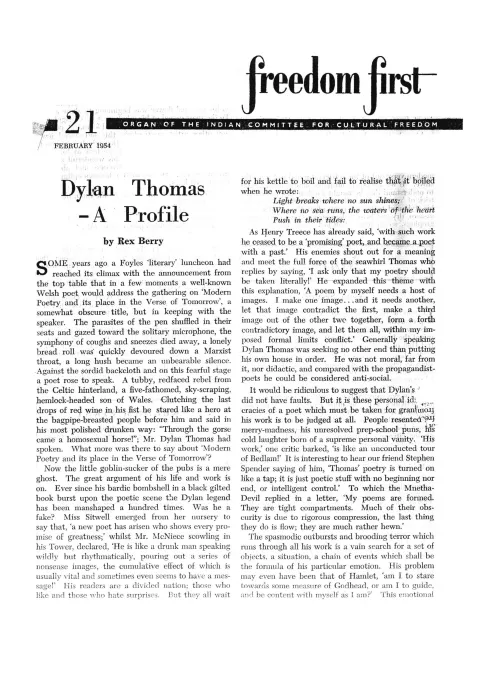
periodical issue
Freedom First
By Dr. Sampurnanand, Rex Berry, Kobita Sarkar, Professor Harold H. Fisher, Prabhakar Padhye, R.H.
printed & published by Prabhakar Padhye at The Kanada Press, 109 Parsi Bazaar Street, Bombay 1 · Bombay · 1954
12 pages
Freedom First
Summary
This is Issue No. 23 (April 1954) of Freedom First, the monthly bulletin of the Indian Committee for Cultural Freedom (edited by Faiz S. Noorani). In the rendered pages the issue opens with Dr. Sampurnanand’s essay on the spiritual and moral vacuum he sees underlying Indian society’s vulnerability to communism, followed by an unsigned Notes section covering domestic politics (the Kerala election results, a challenge to the CPI over the ‘Communist Conspiracy at Madurai’ documents), colonial affairs (Goa, Kenya), and the decline of Senator McCarthy in the US. Cultural criticism follows: Rex Berry’s profile-essay on Ernest Hemingway and Kobita Sarkar’s survey of directorial ‘style’ in world cinema. Professor Harold H. Fisher contributes the second installment of an analysis of Soviet colonialism, arguing that satellite states and foreign Communist parties constitute new forms of colony. The issue also carries the American Committee for Cultural Freedom’s ‘Ethics of Controversy’ statement (a response to McCarthyist rhetoric), I.C.C.F. organisational news, book reviews (including Prabhakar Padhye on Klaus Mehnert’s Stalin Versus Marx and an unsigned review of Kathleen Nott’s The Emperor’s Clothes), brief book notices, a reader letter reproducing the Tribune’s retraction of allegations against the Democratic Research Service, and a closing page of quoted press excerpts (‘With Many Voices’). The volume’s argumentative center, in the rendered pages, is anti-Communist cultural and political criticism combined with reflection on India’s own social and spiritual condition.
Key points
-
Dr. Sampurnanand’s essay argues India’s vulnerability to Communism stems from a spiritual and moral vacuum, criticising the confusion of secularism with the absence of any faith and calling Gandhi the last to have successfully revived an authentically Indian philosophy of life.
-
The “Notes” section reports Professor S. N. Agarwal’s challenge to the CPI to prove the “Communist Conspiracy at Madurai” documents forged, frames the Travancore-Cochin election as a defeat for Communist-aligned forces, and welcomes Senator McCarthy’s political decline as proof democracies cannot fight totalitarianism with totalitarian methods.
-
Rex Berry’s “Hemingway—The Strange Old Man” satirically portrays Hemingway’s public “tough guy” persona against his private, churchgoing side.
-
Kobita Sarkar’s “Style In The Cinema” surveys national cinematic traditions and profiles directors including Chaplin, Hitchcock, Orson Welles and the Italian neorealists as exemplars of personal directorial style.
-
Professor Harold H. Fisher’s “Three Kinds Of Communist Colonies—II” argues foreign Communist parties constitute a distinct “third type” of colony more tightly controlled than traditional national colonies, and predicts Chinese Communism will eventually strain against Soviet dominance.
-
The issue reproduces the American Committee for Cultural Freedom’s “Ethics Of Controversy” statement deploring McCarthyist trends, listing ten standards of ethical public discourse.
-
Prabhakar Padhye reviews Klaus Mehnert’s “Stalin Versus Marx,” tracing twelve elements by which Stalin revised Marxist doctrine, while a review of Kathleen Nott’s “The Emperor’s Clothes” defends liberal humanism against neo-scholastic Catholic critics.
Essays
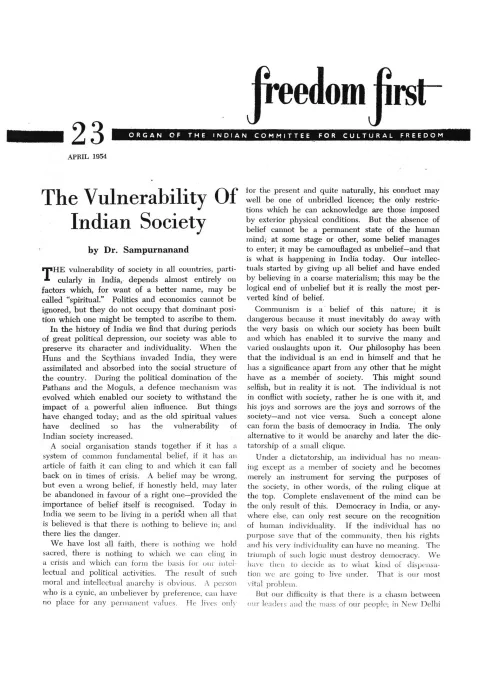
The Vulnerability Of Indian Society
By Dr. Sampurnanand
Dr. Sampurnanand argues that Indian society’s vulnerability stems from the erosion of the ‘spiritual’ beliefs that historically let it absorb political shocks (Huns, Scythians, Pathans, Moguls) without losing its character. He contends that contemporary India has confused secularism with the absence of any faith, producing a corrosive cynicism among the educated classes that is spreading to the masses, and that this moral vacuum leaves the country exposed to communism, which he calls a dangerous ‘belief’ precisely because it denies the individual’s significance apart from society. He contrasts a democratic philosophy that treats the individual as an end in himself with the alternative of dictatorship, in which the individual becomes a mere instrument of the ruling clique. He also criticizes the cultural gap between New Delhi’s Westernised leadership and the rest of India, and closes by calling for a revival of a genuinely Indian philosophy of life adapted to modern conditions, citing Gandhi as the last person to have attempted this successfully.
- Argues India’s social vulnerability is rooted in spiritual/moral factors more than political or economic ones
- Historically Indian society absorbed foreign political domination (Huns, Scythians, Pathans, Moguls) without losing its character, because it held a common fundamental belief
- Today’s crisis is a loss of all belief, producing cynicism and a ‘moral and intellectual anarchy’
- Frames Communism as a dangerous belief because it denies the individual any significance apart from society
- Argues democracy in India can rest only on recognition of human individuality; dictatorship reduces the individual to an instrument of the ruling clique
- Criticizes New Delhi’s leadership as culturally foreign/transplanted and out of touch with Indian tradition, wrongly equating secularism with contempt for religion
- Calls for reviving an authentically Indian philosophy of life, citing Gandhi as the last to have translated it into practical terms
Notes (Agarwal’s Challenge to C.P.I.; Travancore-Cochin; Terror In Goa; Light in Kenya; Exit McCarthy?)
An unsigned editorial Notes section covers five items: a challenge by Professor S. N. Agarwal (General Secretary of the AICC) demanding the Communist Party of India either prove in court that the ‘Communist Conspiracy at Madurai’ documents are forged or accept the charge of subverting the Indian Constitution; commentary on the Travancore-Cochin election results as a defeat for Communist-aligned forces and a call for clean, non-doctrinaire democratic governance; condemnation of Portuguese repression in Goa, citing the arrest and deportation of Dr. Gaitonde; cautious approval of Oliver Lyttleton’s proposals for multi-racial government in Kenya; and a piece welcoming Senator Joseph McCarthy’s apparent political decline as vindicating the argument that democracies cannot fight totalitarianism with totalitarian methods.
- Professor S. N. Agarwal challenges the CPI to prove in court that the Madurai conspiracy documents are forged, or accept responsibility
- Frames the Kerala/Travancore-Cochin election result as a victory of democratic over Communist forces, urging clean governance rather than doctrinaire anti-communism
- Criticizes Portuguese colonial rule in Goa as tyrannical, citing the arrest and deportation of Dr. Gaitonde
- Welcomes Oliver Lyttleton’s Kenya proposals as a step toward multi-racial government, while noting they fall short of full multi-racial rule
- Frames McCarthy’s decline as proof that totalitarian methods cannot be used to fight totalitarianism without endangering democracy itself
Hemingway—The Strange Old Man
By Rex Berry
Rex Berry’s essay, framed as an extract from an ‘unwritten novel’ based on obituary notices following a false report of Ernest Hemingway’s death, is a satirical-affectionate portrait of the writer’s public persona: the hard-drinking, adventure-seeking ‘tough guy’ image versus the private man who attends Mass, quotes Scripture, and reportedly has superstitions about black cats and Fridays. Berry surveys how other writers assess Hemingway’s stature, quoting Arthur Koestler’s claim that Hemingway is ‘the greatest writer living today’ and John O’Hara’s assertion that he is ‘the outstanding author since the death of Shakespeare,’ while noting the exaggeration in both claims given contemporaries like Mann, Eliot, Shaw, and Faulkner. The piece closes (continued on p.4) with reflections on The Old Man and the Sea as possibly Hemingway’s definitive, final statement.
- Frames itself as an extract from an unwritten novel based on obituary notices after a false Hemingway death report
- Contrasts Hemingway’s public ‘tough guy’ image (fishing, shooting, drinking, fighting) with a more private, superstitious, churchgoing side
- Surveys other writers’ assessments of Hemingway’s literary stature, including Koestler and O’Hara’s outsized claims
- Discusses The Old Man and the Sea as possibly Hemingway’s ‘last word’
Style In The Cinema
By Kobita Sarkar
Kobita Sarkar surveys ‘style’ in world cinema, defined as an individualistic, distinctive directorial imprint on a film. She characterizes national cinemas (American technical polish, British reliance on story, French suavity and poetic quality, Italian realism, Swedish atmosphere, Russian ideological colouring, German solidity, Japanese blending of Western and Oriental modes, and India’s emphasis on quantity over originality), then discusses individual directors — Chaplin, Capra, Preston Sturges, de Mille, Hitchcock, Orson Welles, John Ford, John Huston, Robert Rossen, Carl Dreyer, Marcel Carne, Carol Reed, and various Italian directors including Rossellini, Blasetti, and de Sica — as examples of how a director’s personal vision shapes a film’s total effect, sometimes independent of story material or acting.
- Defines cinematic ‘style’ as an individualistic or distinctive manner of self-expression, mainly attributable to the director
- Surveys national cinema characteristics: American technical polish, British story-reliance, French suavity/poetry, Italian realism, Swedish atmosphere, Russian ideological colouring, Japanese East-West blending, India’s quantity over quality
- Profiles individual directors as exemplars of personal style: Chaplin, Capra, Preston Sturges, de Mille, Hitchcock, Orson Welles, John Ford, John Huston, Robert Rossen
- Discusses Italian directors (Rossellini, Blasetti, de Sica) as inconsistent but often original
- Concludes that when a director’s style is sufficiently original, it dominates the finished product regardless of who else contributes to the film
Three Kinds Of Communist Colonies—II
By Professor Harold H. Fisher
In the second installment of his analysis, Professor Harold H. Fisher argues that the Communist bloc has produced a distinct ‘third type’ of colony: Communist parties operating within other countries, which are more tightly controlled and ideologically submissive to Moscow than traditional national colonies, and which work to replace their own governments with Soviet-modelled ones. He traces the shift in Communist theory from expecting revolution in advanced industrial countries to targeting underdeveloped countries as capitalism’s ‘weakest links,’ quotes Stalin on the selective logic of supporting secession only where it serves Soviet interests, and describes Communist tactics of denouncing former nationalist allies (citing Nehru as an example) as having become tools of imperialism. He concludes that Chinese Communism will likely generate its own colonialism and eventually strain against Soviet dominance, and that the free world’s defense of liberty must be paired with a genuine commitment to equality and international cooperation to be persuasive to non-aligned and newly independent peoples.
- Argues Communist parties abroad constitute a ‘third kind’ of colony, more tightly controlled than traditional national colonies and dedicated to installing Soviet-modelled governments
- Communist theory shifted from expecting revolution in advanced countries to targeting underdeveloped ‘weakest links’ of world capitalism
- Quotes Stalin’s selective logic on secession, supporting it for India/Arabia/Egypt but opposing it for regions bordering Russia
- Describes Communist tactics of denouncing former nationalist leaders (e.g. Nehru) as having ‘turned’ toward imperialism once in power
- Predicts Chinese Communism will develop its own colonialism and eventually chafe against Soviet primacy
- Argues that championing liberty against Soviet colonialism must be paired with genuine commitment to equality and international cooperation to persuade newly independent, non-aligned peoples
Ethics Of Controversy
This unsigned piece reproduces the American Committee for Cultural Freedom’s March 4, 1954 statement deploring McCarthyist trends in American political discourse, signed by figures including James T. Farrell, Arthur Koestler, John Steinbeck, Reinhold Niebuhr, Sidney Hook, and others, and lists ten standards of ‘ethical controversy’ the Committee urges public figures to observe (e.g., criticism should target policies rather than personal motives, admit gaps in knowledge, and never refuse discussion). It is followed by I.C.C.F. News reporting on M. R. Masani’s and Prabhakar Padhye’s visits to Madras, Delhi, Patna, Lucknow, Calcutta, and Nagpur to build the Committee’s membership and deliver lectures, including Masani’s lecture on ‘The Social Significance of Bhoodan.’
- Reproduces the ACCF’s March 4, 1954 statement against McCarthyist trends in American public discourse, signed by prominent anti-Communist writers and scholars
- Lists ten standards of ‘ethical controversy,’ including directing criticism at policies not persons, admitting uncertainty, and never refusing discussion
- Announces an ACCF forum on ‘The Ethics of Controversy’ on April 8 featuring Sidney Hook, W. H. Auden, Daniel Bell, Henry Hazlitt, and Will Herberg
- Reports M. R. Masani’s visits to Madras, Delhi, and Patna, including a lecture on ‘The Social Significance of Bhoodan’
- Reports Prabhakar Padhye’s organisational visits to Delhi, Lucknow, Patna, Calcutta, and Nagpur to expand I.C.C.F. membership
I.C.C.F. News
This review section carries two book notices. Prabhakar Padhye reviews Dr. Klaus Mehnert’s Stalin Versus Marx, praising its detailed tracing of twelve elements by which Stalin revised Marxist doctrine, and framing Stalin’s ambition to establish ‘intellectual eminence’ alongside his organisational power as rooted in an inferiority complex relative to more intellectually accomplished Bolshevik colleagues. An unsigned review (initialled R.H.) covers Kathleen Nott’s The Emperor’s Clothes, describing it as a defence of liberal and humanistic philosophy against neo-scholastic claims that humanism is a prideful, doomed philosophy, and summarizing Nott’s critique of T. S. Eliot, Graham Greene, Dorothy Sayers, and C. S. Lewis for what she sees as dogmatic Catholic orthodoxy.
- Padhye’s review of Mehnert’s Stalin Versus Marx traces twelve elements by which Stalin revised Marxist doctrine, including ‘Socialism in One Country’
- Argues Stalin’s drive to establish ‘intellectual eminence’ stemmed from an inferiority complex relative to more intellectually accomplished Bolshevik colleagues like Trotsky
- The Emperor’s Clothes review frames Kathleen Nott’s book as a defence of liberal humanism against a neo-scholastic claim that post-Enlightenment humanism is prideful and doomed
- Summarizes Nott’s attack on T. S. Eliot, Graham Greene, Dorothy Sayers, and C. S. Lewis as proponents of dogmatic Catholic orthodoxy
- The reviewer questions whether Nott’s charge that dogmatic abstractions are ‘special poison’ to charitable, aware artists holds up against counter-examples like Dante and Van Eyck
Review: Stalin Versus Marx (Dr. Klaus Mehnert)
By Prabhakar Padhye
‘Books In Brief’ offers short notices on Edith Sitwell’s Gardeners and Astronomers, a study of De Sade’s Selected Writings edited by Leonard de Saint-Yves, J. P. Stern’s study of Ernst Junger, Francoise Mallet’s novel Into the Labyrinth, and John Ruskin’s collected letters to Kathleen Olander published as The Gulf of Years. This is followed by a reader letter from Shankar Shetty, Secretary of the Democratic Research Service, reproducing in full the London Tribune’s unconditional retraction and apology (dated March 5, 1954) for its earlier article alleging the Democratic Research Service was Communist-linked and U.S.-funded.
- Brief notices cover Edith Sitwell, a De Sade selected-writings volume, a study of Ernst Junger, Francoise Mallet’s Into the Labyrinth, and Ruskin’s letters to Kathleen Olander
- Reader letter from Shankar Shetty reproduces the Tribune’s March 5, 1954 retraction of its ‘U.S. Spies in India’ allegations against the Democratic Research Service
- The Tribune’s retraction confirms the Democratic Research Service received no USIS funding and was not Communist-run, and states it is ‘strongly opposed to McCarthyism’
Review: The Emperor’s Clothes (Kathleen Nott)
By R.H.
‘With Many Voices’ is a closing column of quoted press excerpts under a Tennyson epigraph, gathering remarks from Indian and international newspapers on communism, democracy, and current affairs from February-March 1954 — including comments from Nehru, S. N. Agarwal, Woodrow Wyatt, Syngman Rhee, and M. S. M. Sharma (who credits M. R. Masani’s ‘refreshing habit of calling a spade a spade’ for endearing him to Mahatma Gandhi and for his work founding the Indian Committee for Cultural Freedom).
- Compiles quoted remarks from Indian and Western press (Times of India, Searchlight, Bombay Sentinel, etc.) from February-March 1954
- M. S. M. Sharma credits M. R. Masani’s plainspokenness for endearing him to Mahatma Gandhi and for founding the I.C.C.F.
- Woodrow Wyatt, Labour M.P., is quoted twice warning against cooperation between democratic socialists and Communists
- Includes Nehru’s remarks on Delhi not being representative of India and on India’s role in Sudan’s independence
- Closes the issue; masthead notes it is edited by Faiz S. Noorani and printed by Prabhakar Padhye at The Kanada Press, Bombay
Generated by the v1.5 extraction pipeline. Awaiting editorial review.
Metadata and summary are AI-extracted from the source PDF and reviewed for editorial accuracy. The original work is available via the Read PDF tab above (where present); paragraph-level citation inside the PDF is deferred to a future engagement.