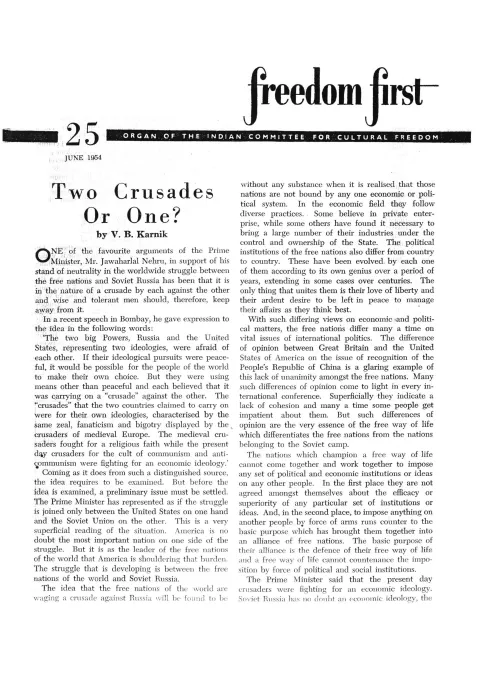
periodical issue
Freedom First
Organ of the Indian Committee for Cultural Freedom
printed & published by Prabhakar Padhye at The Kanada Press, 109 Parsi Bazaar Street, Bombay 1 · Bombay · 1954
12 pages
Freedom First
Summary
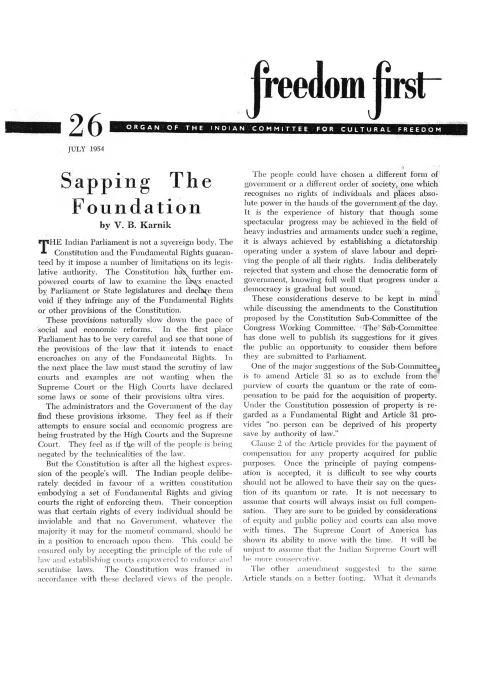
This is the complete July 1954 issue (No. 26) of Freedom First, the monthly bulletin of the Indian Committee for Cultural Freedom, edited by V. B. Karnik and printed/published by Prabhakar Padhye in Bombay. The issue opens with an unsigned lead editorial, “Sapping The Foundation” (by V. B. Karnik), criticising the Congress Working Committee’s proposed constitutional amendments to Article 31 as an executive encroachment on judicial review and the rule of law. A “Notes” section comments on the USSR’s re-admission to the ILO, Soviet obstruction at the UN over Indo-China, and a magistrate’s acquittal of artist Akbar Padmasee on an obscenity charge, alongside a note on the credibility of reports about a Soviet H-bomb setback. Two readers, Anant Kanekar and a contributor signing as “R”, respond to a prior article on “The Committee and America,” debating why well-meaning Indian intellectuals remain suspicious of the ICCF’s stance toward the U.S. despite deep historical ties between Indian and American reform traditions. Sophia Wadia contributes a rejoinder, “Aims And Activities Of P.E.N.,” defending the record and structure of the All-India P.E.N. Centre against a prior mischaracterisation. Yatim Ghaznavi reviews Albert Camus’s L’Homme Revolte (The Rebel) under the title “M. Camus And The ‘Crimes De Logique’,” assessing its reception and its argument against revolutionary violence. T. R. Fyvel’s “The Broken Dialogue” (abridged from Encounter) dissects a breakdown in Anglo-American conversation over the Harry Dexter White espionage case, using it to explore differing British and American senses of security since 1945. The issue closes with a book review section (an unsigned or initialled review of Scott Buchanan’s Essay in Politics by “G.D.P.” and Zafar Futehally’s review of A. Nevett’s India Going Red?), a “Books in Brief” column, ICCF/ACCF organisational news, and a back-page compilation of topical quotations, “With Many Voices.”
Key points
-
V. B. Karnik’s “Sapping The Foundation” criticises the Congress Working Committee’s proposed constitutional amendments to Article 31 as executive encroachment on judicial review of compensation and tribunal oversight.
-
Two readers debate why Indian intellectuals remain suspicious of the ICCF’s pro-Western stance despite historical India-US intellectual ties, one citing self-interested Western anti-communism, the other tracing warm ties from Vivekananda to the Indian Constitution’s debt to US jurisprudence.
-
Sophia Wadia’s “Aims And Activities Of P.E.N.” defends the All-India P.E.N. Centre’s record since its 1933 founding, citing its 1940 editorial defence of Nehru’s free speech while imprisoned.
-
Yatim Ghaznavi reviews Albert Camus’s “L’Homme Revolte” (The Rebel), summarising Camus’s argument that no philosophical precept can justify “crimes de logique” such as assassination and politically justified terrorism.
-
T. R. Fyvel’s “The Broken Dialogue,” abridged from Encounter, uses the Harry Dexter White espionage case to diagnose a broader Anglo-American perception gap over internal security since 1945.
Essays
Sapping The Foundation
By V. B. Karnik
V. B. Karnik’s lead editorial argues that the Indian Parliament is not a sovereign body because the Constitution’s Fundamental Rights and judicial review constrain it, and that this is by deliberate design of the framers rather than a defect. He criticises the Constitution Sub-Committee of the Congress Working Committee’s proposed amendments, especially the plan to exclude courts from reviewing the quantum of compensation paid under Article 31 for property acquisition, and the proposal to curb High Courts’ writ jurisdiction over tribunals. He frames these as attempts by the executive to escape judicial scrutiny rather than legitimate reform, arguing that constitutional change should expand rather than narrow the bounds of freedom.
- The Constitution’s Fundamental Rights and judicial review are deliberate checks the Indian people chose over unchecked majority rule.
- The Congress Working Committee’s Sub-Committee proposed excluding courts from reviewing compensation quantum under Article 31.
- A further proposal would exclude ‘tribunals’ from High Court and Supreme Court superintendence.
- The author argues these suggestions reflect distrust of an independent judiciary, which he calls essential to democracy.
- He also objects to proposals denying public servants judicial recourse against dismissal or rank reduction.
- The piece calls for constitutional changes to expand, not restrict, citizens’ rights and liberties.
Notes
No summary was extracted for this article. Listed for completeness.
The Committee And America
By Anant Kanekar; “R”
Two readers respond to Prabhakar Padhye’s earlier article “The Committee and America.” Anant Kanekar argues that suspicion of the ICCF among well-meaning Indian intellectuals arises because the democratic camp includes unattractive elements — British imperialists, French colonialists, and American business interests — who oppose communism for self-interested rather than principled reasons, making the West’s anti-totalitarian stance appear inconsistent. A second respondent, signing as “R”, counters by tracing a century of warm intellectual and institutional ties between India and the United States (Vivekananda, Har Dayal, Lajpat Rai, the Indian Constitution’s debt to U.S. jurisprudence) and laments that this goodwill has waned since 1947, with Indian media giving disproportionate space to criticism of U.S. foreign policy while ignoring America’s historical generosity and the U.S.S.R.’s failures on slave labour.
- Kanekar argues the ‘devil you know’ logic does not fully explain Indian suspicion of the ICCF’s pro-Western stance.
- He notes fascism was seen by many Indians as more hateful than imperialism during WWII, complicating Western moral framing.
- He points to a parallel suspicion among Asian Socialists, citing Dr. Lohia’s call for a more actively anti-imperialist approach.
- ‘R’ argues India-U.S. intellectual ties are deep and historically reciprocal, citing Vivekananda’s reception in America and U.S. influence on India’s constitution.
- ‘R’ criticizes the Indian press for disproportionate criticism of U.S. policy relative to praise of Moscow/Peking by visiting dignitaries.
- ‘R’ invokes the Spanish Civil War and Munich as cautionary historical analogies against appeasement-style ‘balancing of evils.‘
Essay 3
Sophia Wadia, responding to R. B. Joshi’s June 1954 Freedom First article on the P.E.N. Conference at Chidambaram, defends the All-India P.E.N. Centre’s record since its 1933 founding. She details its publications (Indian Writers in Council, The Indian Literatures of Today, Writers in Free India, an Indian Literatures Series), its monthly organ The Indian P.E.N. (in its 20th volume), and its roster of eminent regional-language writers as members. She disputes Joshi’s claim that the Centre ‘could easily serve as a link’ between regional literatures and the world body, arguing it is already doing so, and cites the Centre’s 1940 editorial defending Jawaharlal Nehru’s free speech when he was imprisoned as evidence of its commitment to the P.E.N.’s free-expression principles.
- The All-India P.E.N. Centre was founded in 1933 and has over 300 established-writer members.
- Its Constitution’s Preamble commits it to spreading appreciation of Indian literatures and serving cultural unity.
- It has published multiple conference proceedings and a dedicated Indian Literatures Series in English translation.
- Its monthly organ The Indian P.E.N. covers regional literatures, translations, reviews, and world P.E.N. news.
- Wadia cites the Centre’s 1940 defence of Jawaharlal Nehru’s imprisonment as proof of its free-speech commitment.
- She lists members representing Assamese, Bengali, Gujarati, Hindi, Kannada, Maithili, Marathi, Malayalam, Oriya, Panjabi, Tamil, Telugu, Sindhi, and Urdu literatures.
Aims And Activities Of P.E.N.
By Sophia Wadia
Yatim Ghaznavi reviews Albert Camus’s L’Homme Revolte, published in English as The Rebel, tracing its warm reception among some French critics (Sir Herbert Read, Emil Heuriot, Andre Billy) and its hostile reception among others, including Francis Jeanson in Les Temps Modernes and Jean-Paul Sartre, whose public break with Camus the review quotes. Ghaznavi summarises the book’s argument — that if Le Myth de Sisyphe asked whether suicide is justified, L’Homme Revolte asks whether murder, especially ‘crimes de logique’ like assassination and politically justified terrorism, can be justified — and concludes that Camus’s answer is no, urging a politics of moderation instead of revolutionary excess. The review notes the abridged English translation cut some of the book’s best passages ‘in interest of the economy’ and finds the work more interesting than good, weaker in history and logic than in style.
- The review situates L’Homme Revolte as a sequel in argument to Camus’s Le Myth de Sisyphe.
- Camus’s central claim: no philosophical precept can justify killing, whether personal or ‘crimes de logique’ like assassination and terrorism.
- The book’s implicit conservatism alienated the Left (Sartre, Jeanson) while gaining praise from the French Right.
- Ghaznavi criticizes the English abridgment (The Rebel) for cutting passages on Baudelaire and Lautremont for economy.
- Camus’s conclusion: rebellion must draw its inspiration from ‘the only system of thought which recognizes limits.’
- The review judges the book ‘neither very good nor very bad, but intelligent and interesting enough.‘
M. Camus And The ‘Crimes De Logique’
By Yatim Ghaznavi
T. R. Fyvel, in a piece abridged from Encounter, recounts a conversation between an American educationist and an English critic that broke down when the critic learned his American guest believed the espionage charges against former U.S. Treasury official Harry Dexter White, despite disliking the manner of the Republican attack on Truman. Fyvel uses the episode to diagnose a broader Anglo-American perception gap: Britain’s long-held sense of insular security was never as sharply shattered as America’s was by the atomic age and the rise of Soviet power after 1945, leaving Americans anxious about internal security in a way the British, comfortable in their post-imperial complacency, find hard to credit or take seriously.
- An English critic and American visitor’s amiable conversation collapsed over disagreement about the Harry Dexter White espionage case.
- The critic disliked the manner of McCarthy-style accusations to the point of general skepticism about any communism charge.
- Fyvel notes Hartley Shawcross’s parallel disclosure of Communist infiltration among British civil servants, handled quietly rather than as public controversy.
- Fyvel argues American loss of security dates from 1945 (atomic age, Soviet ascendance), unlike Britain’s shock in August 1914.
- The piece frames the White case as a genuine cause celebre given his key U.S. Treasury role from 1941-1946, including drafting the Morgenthau Plan.
- Fyvel closes noting no signs the British-American perception gap over internal security will close soon.
Generated by the v1.5 extraction pipeline. Awaiting editorial review.
Metadata and summary are AI-extracted from the source PDF and reviewed for editorial accuracy. The original work is available via the Read PDF tab above (where present); paragraph-level citation inside the PDF is deferred to a future engagement.