periodical issue
Freedom First
By V. B. Karnik, Yatim Ghaznavi, Nissim Ezekiel, R.V.L., A.K.W., R.H.
Edited by V. B. Karnik; printed & published by Prabhakar Padhye at The Kanada Press, 109 Parsi Bazaar Street, Bombay [address cut off] / Indian Committee for Cultural Freedom, 127 Mahatma Gandhi Road, Bombay 1 · Bombay · 1954
12 pages
Freedom First
Summary
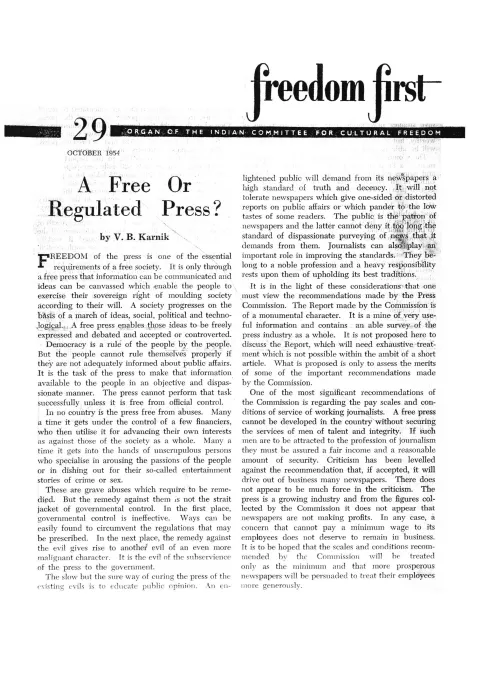
This is the October 1954 issue (No. 29) of Freedom First, the monthly bulletin of the Indian Committee for Cultural Freedom (affiliated to the World Movement for Cultural Freedom, later the Congress for Cultural Freedom), edited by V. B. Karnik and printed in Bombay. The issue opens with a lead article by Karnik assessing the Press Commission’s report and arguing against state regulation of newspapers in favour of press freedom policed by public opinion rather than law. An unsigned “Notes” section comments on a run of contemporary political and cultural events: Chinese agricultural collectivisation contrasted with Yugoslav decollectivisation, British Labour figures’ credulous visit to Moscow and Peking, the Special Marriage Bill then before Parliament, a Bhoodan land-distribution dispute between the Bombay government and Acharya Vinoba Bhave, a Delhi government seizure of an anti-communist pamphlet in Kashmir, the return of Viet-minh prisoners to communist custody after Geneva, the newly signed South-East Asia (Manila) collective-defence pact, the folding of John O’London’s Weekly, and a forthcoming visit to India by the poet Stephen Spender. Two literary and review pieces follow: Yatim Ghaznavi’s essay marking Arthur Rimbaud’s birth centenary, and Nissim Ezekiel’s review of Igor Gouzenko’s anti-Soviet novel The Fall of a Titan. A book-review section covers Czeslaw Milosz’s The Captive Mind, Lydia Kirk’s Postmarked Moscow, and several capsule reviews (“Books in Brief”), followed by a letter to the editor, notes on Congress for Cultural Freedom activities worldwide, and the issue closes with “With Many Voices,” a compilation of quoted press excerpts and remarks (Lenin, Nehru, Ambedkar, and others) on communism, neutrality, and Cold War politics. The volume’s argumentative center is anti-communist, pro-press-freedom classical liberalism, consistent with the Committee’s cultural-Cold-War orientation.
Key points
-
V. B. Karnik’s “A Free Or Regulated Press?” assesses the Press Commission’s report, endorsing improved journalists’ pay but rejecting extension of the Industries (Development and Regulation) Act to newspapers as the most objectionable route to government control.
-
The “Notes” section criticises Mao’s accelerated farm collectivisation even as Yugoslavia decollectivises, and welcomes the newly signed South-East Asia (Manila) collective-defence pact against Communist expansion.
-
Yatim Ghaznavi’s “Arthur Rimbaud: Le Voyant,” marking Rimbaud’s birth centenary, analyses “Le Bateau Ivre” as the archetype of his major themes and links his eventual poetic silence to a near-mystical sense that no expression suffices for absolute truth.
-
Nissim Ezekiel’s “Breaking The Human Spirit” reviews Igor Gouzenko’s novel “The Fall of a Titan,” a fictionalised account of Maxim Gorky’s disillusion with Communism, praising its “blandly prosaic” realism for conveying pervasive rather than dramatic fear.
-
R.V.L. reviews Czeslaw Milosz’s “The Captive Mind,” dwelling on Milosz’s concept of “Ketman,” outward conformity concealing inward resistance under Soviet-aligned regimes.
-
A.K.W. reviews Lydia Kirk’s “Postmarked Moscow” on daily Soviet life and the restricted conditions faced by Western diplomats in Moscow.
Essays
A Free Or Regulated Press?
By V. B. Karnik
V. B. Karnik’s lead article assesses the Report of the Press Commission and argues that while press abuses (sensationalism, ownership concentration, low pay for journalists) are real, the remedy of state regulation is worse than the disease. He supports the Commission’s recommendations on journalists’ pay scales but criticizes its price-page schedule proposal, its endorsement of continuing the Press (Objectionable Matters) Act, its plan for a government-created Press Council, and especially its suggestion that the Industries (Development and Regulation) Act be extended to newspapers, which he sees as opening the door to far-reaching government control. He invokes Thomas Jefferson’s dictum that press freedom is the foundation of all other freedoms and closes by urging public opinion, not law, as the proper check on press abuses.
- A free press is essential to democracy because it informs the people who must govern themselves.
- Press abuses exist everywhere but government control is an ineffective and dangerous remedy, creating subservience of the press to the state.
- The Press Commission’s recommendation on journalists’ pay and conditions is welcomed as a floor, not a ceiling.
- The price-page schedule recommendation (limiting pages relative to price) is well-intentioned but unlikely to work and revives a wartime scarcity measure for a different purpose.
- The proposal for a government-appointed Press Registrar to compile facts and figures is welcomed, provided its powers stay limited to information-gathering.
- Continuation of the Press (Objectionable Matters) Act and a new defamation-of-public-servants offence are criticized as unnecessary special penalties beyond ordinary law.
- Extending the Industries (Development and Regulation) Act to newspapers is called the most objectionable recommendation, since it would subject the press industry to close government control under the guise of statistics-gathering.
- India’s press industry (320 dailies, ~25 lakh circulation for 36 crore population) has vast room to grow, but growth depends on minimal state interference.
Notes (Carbon Copy; Purblind; Special Marriage Bill; Bombay Government and Bhoodan; Unwarranted Action; Lost Ground; A Beginning; John O’London’s Weekly; Stephen Spender’s Visit)
The unsigned “Notes” section is a set of short editorial commentaries. “Carbon Copy” criticizes Mao Zedong’s acceleration of agricultural collectivisation in China even as Yugoslavia dismantles collective farming, and mocks British Labour visitors (Attlee, Bevan) for naively praising Moscow and Peking, contrasting their credulity with an Indian socialist’s (Brajkishore Shastri) more clear-eyed account of Chinese press censorship in his book From My China Diary. “Purblind” continues by questioning who benefits from India’s move to cut cable press rates with China, suggesting it serves only Chinese propaganda interests, and notes a British/Australian book Planned Perfidy defending North Korean/Chinese conduct. Other notes cover the Special Marriage Bill (supported as a modest step for social progress against orthodox opposition, credited partly to the Prime Minister’s intervention), a dispute over the Bombay government’s Bhoodan land-distribution committees bypassing Acharya Vinoba Bhave, the Delhi government’s seizure of an anti-communist pamphlet on Kashmir without prosecution (“Unwarranted Action”), the forced return of Viet-minh prisoners to communist custody after their shipboard mutiny (“Lost Ground”), and the newly signed South-East Asia Defence (Manila) Pact, which the piece welcomes as a beginning of collective security against communist expansion in Asia, noting U Nu of Burma’s earlier warnings. The section closes noting the demise of John O’London’s Weekly and the upcoming Indian visit of poet Stephen Spender at the Committee’s invitation.
- Mao’s China is accelerating farm collectivisation even as Yugoslavia moves away from it, framed as evidence communism ‘learns nothing and forgets nothing.’
- British Labour visitors to Moscow/Peking (Attlee, Bevan) are criticized for naive, uncritical impressions contrasted with a more clear-eyed Indian account of Chinese press censorship.
- The piece questions the wisdom of India lowering cable rates with China, suspecting it serves only Chinese/Soviet propaganda interests.
- The Special Marriage Bill is endorsed as a modest, welcome step toward a common civil marriage law over orthodox religious objection.
- A Bhoodan land-redistribution dispute pits the Bombay government’s own committees against Vinoba Bhave’s movement.
- The Delhi government’s seizure of an anti-communist Kashmir pamphlet without prosecution is called a ‘gross violation of the freedom of press.’
- The forced repatriation of Viet-minh mutineer-prisoners to communist custody after the French capitulation at Geneva is described as a moral tragedy.
- The newly concluded South-East Asia (Manila) collective defence pact is welcomed as a beginning against communist aggression, though weakened by dropping explicit anti-communist wording from the draft.
Arthur Rimbaud: Le Voyant
By Yatim Ghaznavi
Yatim Ghaznavi’s essay, published on the centenary of Rimbaud’s birth, surveys critical approaches to Rimbaud’s poetry (Une Saison en Enfer, Les Illuminations, Le Bateau Ivre) and argues against reducing the poet to any single explanatory system. The essay traces how Symbolists, mystics, and Surrealists each claimed Rimbaud for their own purposes, discusses his relationship with Verlaine, and analyzes Le Bateau Ivre as the archetype containing all his later themes—departure, marvel, disillusion, and the wish to return to childhood. The piece closes (continued on page 10) surveying further critical positions (Fondane’s voyou, Riviere’s Catholic Rimbaud, Reneville’s Asiatic-mystic Rimbaud, Bousquet’s Swedenborgian Rimbaud) and reflects on the poet’s eventual silence as bound up with poetry’s own fatal approximation to the absolute.
- No single theory adequately explains Rimbaud; his major works reflect distinct moments of his development.
- Symbolists admired Rimbaud partly for the mystery of his life and abandonment of poetry at twenty, more than for direct affinity with his work.
- Surrealists later claimed Rimbaud as an investigator of the surreal, though his poetic method is described as more active and violent than their passive reliance on the subconscious.
- Le Bateau Ivre is analyzed as the archetype of Rimbaud’s whole body of work, containing his major themes and the arc from marvel through disillusion to a longing for return.
- Rimbaud’s eventual silence is linked to a near-mystical belief that for absolute truth there is no adequate literary expression.
- Critics disagree sharply on how to categorize Rimbaud (Catholic, pagan, Marxist, mystic), which the essay treats as evidence of his poetry’s irreducible ambiguity.
Breaking The Human Spirit (review of The Fall of a Titan by Igor Gouzenko)
By Nissim Ezekiel
Nissim Ezekiel reviews Igor Gouzenko’s novel The Fall of a Titan (Cassell, 18s.), written by the Soviet Embassy defector famous for exposing the Canadian spy network in 1945. Ezekiel finds the 680-page novel a convincing panoramic portrait of Soviet life built around the thinly-disguised story of Maxim Gorky’s disillusion with communism (fictionalised as the writer Gorin), and praises its blandly prosaic realism as more effective than the concentrated terror of Darkness at Noon because it conveys fear as an all-pervasive, everyday condition of Soviet society rather than a dramatic exception.
- The Fall of a Titan is Gouzenko’s fictionalised, thinly-disguised account of Maxim Gorky’s disillusion with and eventual destruction by Soviet communism.
- Ezekiel judges the novel’s realism ‘blandly prosaic’ but effective, conveying pervasive fear rather than concentrated terror.
- The novel is praised for organic unity and panoramic range despite its length and huge cast of characters.
- Women characters are singled out as particularly well realised, conveying dignity and tragic suffering.
Review: The Captive Mind by Czeslaw Milosz
By R.V.L.
The Review section opens with R.V.L.’s review of Czeslaw Milosz’s The Captive Mind (Secker & Warburg), praising it as a clinically accurate exposure of how Eastern European writers and intellectuals were seduced and coerced into ideological conformity under Soviet-imposed regimes. The review dwells on Milosz’s concept of ‘Ketman’ (outward conformity concealing inward resistance, borrowed from Persian Islamic heretics) and quotes extensively on the psychological mechanisms of capitulation, before noting the book is at times overlong and would benefit from trimming into a sharper pamphlet. A.K.W. then reviews Lydia Kirk’s Postmarked Moscow, the journal of the wife of the American ambassador to Russia (1949-1952), describing it as unoriginal in substance (forced labour, low living standards, restricted diplomatic contacts) but vivid in everyday detail, illustrating the tension between Western democratic and Soviet authoritarian worlds.
- The Captive Mind is praised as a clinically precise account of how corruption, degradation, and subtle conversion bring East European intellectuals to heel under Soviet-aligned regimes.
- Milosz’s concept of ‘Ketman’ describes a system of outward conformity that lets individuals privately preserve a domain of freedom and resistance under totalitarian conditions.
- The review criticizes uncritical Western emigre and propaganda responses to captive-country intellectuals as misdirected and harmful.
- The reviewer suggests the book, though excellent, is overlong and would work better condensed into a sharper pamphlet form.
- Postmarked Moscow is judged unoriginal but valuably detailed on daily Soviet life and the restricted, tense conditions faced by Western diplomats in Moscow.
Review: Postmarked Moscow by Lydia Kirk
By A.K.W.
Capsule reviews under ‘Books in Brief’ (signed R.H.) cover H. W. Belmore’s Rilke’s Craftsmanship (criticized as repetitive and insufficiently insightful), Nancy Mitford’s Madame de Pompadour (dismissed as poor history and gushily feminine writing), Wyndham Lewis’s Self Condemned (found less impressive than its dust-jacket praise suggests), George Simenon’s Strangers in the House (praised for Flaubertian irony), and Par Lagerkvist’s The Eternal Smile and Other Stories, noting Lagerkvist’s self-description as ‘a believer without faith—a religious atheist.’ This is followed by a Letter to the Editor referencing an appreciative citation of V. B. Karnik’s June Freedom First article on Nehru’s non-alignment doctrine in the Swiss Review of World Affairs, C.C.F. News reporting scholarships for exiled Eastern European students, the founding of the Mexican Committee for Cultural Freedom, a Congress for Cultural Freedom conference in Santiago de Chile, and a forthcoming Beacon Press book on McCarthy and the Communists.
- Several capsule book reviews cover Rilke criticism, a Pompadour biography, Wyndham Lewis’s novel, Simenon, and Nobel laureate Par Lagerkvist.
- A letter to the editor cites praise in the Swiss Review of World Affairs for V. B. Karnik’s earlier Freedom First critique of Nehru’s non-alignment policy.
- C.C.F. News reports scholarships granted to eight exiled Eastern European students for a seminar on the ‘Situation and Tasks of the European East.’
- The Mexican Committee for Cultural Freedom was formally inaugurated in August 1954, addressed by Salvador Azuelz of the University of Mexico.
- A Congress for Cultural Freedom conference was held in Santiago de Chile with delegates from Chile, Mexico, Cuba, Honduras, and Uruguay.
Books In Brief (Rilke’s Craftsmanship; Madame de Pompadour; Self Condemned; Strangers In The House; The Eternal Smile and other stories)
By R.H.
“With Many Voices” closes the issue with a compilation of quoted excerpts from newspapers, journals, and public figures on communism, neutrality, and Cold War alignment, drawn from sources including the New York Times, Encounter, Times of India, Current, Mysindia, Hindustan Times, Janata, Free Press Bulletin, and Nippon Times, dated August-September 1954. Quoted figures include Lenin (on the acceptable cost of achieving worldwide communism), Nehru critic Aneurin Bevan, William Stenson, Dodds Parker, Raja Hutheesing, and Dr. Ambedkar, among others, illustrating a range of contemporary opinion on Soviet and Chinese communism, non-alignment, and coexistence.
- A compilation of quotations from the international and Indian press on communism, neutrality, and Cold War politics, dated August-September 1954.
- Includes a Lenin quotation (via Encounter) on the acceptability of mass loss of life if the surviving quarter of humanity were communist.
- Includes Dr. Ambedkar’s remark, quoted in The Examiner, likening communism to a ‘forest fire’ that made Indian talk of coexistence untenable.
- Includes commentary on Nehru’s cultural diplomacy toward China and Russia contrasted with Congress ministers’ anti-communist rhetoric domestically.
Generated by the v1.5 extraction pipeline. Awaiting editorial review.
Metadata and summary are AI-extracted from the source PDF and reviewed for editorial accuracy. The original work is available via the Read PDF tab above (where present); paragraph-level citation inside the PDF is deferred to a future engagement.