periodical issue
Freedom First
Organ of the Indian Committee for Cultural Freedom
By Guy J. Pauker, Yatim Ghaznavi, Aziz Madni, R.H., Laeeq Futehally, P. Lal, L. R. Radhakrishnan
printed & published by Prabhakar Padhye at The Kanada Press, 109 Parsi Bazzar Street, Bombay 1 · Bombay · 1955
10 pages
Freedom First
Summary
This is issue No. 36 of Freedom First (May 1955), the monthly bulletin of the Indian Committee for Cultural Freedom, edited by V. B. Karnik. The issue’s argumentative center is an unsigned editorial, ‘Towards A Communist Pattern?’, which attacks the composition of Prime Minister Nehru’s Second Five Year Plan drafting team under Prof. P. C. Mahalanobis, alleging it is dominated by economists from Iron Curtain countries and fellow-travellers, and warns that the plan’s ‘physical approach’ to planning will produce a ‘highly centralised totalitarian kind of planning’ modelled on Soviet Russia, with attendant threats to property rights and the rule of law. Guy J. Pauker contributes a sharply critical profile of K. M. Panikkar as an intellectual opportunist who tailors his historical writing to please shifting patrons and audiences, abridged from World Politics. Yatim Ghaznavi writes a literary-critical essay, ”Literature And Belief”, on the erosion of imaginative and religious sensibility in twentieth-century fiction and criticism. The reviews section covers Max Beloff’s Soviet Policy in the Far East, a Ford Foundation report on its India-supported activities, and Ignazio Silone’s novel A Handful of Blackberries. The issue also carries letters to the editor, a report on Justice U Chan Htoon’s visit to Bombay under ICCF auspices, brief CCF News items, and the recurring ‘With Many Voices’ column of quoted press excerpts.
Key points
-
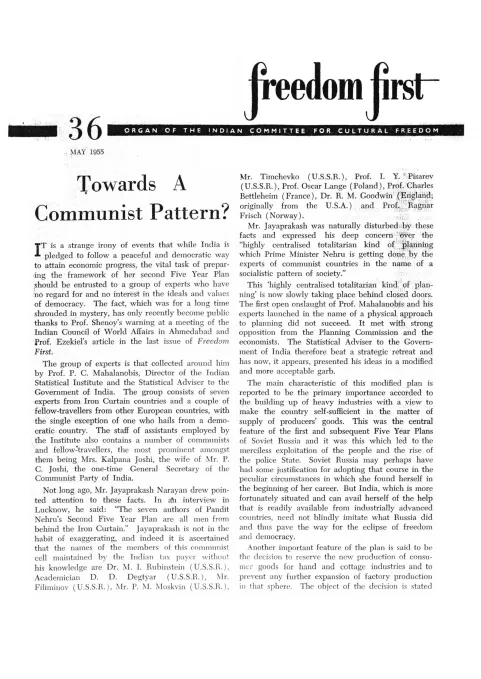
The unsigned editorial ‘Towards A Communist Pattern?’ alleges the Second Five Year Plan’s drafting team under Mahalanobis is dominated by Iron Curtain economists, quoting Jayaprakash Narayan’s charge that its ‘seven authors… are all men from behind the Iron Curtain,’ and criticises V. K. R. V. Rao’s proposed National Labour Force as a possible precursor to forced labour.
-
Guy J. Pauker’s essay ‘Sardar Panikkar — A Gifted Opportunist,’ abridged from World Politics, portrays K. M. Panikkar as an opportunist whose Asia and Western Dominance was written to flatter Asian audiences seeking to accommodate Soviet and Chinese power, quoting Nehru’s remark that Panikkar ‘will be Communist in Peking and a champion of freedom in Washington.’
-
Yatim Ghaznavi’s essay ‘Literature And Belief’ argues twentieth-century fiction suffers an ‘erosion of the imaginative soil’ as science and psychoanalysis annex territory once held by religion, finding even Graham Greene and Evelyn Waugh incapable of ‘full-blooded doubt.’
-
Reviews cover Max Beloff’s Soviet Policy in the Far East (Aziz Madni), a Ford Foundation report on its India-supported activities (R.H.), and Ignazio Silone’s novel A Handful of Blackberries about a disillusioned Italian communist party worker (Laeeq Futehally).
-
Letters to the editor debate Dr. Kalidas Nag’s foreword to a poetry translation and propose forming ‘The Friends of Democratic Nations’ to counter communist propaganda domestically.
-
A news report describes Justice U Chan Htoon of Burma’s Supreme Court touring Bombay under I.C.C.F. auspices, linking Buddhist revival in Burma, Thailand and Ceylon to resistance against communism and materialism.
-
C.C.F. News notes the Italian Association for Cultural Freedom’s Rome meeting and a Hamburg lecture series including Siegfried Landshut on ‘Karl Marx in our Time.’
-
‘With Many Voices’ closes with quotations from Lal Bahadur Shastri and Master Tara Singh on communism, alongside the ICCF membership enrolment form and the masthead naming editor V. B. Karnik and printer Prabhakar Padhye.
Essays
Towards A Communist Pattern?
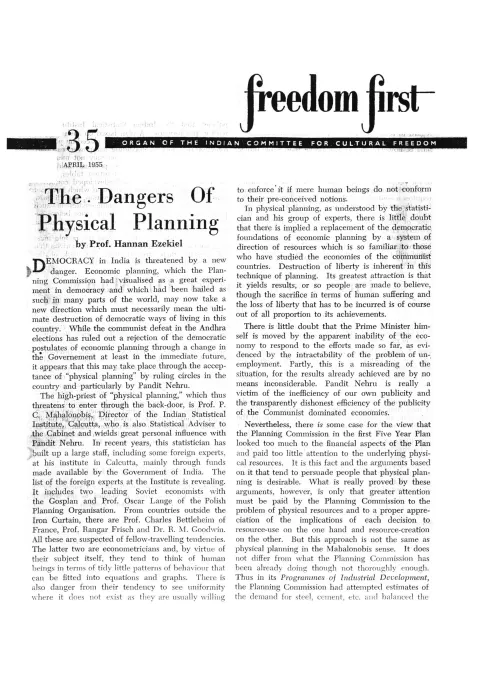
This unsigned editorial argues that India’s Second Five Year Plan is being shaped behind closed doors by a team of experts under Prof. P. C. Mahalanobis that is heavily weighted toward economists from communist and fellow-traveller backgrounds, citing Jayaprakash Narayan’s warning that ‘the seven authors of Pandit Nehru’s Second Five Year Plan are all men from behind the Iron Curtain.’ It traces the ‘physical approach’ to planning to a working paper by the French communist economist Charles Bettleheim, which called for very high forced investment rates and predicted a doubling of national income, and argues this model requires rigid labour and resource control that is incompatible with a free society. The piece further criticizes Prof. V. K. R. V. Rao’s proposal for a National Labour Force of one to two million persons operating under ‘semi-military discipline’ as a possible precursor to forced-labour camps, and links these planning trends to recent constitutional amendments removing compensation questions from judicial review, which the editorial says has effectively nullified the fundamental right to property. It closes by acknowledging Nehru’s own declarations that India would not sacrifice democratic institutions for economic progress, but warns that the drift of planning may nonetheless carry the country toward centralised totalitarianism.
- Alleges the Second Five Year Plan’s expert drafting team, under Mahalanobis, is dominated by economists from Iron Curtain countries plus a few Western fellow-travellers
- Cites Jayaprakash Narayan’s charge that the plan’s authors are ‘all men from behind the Iron Curtain’
- Attributes the ‘physical approach’ to planning to Charles Bettleheim’s working paper proposing 10.8% and 15.3% investment rates for the second and third plans
- Warns that rapid heavy-industry-focused industrialisation historically required Soviet-style coercion of labour and suppression of living standards
- Criticizes V. K. R. V. Rao’s proposed National Labour Force (1-2 million workers under ‘semi-military discipline’) as a possible precursor to forced labour
- Argues recent constitutional amendments on compensation have effectively nullified the fundamental right to property by removing judicial review
- Quotes Nehru’s own assurances that India will not sacrifice democratic institutions, while warning that planners’ ‘craze for rapid industrialisation’ may override such sentiments
Sardar Panikkar—A Gifted Opportunist
By Guy J. Pauker
Guy J. Pauker’s essay, abridged from World Politics (October 1954), portrays K. M. Panikkar as a career opportunist whose scholarly writing has consistently tracked and served his shifting positions in public life, from service to Indian princely states (Patiala, Bikaner) to his ambassadorial role in Communist China. Pauker traces Panikkar’s admiring 1930 biography of Maharaja Gulab Singh, in which Panikkar praised the Maharaja’s willingness to use ‘tricks and stratagems,’ as consistent with a Machiavellian reading of ancient Hindu political theory. He then turns to Panikkar’s 1953 book Asia and Western Dominance, arguing it is best understood not as objective history but as a purposive rewrite crafted to flatter a particular Asian audience craving justification for accommodating Soviet and Chinese power, citing his treatment of colonial ‘barbarism,’ the opium trade, and especially his soft treatment of the Russian Revolution’s impact on Asia. Pauker cites Raja Hutheesingh’s report that Nehru himself remarked Panikkar ‘will be Communist in Peking and a champion of freedom in Washington so long as it takes Mr. Panikkar somewhere,’ and concludes that Panikkar is not a genuine communist but a ‘gifted opportunist’ who constructs the image of the communist bloc that ‘neutralist’ Asian intellectuals want to see.
- Frames Panikkar’s career as a pattern of scholarly works followed by advancement to corresponding positions of public power
- Cites Panikkar’s 1930 biography of Maharaja Gulab Singh praising the ruler’s use of ‘tricks and stratagems’ as consistent with a Machiavellian reading of Hindu political theory
- Argues Asia and Western Dominance (1953) was written to flatter an Asian audience seeking rationale for accommodating Soviet/Chinese power rather than as objective history
- Notes Panikkar’s restrained, non-Marxist treatment of the Russian Revolution’s impact on Asia, crediting it with ‘undermining’ Western domination
- Quotes Raja Hutheesingh’s report of Nehru’s remark that Panikkar will be ‘Communist in Peking and a champion of freedom in Washington’ depending on where it takes him
- Concludes Panikkar is not a communist but an opportunist constructing the image of the communist bloc that neutralist Asian intellectuals want to see
’Literature And Belief’
By Yatim Ghaznavi
Yatim Ghaznavi’s essay argues that twentieth-century creative writers face an ‘erosion of the imaginative soil,’ as territory once occupied by religious and metaphysical imagination has been progressively colonized by the natural sciences, psychology, and anthropology. He traces this shrinkage through philosophy’s narrowing from ‘the study of Reality’ to ‘the a priori study of language,’ through psychoanalytic criticism’s reduction of works like Hamlet to case-histories, and through the ‘pragmatic, social’ assessment of visual art as therapy. For writers of religious sensibility, Ghaznavi argues, this erosion forces a choice between aggressive unbelief, militant faith, or an eclectic humanism that abandons the belief-unbelief debate as unprofitable; he finds even self-consciously Catholic novelists like Graham Greene and Evelyn Waugh incapable of ‘full-blooded doubt.’ Drawing on Fr. Martin Jarrett-Kerr’s Studies in Literature and Belief, he discusses James Joyce’s own agonized relationship to the faith he abandoned, and closes by invoking Kafka’s observation that ‘whoever has faith cannot define it, and whoever has none can only give a definition which lies under the shadow of grace witheld.’
- Argues twentieth-century fiction suffers from an ‘erosion of the imaginative soil’ as science, psychology, and anthropology annex territory once held by religious/metaphysical imagination
- Traces the narrowing of philosophy from the study of Reality to empirical psychology to the a priori study of language
- Criticizes psychoanalytic literary criticism (e.g., of Hamlet) for reducing drama to case-history and finding this a diminishment of genius
- Argues the erosion forces the religious writer toward aggressive unbelief, militant faith, or a humanism that treats belief-unbelief as profitless
- Finds even committed Catholic novelists (Graham Greene, Evelyn Waugh) incapable of full-blooded doubt, lacking Donne’s ‘creative scepticism’
- Discusses Joyce’s unresolved relationship to the Catholic faith he abandoned, drawing on Fr. Jarrett-Kerr’s Studies in Literature and Belief
- Closes with Kafka’s remark on the impossibility of defining faith from either side of belief or unbelief
Reviews: Soviet Policy in the Far East (review of Max Beloff)
By Aziz Madni
A book-review page carrying three notices. Aziz Madni reviews Max Beloff’s Soviet Policy in the Far East (Oxford University Press), praising its lucid, well-documented, dispassionate account of Soviet policy from Yalta to San Francisco and quoting Beloff’s observations on the West’s difficulty countering the charge of ‘colonialism’ in resisting Soviet expansion in Asia. An unsigned review by ‘R.H.’ covers The Ford Foundation and Foundation Supported Activities in India, describing the Foundation’s post-1951 focus on hunger and rural development, and mildly suggesting it should also assist existing private agencies rather than operating solely through government-vetted programmes. Laeeq Futehally reviews Ignazio Silone’s novel A Handful of Blackberries (tr. Darina Silone), about a disillusioned former Communist Party worker in the Italian countryside, praising Silone’s ideas as more important than the somewhat ‘staccato’ English translation or the loosely woven plot.
- Aziz Madni praises Max Beloff’s Soviet Policy in the Far East for objectivity, documentation, and readability, calling it a ‘must’ for students of international affairs
- Quotes Beloff’s argument that Western powers were handicapped by their own history of colonialism in countering charges that anti-communism was a pretext for imperialism
- R.H.’s review of the Ford Foundation report describes the Foundation’s 1951 India entry amid famine and its focus on rural/social development programmes vetted with government
- R.H. suggests the Foundation should also support existing private agencies directly, not only government-recommended programmes
- Laeeq Futehally reviews Silone’s A Handful of Blackberries, summarizing its plot of a disillusioned communist party worker (Rocco) and his beloved Stella’s persecution by the party
- Futehally judges the novel’s ideas more compelling than its somewhat staccato translation or loose plotting
Reviews: The Ford Foundation and Foundation Supported Activities in India
By R.H.
Two letters to the editor. P. Lal of Calcutta defends Dr. Kalidas Nag against a prior reviewer’s (‘N.E.’) criticism of his foreword to Sochi Raut Roy’s poetry collection, arguing Nag’s role was to introduce new writers rather than act as a literary critic. L. R. Radhakrishnan of Bombay proposes forming an organisation, ‘The Friends of Democratic Nations,’ to educate Indians about democratic values and counter communist propaganda, inspired by contacts from Rangoon. A second letter, unsigned in the visible excerpt but addressing ‘Democratic Education,’ argues that anti-communist organisations like the ICCF neglect the more fundamental task of educating illiterate Indians in democratic principles, and criticizes the spread of cheap Soviet publications versus the neglect of popularising figures like Lincoln and Gandhi.
- P. Lal defends Dr. Kalidas Nag’s foreword to S. R. Roy’s poems against a charge of weak literary criticism, saying Nag’s aim was introducing new writers, not criticism
- A letter on ‘Democratic Education’ argues anti-communist groups neglect educating illiterate Indians in democratic principles, alongside criticizing communist propaganda distribution
- L. R. Radhakrishnan proposes forming ‘The Friends of Democratic Nations’ to disseminate democratic ideals domestically and abroad, inspired by contacts from Rangoon
- The letters reflect ICCF-aligned readers debating the practical scope of anti-communist cultural work in India
Reviews: A Handful of Blackberries (review of Ignazio Silone)
By Laeeq Futehally
A news report describes a four-day visit to Bombay by Justice U Chan Htoon, a judge of the Supreme Court of Burma and Buddhist leader, hosted by the Indian Committee for Cultural Freedom. He addressed ICCF members, Buddhist scholars, and a public reception, discussing the revival of Buddhism in Burma, Thailand, and Ceylon as a counter to communism and materialism, and reflecting on the recent Rangoon Conference on Cultural Freedom in Asia and its effect on clarifying the distinction between state neutrality and individual neutrality on communism. A short ‘C.C.F. News’ column follows with brief items: the Italian Association for Cultural Freedom’s annual meeting in Rome, an exhibition of 44 young European and American painters touring Rome, Brussels, and Paris under Congress for Cultural Freedom sponsorship, and a lecture series in Hamburg including a February talk by Professor Siegfried Landshut on ‘Karl Marx in our Time.’
- Justice U Chan Htoon of Burma’s Supreme Court visited Bombay for four days at ICCF’s invitation, addressing members, Buddhist scholars, and a public reception
- He linked the revival of Buddhism in Burma, Thailand, and Ceylon to resistance against communism and materialism
- He described the Rangoon Conference on Cultural Freedom in Asia as clarifying that state neutrality differs from individual neutrality on communism
- C.C.F. News reports the Italian Association for Cultural Freedom’s Rome meeting, a touring exhibition of 44 young painters, and a Hamburg lecture series including Siegfried Landshut on ‘Karl Marx in our Time’
Letters to the Editor: Dr. Kalidas Nag and S. R. Roy’s Poems
By P. Lal
The closing ‘With Many Voices’ column collects short quoted excerpts from newspapers and journals of March-April 1955, mostly criticizing communist rhetoric, Soviet/Chinese policy, and domestic Indian political commentary on planning, compensation, and party politics. Contributors quoted include Sal Tas, Lal Bahadur Shastri, C. Subramaniam, an Economist editorial, an Onlooker column in the Times of India, G. K. Reddy, Jan Sevak, Master Tara Singh, a People’s Daily editorial, Eugene Lyons, Salvador de Madariaga, Frank Anthony, N. C. Chatterjee, Jaipal Singh, and an Eastern Economist item on Mahalanobis. The page closes with an ICCF membership enrolment form and the masthead crediting V. B. Karnik as editor and Prabhakar Padhye as printer/publisher.
- Compiles brief press quotations from March-April 1955 critical of communist governance and rhetoric in Asia and Europe
- Includes domestic Indian political commentary on the Five Year Plan, compensation law, and party politics
- Quotes Lal Bahadur Shastri on Soviet passenger fares and Master Tara Singh on communism as his ‘chief enemy’
- Quotes an Eastern Economist line describing Mahalanobis as embodying ‘the mixed economy’
- Includes the ICCF membership enrolment form and the issue’s masthead crediting editor V. B. Karnik and printer/publisher Prabhakar Padhye
Generated by the v1.5 extraction pipeline. Awaiting editorial review.
Metadata and summary are AI-extracted from the source PDF and reviewed for editorial accuracy. The original work is available via the Read PDF tab above (where present); paragraph-level citation inside the PDF is deferred to a future engagement.