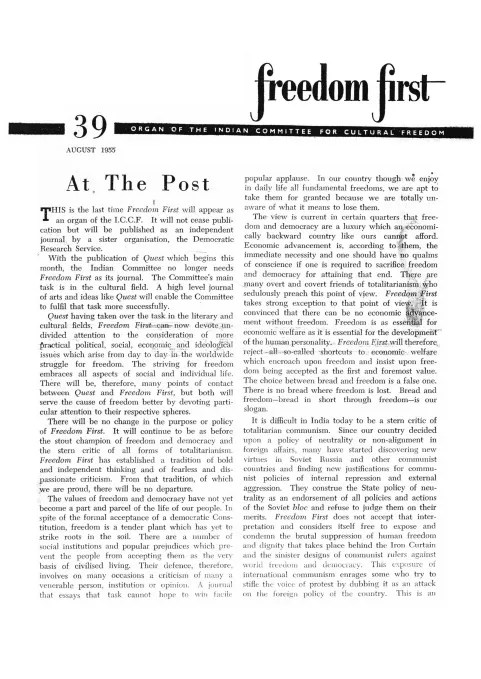
periodical issue
Freedom First
Edited, printed & published for the Democratic Research Service by V. B. Karnik at The Kanada Press, 109 Parsi Bazar Street, Bombay 1. · Bombay · 1955
12 pages
Freedom First
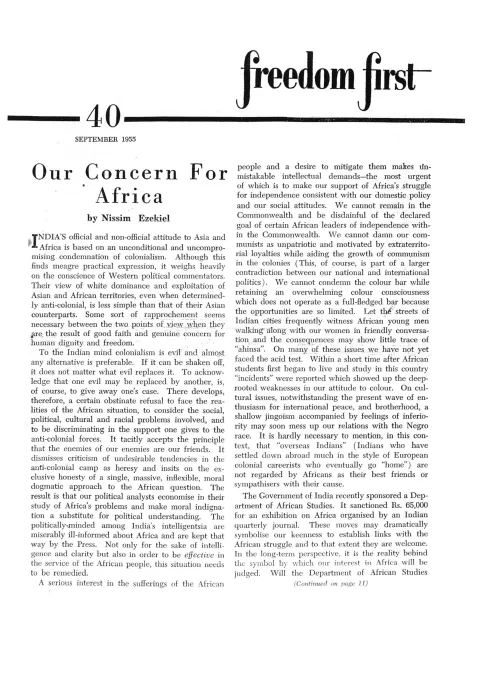
Summary
This is the complete twelve-page issue No. 40 of Freedom First (September 1955), a Bombay-based monthly published by the Democratic Research Service and edited/printed by V. B. Karnik. The issue opens with Nissim Ezekiel’s essay urging India to develop an informed, unsentimental policy toward Africa’s anti-colonial struggles rather than reflexive moral posturing, followed by an unsigned report (byline Zafar Futehally) previewing the Congress for Cultural Freedom’s international conference on “The Future of Freedom” in Milan. A substantial “Notes” section carries short editorial pieces on the right to travel and passport refusals, violence in Morocco and Algeria, the propriety of hartals and street demonstrations in a democracy, police reform following firings in Patna, and homage to those who died in the Goa liberation struggle. The issue’s two major essays are Edward Shils’s “Intellectuals and Politicians in America,” tracing the historical estrangement between American intellectuals and politicians from the Republic’s founding through McCarthyism, and the second installment of Arthur Koestler’s “The Trail of the Dinosaur,” a wide-ranging meditation on the balance of power between civilizational blocs and the long-term decline of religious faith since the Copernican revolution, reprinted from Encounter. The issue closes with a reader’s letter on the bread-versus-freedom debate, ICCF news notices, and the recurring “With Many Voices” column of quotations from contemporary public figures and newspapers.
Key points
-
Nissim Ezekiel’s ‘Our Concern For Africa’ argues India’s condemnation of colonialism substitutes moral indignation for genuine political understanding, pointing to Indians’ own persistent colour consciousness toward Africans living in India.
-
Zafar Futehally’s report previews the Congress for Cultural Freedom’s international conference on ‘The Future of Freedom’ in Milan (12-17 September 1955), naming attendees including Raymond Aron, J. K. Galbraith, Hayek and India’s M. R. Masani, B. R. Shenoy and Amlan Dutta.
-
A ‘Notes’ section questions arbitrary Indian passport refusals, condemns escalating violence in Morocco and Algeria, argues hartals are increasingly inappropriate against an elected government, reports Jayaprakash Narayan’s condemnation of the August 1955 Patna police firings, and honours Goa satyagrahis killed by Portuguese authorities.
-
Edward Shils’s ‘Intellectuals And Politicians In America’ traces the historical estrangement between American intellectuals and politicians from the Republic’s founding through McCarthyism, concluding the episode set back but did not reverse a century-long healing of the rift.
-
Arthur Koestler’s ‘The Trail of the Dinosaur — II’ examines the long-term decline of religious faith since the Copernican revolution, warning nuclear and bacteriological weapons will soon decide whether humanity ‘goes the way of the dinosaur.’
-
A letter from Prabhakar Padhye argues bread and freedom form a unity rather than a false dichotomy, pressing Freedom First to recognise ‘economic freedom’ as integral to its concept of liberty.
-
I.C.C.F. News reports the opening of the Congress for Cultural Freedom’s Asian office in New Delhi, headed by Padhye, and lectures by Kodanda Rao and Edward Shils.
-
‘With Many Voices’ quotes Eisenhower on never trading freedom ‘for the pottage of a false peace’ and communist leader P. Ramamurthi crediting Nehru’s foreign policy to Lenin’s thesis of peaceful co-existence.
Essays
Our Concern For Africa
By Nissim Ezekiel
Nissim Ezekiel argues that India’s official and popular attitude toward Africa is shaped by an uncompromising, undiscriminating condemnation of colonialism that substitutes moral indignation for genuine political understanding. He contends Indians are ill-informed about Africa’s actual social, political, and racial complexities, and that this incuriosity undermines India’s claimed solidarity with the African cause. He points to contradictions in Indian attitudes — professed anti-colonialism alongside a persistent colour consciousness toward Africans living in India — and questions whether the government’s new Department of African Studies and a state-sponsored Africa exhibition will produce serious scholarship or merely reinforce a simplified, self-congratulatory narrative.
- India’s political class shows an uncompromising condemnation of colonialism paired with poor factual knowledge of Africa
- The essay argues that treating ‘enemies of our enemies’ as automatic friends blocks honest appraisal of the anti-colonial camp
- Domestic contradictions are named: criticizing colour bar abroad while India retains its own colour consciousness at home
- The government sanctioned Rs. 65,000 for an Africa exhibition and created a Department of African Studies, moves the author calls welcome but insufficiently scrutinized
- The piece questions whether the new Department will produce objective scholarship or merely reinforce existing, oversimplified narratives about Africa
”The Future Of Freedom”
By Zafar Futehally
This unsigned report, signed by Zafar Futehally, previews the Congress for Cultural Freedom’s International Conference on “The Future of Freedom,” to be held in Milan from 12 to 17 September 1955. It frames the conference as a research project aimed at distinguishing real problems from pseudo-problems in the defence of free societies, listing topics such as threats to a free society, economic systems, and the strategy of freedom. The piece names prominent attendees including Raymond Aron, John Kenneth Galbraith, Hugh Gaitskell, Friedrich Hayek, Sidney Hook, and Indian delegates M. R. Masani, B. R. Shenoy, and Amlan Dutta, and closes by invoking Magna Carta and the atomic age as historical bookends framing the stakes of the conference.
- The Congress for Cultural Freedom organized an International Conference on ‘The Future of Freedom’ in Milan, 12-17 September 1955
- The conference sought to distinguish real from pseudo-problems in economics, sociology, and political philosophy relevant to free societies
- Named attendees span a wide ideological range, including Raymond Aron, J. K. Galbraith, Hugh Gaitskell, Friedrich Hayek, Sidney Hook, George Kennan, and India’s M. R. Masani, B. R. Shenoy, and Amlan Dutta
- The report frames the present crisis as one where the modern State increasingly intrudes on individual liberty even within democracies
- It closes by comparing the conference to the barons at Runnymede, framing the Milan gathering as a modern defence of threatened liberties
Notes (Right to Travel; Violence in Morocco; Hartal and Demonstrations; Educating the Police; Homage)
The ‘Notes’ section is a set of short unsigned editorial items. ‘Right to Travel’ discusses whether the right to travel is a fundamental right, citing the US case Schachtman vs. Dulles and criticizing arbitrary Indian passport refusals, including a case pending in the Bombay High Court. ‘Violence in Morocco’ condemns escalating French-nationalist violence in Morocco and Algeria and calls for European powers to accommodate Asian and African aspirations for independence. ‘Hartal and Demonstrations’ argues that hartals, though useful under foreign rule, are increasingly inappropriate tools against an elected, changeable government and calls for restraint and civic responsibility. ‘Educating the Police’ reports Jayaprakash Narayan’s condemnation of police firings in Patna in August 1955 and calls for police reform. ‘Homage’ pays tribute to Goa satyagrahis killed by Portuguese authorities and argues that Portuguese colonial rule in Goa is an anachronism that must end.
- Right to Travel: questions whether India’s passport regime, which allows arbitrary refusal without disclosed grounds, violates a fundamental right to travel, citing the US Schachtman vs. Dulles ruling
- Violence in Morocco: over 1,500 lives lost in Morocco/Algeria violence; the piece urges France to address nationalist aspirations rather than rely on repression
- Hartal and Demonstrations: argues that street hartals, a useful anti-colonial tool, are being overused against India’s own elected government and calls for restraint by organizers and citizens
- Educating the Police: recounts Jayaprakash Narayan’s condemnation of the Patna firings of August 1955 as ‘a matter of shame for all of us’ and calls for police-code reform
- Homage: honors satyagrahis killed in the Goa liberation struggle and frames continued Portuguese colonial rule as an international obligation to help end
Intellectuals And Politicians In America
By Edward Shils
Edward Shils, an American sociologist visiting India, traces the historical relationship between intellectuals and politicians in the United States. He argues the American Republic was founded by intellectuals (Jefferson, Madison, Hamilton, Franklin) but that this patrician intelligentsia’s hegemony was broken by Jacksonian mass democracy and the rise of urban immigrant political machines, then further eroded by industrialization and the ‘robber baron’ plutocracy. Shils describes the resulting estrangement of intellectuals from politics, evident in figures like Emerson, Melville, and Henry James, and in the muckraking literary tradition. He then examines the New Deal’s expansion of the university-trained civil service under Franklin Roosevelt, arguing this created new resentments among politicians (culminating in McCarthyism), and situates the postwar exposure of Soviet espionage as fuel for a broader, unjust assault on American intellectuals — though he sees the McCarthy episode as a temporary setback within a longer-term healing of the intellectual-political estrangement.
- The American Republic’s founding generation of intellectuals (Jefferson, Madison, Hamilton, Franklin) gave way to a Jacksonian mass democracy that displaced the patrician intelligentsia
- Irish immigration and urban party machines further weakened the old intellectual-mercantile class’s political position after the Civil War
- Industrial-era ‘robber barons’ produced a literary and academic backlash (Dreiser, Norris, muckrakers like Lincoln Steffens and Upton Sinclair) that kept intellectuals ‘angrily anti-political’ rather than apolitical
- Franklin Roosevelt’s New Deal brought university-trained intellectuals into the civil service in large numbers, protected by Roosevelt’s personal authority from politicians’ resentment
- The postwar revelation that a handful of 1930s fellow-travelling intellectuals had spied for the Soviets was exploited by a ‘resentful group of politicians’ (McCarthy, McCarran, and others) to attack a far larger, innocent group
- Shils argues McCarthyism set back, but did not reverse, a century-long healing of the rift between American intellectuals and politicians
The Trail Of The Dinosaur—II
By Arthur Koestler
Arthur Koestler’s essay (second installment, reprinted from Encounter) examines the long-term prospects for avoiding total civilizational conflict. He argues that historical polarizations between rival power blocs end either in subjugation or in a stalemate sustained by ‘central’ and ‘peripheral’ strength, and that lasting peace additionally requires a spontaneous ‘mutation’ in the spiritual climate that redirects mass psychological energy elsewhere. Koestler then traces a long history of the decline of religious faith since the Copernican revolution and the Thirty Years’ War, arguing that science displaced religious authority without providing any replacement source of ethical meaning, producing a ‘spiritual ice age’ masked by competing secular ideologies (nationalism, Marxism, fascism). He closes by speculating, in admittedly vague terms, about whether a new form of faith might emerge to reunify reason and meaning before nuclear and biological weapons make the choice moot, ending with the dinosaur metaphor that gives the essay its title.
- Historical power-bloc polarizations end either in subjugation (Rome vs Carthage pattern) or in stalemate (Christianity vs Islam pattern), the latter requiring both ‘central’ and ‘peripheral’ strength
- A lasting resolution additionally requires a ‘mutation’ in the spiritual climate that shifts mass psychological energy away from the polarizing conflict
- Koestler quotes C. V. Wedgwood’s The Thirty Years War to show how religious authority collapsed into nationalist sentiment across the 17th century
- The Copernican-Galilean-Newtonian revolution is presented as the deep historical rupture that removed transcendental meaning from human destiny, replacing it with impersonal mechanical, and later biological, determinants
- Modern secular ideologies (Liberté-Égalité-Fraternité, humanist creeds, fascism, communism) are framed as failed substitutes for the lost ‘oceanic feeling’ of religious faith
- The essay closes with the warning that nuclear and bacteriological weapons will, within decades, decide whether humanity ‘goes the way of the dinosaur’ or mutates toward a stabler future
To The Editor (letter re: bread and freedom)
By Prabhakar Padhye
A letter to the editor from Prabhakar Padhye of New Delhi responds to an earlier Freedom First editorial (‘At the Post’) on the relationship between bread and freedom, arguing that the two are a unity rather than a false dichotomy, and that ‘economic freedom’ must be recognized alongside political freedom for the magazine’s anti-communist and anti-totalitarian project to succeed. This is followed by an ICCF News column reporting on the opening of the Congress for Cultural Freedom’s Asian office in New Delhi (declared open by economist Collin Clark), lectures by Kodanda Rao and Edward Shils in Bombay and Delhi, and a talk on atheism and modern science by Saif Tyabji.
- Prabhakar Padhye’s letter argues bread and freedom form a unity, not a false dichotomy, and presses Freedom First to recognize ‘economic freedom’ as integral to its concept of liberty
- The Congress for Cultural Freedom opened an Asian Office in New Delhi at 5, Hailey Road, headed by Prabhakar Padhye as Asian Representative
- Economist Collin Clark declared the ICCF Asian office open on 31 July 1955 with a speech on economic development in backward countries, chaired by Eric da Costa
- Kodanda Rao of the Servants of India Society lectured in New Delhi under the Delhi Group of the Indian Committee for Cultural Freedom
- Edward Shils spoke in Bombay on 8 August on ‘The American Intellectuals’, chaired by A. D. Gorwala; Saif Tyabji gave a talk on ‘Atheists and Modern Science’
I.C.C.F. News
‘With Many Voices’ is the issue’s closing column of short quotations excerpted from contemporary newspapers and public figures, prefaced by a Tennyson epigraph. Quoted voices include Sir John Kotelawala (Prime Minister of Ceylon) on Ceylon-Russia relations, Dr. Bidhan Chandra Roy on public service, Colin Clark on India’s oligarchic tendencies, Congress President U. N. Dhebar on capitalists, communist leader P. Ramamurthi praising Nehru’s foreign policy, President Eisenhower on not trading freedom for false peace, and others from The Economist, Times of India, Blitz, and Thought, forming a satirical/documentary snapshot of contemporary political rhetoric.
- The column compiles brief, often ironic quotations from contemporary politicians and press across India and abroad
- Sir John Kotelawala’s remarks on Ceylon’s relations with Russia and the United Nations bookend the column
- President Eisenhower is quoted warning the US must never trade away ‘the freedom of men for the pottage of a false peace’
- Communist leader P. Ramamurthi is quoted crediting Nehru’s foreign policy to Lenin’s thesis of peaceful co-existence, presented pointedly given the magazine’s anti-communist stance
- The column functions as an editorial device highlighting contradictions and rhetorical excesses in public discourse of August 1955
Generated by the v1.5 extraction pipeline. Awaiting editorial review.
Metadata and summary are AI-extracted from the source PDF and reviewed for editorial accuracy. The original work is available via the Read PDF tab above (where present); paragraph-level citation inside the PDF is deferred to a future engagement.