periodical issue
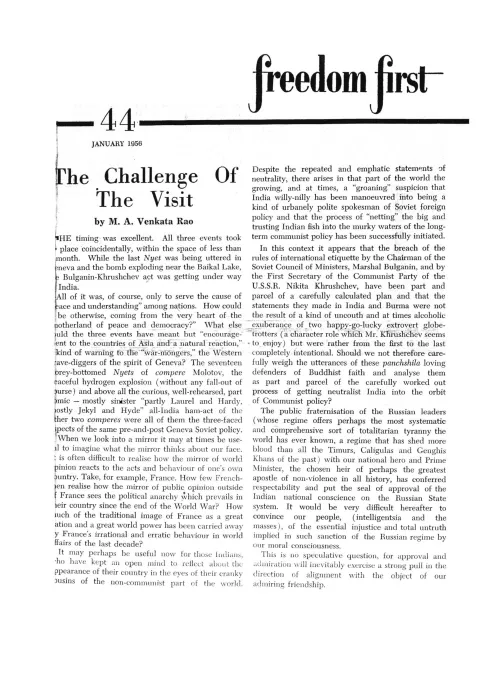
Freedom First
By V. B. Karnik, Bertram D. Wolfe, M. B. Shah, Laeeq Futehally, W. Z. Laqueur
Edited, printed & published for the Democratic Research Service by V. B. Karnik at The Kanada Press, 109 Parsi Bazar, Bombay 1 · Bombay · 1955
12 pages
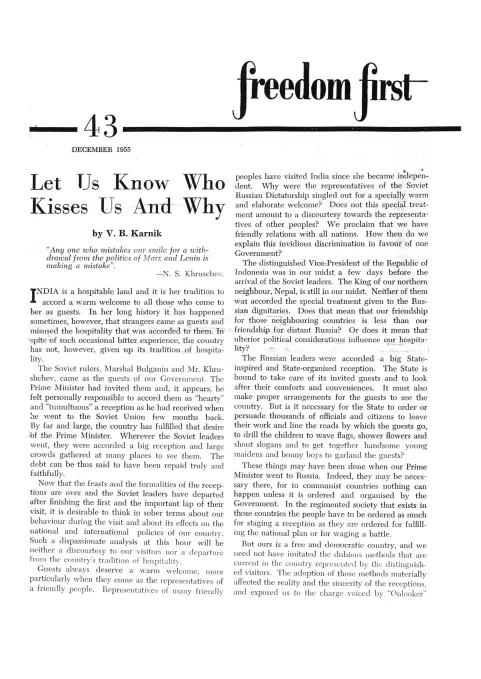
Freedom First
Summary
This is the December 1955 issue (No. 43) of Freedom First, the monthly journal of the Democratic Research Service edited by V. B. Karnik in Bombay. The issue is organized around the Cold War and the recent state visit of Soviet leaders Bulganin and Khrushchev to India, which several pieces use as an occasion to warn against Soviet propaganda, question the Nehru government’s ceremonial deference to the visiting dictatorship, and expose the gap between Soviet rhetoric of peaceful co-existence and Soviet practice. Alongside these pieces on Cold War politics, the issue carries an editorial ‘Notes’ section on domestic affairs (the States Reorganisation Commission, the Samyukta Maharashtra agitation and police firing in Bombay, and comparative claims about health and education under communism), a philosophical essay on the foundations of freedom, a light essay on Bombay’s new enthusiasm for nature, and news of the Indian Committee for Cultural Freedom’s activities. The volume’s argumentative center is a sustained brief for democratic, anti-totalitarian liberalism: distrust of Soviet ‘peaceful co-existence’ as propaganda, defense of civil liberties and free elections against both communist and other authoritarian temptations, and skepticism of using state machinery (including children) to stage displays of enthusiasm for foreign dignitaries.
Key points
-
V. B. Karnik’s lead article ‘Let Us Know Who Kisses Us And Why’ criticises the Indian government’s elaborate, state-orchestrated reception of Bulganin and Khrushchev, objecting to the ‘cynical use… of children as instruments of diplomacy’ and the Soviet leaders’ attacks on Western democracies during their Parliament address.
-
A ‘Notes’ section endorses Vinoba Bhave’s view that states reorganisation is chiefly administrative, condemns the twelve deaths in police firing during the Samyukta Maharashtra agitation, and disputes Rajkumari Amrit Kaur’s claim that China’s health services outpace India’s.
-
Bertram D. Wolfe’s ‘Peaceful Co-Existence’ dissects the term as Soviet ‘Newspeak’ masking simultaneous internal purges and external world conquest, tracing its origins to Trotsky’s 1917 peace programme and Lenin’s opportunistic use of peace rhetoric.
-
M. B. Shah’s ‘Philosophy Of Freedom’ traces freedom’s historical emergence through liberalism, arguing democracy’s failure to realise the Declaration of the Rights of Man in practice fuelled fascism and communism, and calls for a ‘positive freedom’ via Erich Fromm and M. N. Roy.
-
W. Z. Laqueur’s ‘The Double Think And Double Talk,’ reprinted from The New Leader, contrasts Bulganin and Khrushchev’s public praise of Gandhi with Soviet textbooks that still call him a ‘traitor,’ tracing Soviet experts’ opportunistic reversal on Nehru.
-
Laeeq Futehally’s light essay ‘Our New Hobby’ wryly observes Bombay’s new enthusiasm for Nature excursions to spots like Powai Lake and a boom in domestic gardening.
-
I.C.C.F. News reports Nicolas Nabokov’s November 1955 tour of India and the Committee’s Annual General Meeting scheduled for 17-18 December in Bombay.
-
‘With Many Voices’ quotes Anthony Eden arguing free elections cannot be held while Germany’s communist system must be preserved.
Essays
Let Us Know Who Kisses Us And Why
By V. B. Karnik
V. B. Karnik’s lead article criticizes the Indian government’s lavish, state-orchestrated reception of Soviet leaders Marshal Bulganin and Nikita Khrushchev during their 1955 visit, arguing that mobilizing schoolchildren and citizens to stage a ‘spontaneous’ welcome was both undemocratic and undignified, unlike the treatment given to other foreign dignitaries such as Indonesia’s Vice-President or Nepal’s King. Karnik argues the Soviet leaders violated diplomatic norms by using their address to Parliament to attack Western democracies, and situates the visit within a broader Cold War contest for the allegiance of uncommitted Asian nations. The piece closes (in the page-8 continuation) by noting that Nehru’s own stated principles of non-alignment and ‘good means for good ends’ sharply distinguish Indian from Soviet policy, but warns that the visit’s spectacle risks making international communism seem less odious to less mature sections of Indian opinion.
- Criticizes the Indian government for giving Soviet leaders Bulganin and Khrushchev a uniquely elaborate reception compared to other visiting dignitaries.
- Objects to the ‘cynical use… of children as instruments of diplomacy,’ describing how schools were made to rehearse welcome ceremonies.
- Argues the Soviet leaders’ attacks on Western democracies during their Parliament address were a ‘gross violation’ of diplomatic courtesy owed to a host country.
- Frames the visit as a Cold War propaganda exercise aimed at winning over uncommitted Asian nations, citing the Times of India’s characterization of ‘salesmanship.’
- Quotes Nehru’s own principled distinction between Indian and Soviet policy (good means for good ends) as evidence India has not truly departed from non-alignment.
- Warns that the pageantry of the visit may make communism ‘less odious’ to immature sections of Indian public opinion, urging counter-education about Soviet ‘double thinking and double talk.‘
Notes (Reorganisation Of States; Agitation Over Bombay; The Failure And Its Responsibility; Education Under Communism; Health Services in China)
The unsigned ‘Notes’ editorial section covers five domestic and international topics: it cautions against the ‘ugly controversies’ surrounding the States Reorganisation Commission’s report, endorsing Acharya Vinoba Bhave’s view that reorganisation is chiefly an administrative matter that should not create disunity; it condemns the violence and police firing (twelve dead) during the Samyukta Maharashtra agitation over Bombay’s inclusion, blaming agitation leaders for the ‘goondaism’ unleashed; it reports on the collapse of the Geneva Foreign Ministers’ Conference, blaming Soviet negotiator Molotov’s obstruction on German reunification and disarmament; it criticizes the regimented, Marxist-dogma-based character of education under communism, invoking C. P. Ramaswamy Ayyar’s remarks on China; and it disputes Rajkumari Amrit Kaur’s claim that China’s health services are comparable to India’s, arguing Communist China in fact suffers from a shortage of doctors and medicines worsened by totalitarian regimentation.
- States Reorganisation Commission report has triggered disunity-inducing controversies; the editorial urges perspective, citing Acharya Vinoba Bhave that reorganisation is mainly administrative.
- Twelve lives were lost in police firing during the Samyukta Maharashtra strike/agitation in Bombay; blame is placed on agitation leaders (with communists said to have taken control) rather than solely on ‘anti-social elements.’
- The Geneva Foreign Ministers’ Conference failed; Molotov is blamed for rejecting Western proposals on East-West contacts, German unification, and disarmament.
- Communist education (citing C. P. Ramaswamy Ayyar on China) is described as rigidly regimented around Marxist principles, suppressing independent thought in children.
- Rajkumari Amrit Kaur’s claim that India lags China in health services is disputed; the editorial argues China suffers a shortage of doctors and medicine under totalitarian regimentation.
Peaceful Co-Existence
By Bertram D. Wolfe
Bertram D. Wolfe’s essay dissects the Soviet term ‘peaceful co-existence’ as a piece of ‘Newspeak,’ arguing it masks two simultaneous, unrelenting wars waged by the Kremlin: an internal war of purges and totalitarian control against the Soviet Union’s own people, and an external war to extend Communist rule worldwide. He traces the term’s history to Trotsky’s 1917 formulation and Lenin’s tactical use of ‘peace’ talk only when too weak to fight, arguing the doctrine has always been a means of lulling adversaries before conquering by infiltration once they are strong enough. The piece closes with Salvador Madariaga’s ‘Animal Farm’-style parable, delivered at a League of Nations disarmament debate, satirizing Litvinov-era Soviet disarmament proposals as self-serving.
- Argues ‘peaceful co-existence’ originates from Soviet ‘Newspeak,’ where words like democracy and liberation are inverted.
- Identifies two simultaneous total wars waged by the Kremlin: an internal war on its own people (purges, slave camps, espionage) and an external war of world conquest.
- Cites the fates of Trotsky, Bukharin, Zinoviev, Kamenev, Yagoda, Yezhov, and Beria as evidence that even loyal Communists are not safe from the internal war.
- Attributes the first use of ‘peaceful co-existence’ to Leon Trotsky’s November 1917 peace programme statement, and traces Lenin’s opportunistic use of peace rhetoric.
- Cites Salvador Madariaga’s Animal Farm-style fable about a ‘conference of beasts’ discussing disarmament, used to satirize Litvinov’s Soviet disarmament proposals at the League of Nations.
Philosophy Of Freedom
By M. B. Shah
M. B. Shah’s philosophical essay explores the historical and conceptual foundations of freedom as a human (not natural) value, tracing how the Enlightenment and Industrial Revolution created an individuated but ‘atomized’ modern person, and how the Declaration of the Rights of Man promised human dignity that democracy in practice often failed to realize under conditions of economic scarcity and dehumanization. Shah argues that this failure produced widespread frustration, resignation, and a willingness to surrender freedom to totalitarian ideologies (fascism, nazism, communism), and calls (in the page-11 continuation) for democracy to evolve toward a ‘positive freedom’ that integrates individual self-realization with social cooperation, drawing on Erich Fromm’s argument that only such a reoriented democracy can secure genuine individual freedom.
- Freedom is defined as a human value rather than a natural one; the essay traces its historical emergence through liberalism and laissez-faire economics.
- Argues that individuation from traditional securities also atomized the individual, leaving him ‘powerless to make his way single-handedly.’
- Notes that democracy, despite the Declaration of the Rights of Man, often failed to treat man as an end in himself within social and economic structures.
- Attributes the rise of fascism, nazism, nihilism and communism to mass frustration, resignation, and fear of freedom following this failure.
- Calls for democracy to pursue ‘positive freedom’-conditions enabling full realization of human potential-rather than merely negative freedom from restriction, citing Erich Fromm’s Fear of Freedom and M. N. Roy’s Principles of Radical Democracy.
Our New Hobby
By Laeeq Futehally
Laeeq Futehally’s light essay observes Bombay’s sudden enthusiasm for ‘Nature’-crowded Sunday excursions to beauty spots like Powai Lake and a boom in domestic gardening (rock-gardens, croton borders, bougainvillea trellises)-and wryly welcomes this new national hobby as an affordable and harmless enthusiasm compared to the country’s other preoccupations.
- Describes Bombay’s new mania for Nature: crowded Sunday exoduses to spots like Powai Lake.
- Notes the parallel trend of bringing ‘nature into the city’ via rock-gardens and flower beds in new housing construction.
- Frames the phenomenon satirically, comparing it to ministers praising the ‘green glory of forests’ and Delhi’s Bird-Watching Society.
- Concludes the hobby is a fortunate one because, unlike other national enthusiasms, it costs nothing and can be enjoyed by all.
The Double Think And Double Talk
By W. Z. Laqueur
W. Z. Laqueur’s essay (reproduced from The New Leader) examines the ideological contradictions in Soviet Oriental studies and propaganda toward Asian nationalism, contrasting the flattering public praise Bulganin and Khrushchev gave Gandhi and Nehru during their India visit with harshly hostile portrayals of the same figures in Soviet academic textbooks intended for domestic/expert consumption-where Gandhi is still called a ‘traitor’ and Nehru’s ‘pseudo-leftist’ Congress leadership is accused of serving bourgeois and landowning class interests. Laqueur traces how Soviet India-experts Balabushevich and Dyakov swung from harsh 1930s-era condemnations of Nehru to a laudatory 1955 review of his Discovery of India, illustrating the Kremlin’s opportunistic, ideologically inconsistent approach to Asian nationalist movements, and concludes that Leninist doctrine’s refusal to accept peaceful coexistence between parties (as opposed to states) makes durable Soviet-nationalist cooperation in Asia inherently unstable.
- Contrasts Bulganin and Khrushchev’s public praise of Gandhi in India with Soviet academic texts that still call Gandhi a ‘traitor.’
- Describes Soviet textbooks’ hostile treatment of Nehru and the Congress ‘pseudo-leftist’ leadership as serving bourgeois and landowner class interests.
- Traces Soviet India-experts V. Balabushevich and A. Dyakov’s ideological reversal: harsh condemnation of Nehru’s circle in 1930s writings versus a laudatory 1955 review of Nehru’s Discovery of India in Kommunist.
- Notes a Kommunist editorial urging Soviet Orientalists to recognize a ‘progressive kernel’ in each national movement, signaling an approaching Soviet policy shift.
- Concludes that Leninist doctrine permits peaceful coexistence between states but not between parties/movements, making the Communist-nationalist detente in Asia fundamentally unstable absent a major ideological reorientation.
I.C.C.F. News
An unsigned news column reports on the activities of Nicolas Nabokov, Secretary General of the Congress for Cultural Freedom, during his November 1955 tour of India, including lectures in Delhi and Calcutta on Western music and modern intellectuals, and previews his planned visits to Madras, Trivandrum, Bangalore, and Bombay in December, alongside the Indian Committee for Cultural Freedom’s Annual General Meeting scheduled for December 17-18 in Bombay.
- Nicolas Nabokov, Secretary General of the Congress for Cultural Freedom, toured Delhi and Calcutta in November 1955, giving lectures on Western music and modern intellectuals.
- In Calcutta he met literary and artistic figures including Uday Shankar, Amla Shankar, Buddhadev Bose, and Samar Sen.
- His itinerary continues to Rangoon, Tokyo, then back to Madras, Trivandrum, Bangalore, and Bombay in December.
- The Indian Committee for Cultural Freedom’s Annual General Meeting is scheduled for December 17-18 at the Jehangir Art Gallery in Bombay, with a public lecture by Nabokov on December 18.
With Many Voices
The closing ‘With Many Voices’ column compiles short newspaper quotations from various public figures on Cold War themes-communism, colonialism, disarmament, and free elections-drawn from sources like the Times of India, Bombay Chronicle, and New Leader in October-November 1955, including remarks by C. D. Deshmukh, Vinoba Bhave, Harold Macmillan, Anthony Eden, and others.
- Compiles brief quotations on Cold War and colonialism themes from public figures published in October-November 1955.
- Includes C. D. Deshmukh’s remark on lending and borrowing, and Vinoba Bhave’s warning against dependence on ‘one single man’s goodness or badness.’
- Quotes Sir Anthony Eden arguing free elections cannot be held if the Communist system in Germany must be preserved.
- Includes commentary comparing Soviet ‘colonialism’ toward satellite states with Western colonialism, and a note on Chinese versus Indian railway labor productivity.
Generated by the v1.5 extraction pipeline. Awaiting editorial review.
Metadata and summary are AI-extracted from the source PDF and reviewed for editorial accuracy. The original work is available via the Read PDF tab above (where present); paragraph-level citation inside the PDF is deferred to a future engagement.