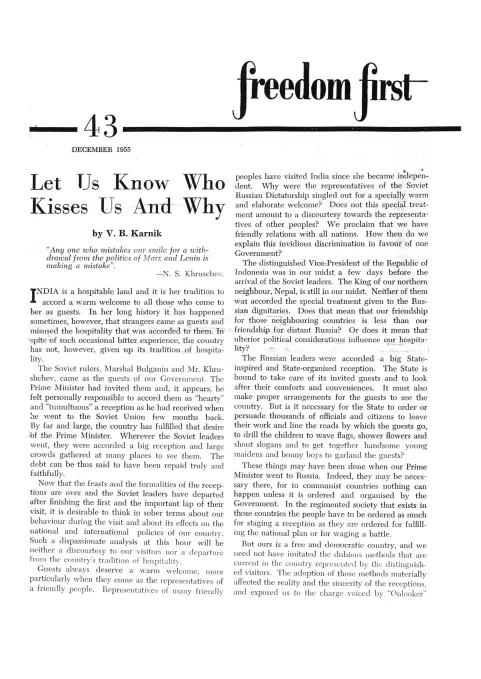
periodical issue
Freedom First
By M. A. Venkata Rao, Asiaticus, Philip Spratt
Edited, printed & published for the Democratic Research Service by V. B. Karnik at The Kanada Press, 109 Parsi Ba[g], Bombay 1. · Bombay · 1956
12 pages
Freedom First
Summary
This is issue no. 44 of Freedom First (January 1956), the monthly journal of the Democratic Research Service (Bombay), reflecting the classical-liberal, anti-communist editorial line associated with the Forum of Free Enterprise milieu. The issue is dominated by anxious commentary on the just-concluded Bulganin-Khrushchev tour of India: M. A. Venkata Rao’s lead essay reads the visit as a calculated Soviet manoeuvre to draw a nominally neutral India into the communist orbit; the unsigned ‘Notes’ column criticises the Nehru government’s handling of the visit, Soviet forced-labour camps, and a stalled passport-rights case; and a page of press excerpts (‘With Many Voices’) collects Indian and international reactions to the visit, mostly skeptical or hostile. Alongside this, Asiaticus’s ‘China Enters Stalinism’ argues from Chinese Communist Party sources that Peking has entered a full-scale Stalinist purge targeting intellectuals (the Hu Feng affair) and ordinary citizens via denunciation campaigns. The issue also documents the Indian Committee for Cultural Freedom’s Third General Meeting (with addresses by Asoka Mehta and Nicolas Nabokov and resolutions on the Second Five Year Plan and the political use of schoolchildren during the Soviet visit), a report on Nabokov’s subsequent India tour, a book review of Gabriel Almond’s The Appeals of Communism, and reader letters.
Key points
-
M. A. Venkata Rao’s ‘The Challenge Of The Visit’ reads the Bulganin-Khrushchev tour of India and Burma, alongside a Soviet ‘Nyet’ at Geneva and a hydrogen bomb test, as one calculated Soviet peace offensive that risks blurring the moral distinction between Gandhian Congress values and Bolshevik practice.
-
Asiaticus’s ‘China Enters Stalinism’ traces escalating Chinese Communist campaigns from 1951 film criticism through the 1955 Hu Feng affair, citing 271,074 arrests and concluding China may eventually exceed Soviet-era terror given its greater backwardness.
-
An unsigned ‘Notes’ section urges investigation of an Indian reportedly detained in the Vorkuta labour camp, praises the two Lok Sabha members, N. C. Chatterjee and H. V. Kamath, who alone protested the Soviet visit, and criticises a Bombay High Court ruling that passport denial is non-justiciable.
-
An unsigned report on the I.C.C.F.’s Third General Meeting (17-18 December 1955) records addresses by Asoka Mehta and Nicolas Nabokov and four resolutions, including disapproval of mobilising schoolchildren during the Soviet visit.
-
‘What Would The Marshal Have Said?’ describes the cancelled Bombay Press Guild reception for Bulganin and Khrushchev and a combative Rangoon press exchange challenging the Soviets on Panchashila’s applicability to their own satellites.
-
Philip Spratt reviews Gabriel Almond’s The Appeals of Communism, highlighting its finding that Communist propaganda emphasises tactical discipline (94%) far more than ideal ‘goal qualities’ (6%) in canonical texts.
-
A report details Nicolas Nabokov’s December tour of Madras, Bangalore, Mysore and Bombay, and a reader’s letter from S. S. Bankeshwar accuses Nehru of a double standard on US versus Soviet military aid and weapons tests.
Essays
The Challenge Of The Visit
By M. A. Venkata Rao
M. A. Venkata Rao’s ‘The Challenge Of The Visit’ argues that the near-simultaneous Soviet ‘Nyet’ at Geneva disarmament talks, a Soviet hydrogen bomb test, and the Bulganin-Khrushchev tour of India and Burma were parts of one calculated Soviet peace offensive rather than spontaneous goodwill. He contends that the warmth of the Indian public and governmental reception—extending to comparisons of the Soviet leaders with epic heroes and avatars—risks blurring the moral distinction between Gandhian Congress values and Bolshevik practice, and that the growing intimacy between Nehru and the Soviet leadership is manoeuvring India toward alignment with Soviet foreign policy despite official professions of neutrality.
- Frames the Bulganin-Khrushchev visit, the Soviet Geneva ‘Nyet’, and a Soviet hydrogen bomb test as a single coordinated ‘peace’ offensive.
- Warns that lavish, uncritical Indian receptions for the Soviet leaders elevate them to the status of national heroes, comparing this to reverence once reserved for Gandhi.
- Argues the close personal rapport between Nehru and the Soviet leaders blurs the distinction between Congress’s Gandhian values and Bolshevik practice.
- Sees India being ‘netted’ into a tacit alignment with Soviet policy despite its declared non-alignment.
- Concludes that admiration for the Soviet regime will exert a real pull toward political alignment with it, not merely a diplomatic courtesy.
The Pot And The Kettle
This unsigned ‘Notes’ column runs six short editorial items. ‘The Pot And The Kettle’ argues that Indian outrage at the U.S. Dulles-Cunha communique on Goa is hypocritical given Nehru’s own equivocal statements on Soviet-bloc captive nations. ‘Moscow’s Advice To C.P.I.’ reports on a leaked Shepilov letter instructing the Communist Party of India not to disrupt the Soviet diplomatic courtship of India, while promising Indian communists that a reckoning with the ‘bourgeois Government’ will come eventually. ‘Indian In Soviet Camp’ presses the government to investigate credible reports of an Indian national detained in the Vorkuta concentration camp. ‘The Courageous Two’ praises Lok Sabha members N. C. Chatterjee and H. V. Kamath for being the only members to object to the conduct of the Soviet visit, and criticises Congress members for shouting them down. ‘An Unhelpful Decision’ criticises a Bombay High Court ruling (Justice Coyajee) that passport denial is non-justiciable, contrasting it with a more liberal U.S. federal ruling. ‘Need For National Unity’ cites Madras Governor Sri Prakasa’s convocation address on the danger linguistic-provincial disputes pose to national unity following the States Reorganisation Commission report.
- Criticises Nehru’s silence on Soviet-bloc ‘captive peoples’ as inconsistent with Indian anger at U.S. diplomatic language on Goa.
- Reports a leaked Shepilov letter directing the CPI not to interfere with Soviet diplomacy toward India, while promising an eventual reckoning with the Indian government.
- Urges the Government of India to investigate reports of an Indian detained in the Vorkuta Soviet concentration camp.
- Praises the two Lok Sabha members who protested the conduct of the Soviet visit and criticises Congress members who shouted them down.
- Criticises a Bombay High Court decision holding passport issuance non-justiciable, contrasting it with U.S. case law protecting freedom of movement.
- Warns that linguistic-provincial disputes following the States Reorganisation Commission report threaten national unity.
China Enters Stalinism
By Asiaticus
Asiaticus’s ‘China Enters Stalinism’ argues, against the favourable reports of Western visitors like Pietro Nenni, that the People’s Republic of China embarked in 1955 on a major Stalinist-style purge. Tracing a sequence of ideological campaigns—the 1951 criticism of the film ‘The Story of U Sun,’ the 1952 anti-corruption drives, the 1954 campaign against ‘formalist’ literary critics influenced by Hu Shi, and finally the 1955 ‘Hu Fengism’ campaign—the essay documents how a movement that began as an ideological critique of one dissident escalated into an accusation that Hu Feng led an anti-state conspiracy with hundreds of thousands of members. It quotes Chinese press denunciations of alleged ‘counter-revolutionary’ sabotage, state-encouraged denunciation of family members (including children reporting on parents), and mass arrest figures, concluding that China, being more backward than 1930s Russia, may eventually surpass Soviet Stalinism in severity.
- Challenges the favourable accounts of Western visitors to China (e.g., Pietro Nenni) with evidence from official Chinese Communist press and radio of a major purge beginning in summer 1955.
- Traces escalating ideological campaigns from 1951 (film criticism) through 1952 (anti-corruption drives) to 1954 (literary ‘formalism’ campaign against Hu Shi’s influence) to the 1955 Hu Feng affair.
- Describes the Hu Feng affair’s escalation from an ideological deviation charge to accusations Hu Feng led an ‘anti-party, anti-state’ conspiracy with agents throughout China.
- Quotes official Chinese accounts of denunciation culture, including children praised or punished based on whether they reported ‘counter-revolutionary’ parents.
- Cites a reported 271,074 arrests across several Chinese provinces under Lo Jui Ching.
- Concludes China has entered the ‘Stalinist stage’ of Communist development and, given its greater backwardness relative to 1930s Russia, may eventually exceed Soviet-era terror.
Notes (The Pot And The Kettle; Moscow’s Advice To C.P.I.; Indian In Soviet Camp; The Courageous Two; An Unhelpful Decision; Need For National Unity)
No summary was extracted for this article. Listed for completeness.
I.C.C.F. Report Of General Meeting
No summary was extracted for this article. Listed for completeness.
Indian Committee For Cultural Freedom: Resolutions adopted by the Annual General Meeting held on December 17 and 18, 1955
This unsigned report covers the Indian Committee for Cultural Freedom’s Third General Meeting, held in Bombay on 17-18 December 1955. It summarises inaugural addresses by Asoka Mehta (on the loss of human values under technological civilisation and the intellectual’s task of recovering the potency of ideas) and Nicolas Nabokov of the Congress for Cultural Freedom (on the threat totalitarianism poses to free culture, and a perceived affinity between the Russian and Indian peoples). It records the election of a new Executive (including Jayaprakash Narayan, Minoo Masani, and others) and reproduces the four resolutions adopted: solidarity with the Sarva Seva Sangh’s Sampattidan movement; a call for the Second Five Year Plan to avoid centralised, totalitarian planning risks; disapproval of the political mobilisation of schoolchildren during the Soviet visit; and endorsement of the Congress for Cultural Freedom’s Milan resolution on solidarity with intellectuals of underdeveloped regions.
- Reports the ICCF’s Third General Meeting in Bombay (17-18 December 1955), attended by delegates from multiple Indian cities.
- Summarises Nicolas Nabokov’s address on totalitarianism’s threat to free culture and self-expression.
- Summarises Asoka Mehta’s presidential address on recovering human values against the backdrop of technological civilisation.
- Records the newly elected Executive, including Jayaprakash Narayan, Minoo Masani, and Rukmini Devi Arundale.
- Reproduces four resolutions: on the Sampattidan movement, on risks of centralised planning in the Second Five Year Plan, condemning the political exploitation of schoolchildren during the Soviet visit, and endorsing the Milan CCF resolution on underdeveloped regions.
What Would The Marshal Have Said?
This unsigned piece, ‘What Would The Marshal Have Said?’, recounts the cancellation of a Press Guild of India reception for Bulganin and Khrushchev in Bombay, allegedly to ‘lessen the strain on the Soviet guests,’ and speculates the Soviets avoided facing pointed questions from the Bombay press about free expression, forced labour, and one-party rule. It also describes a genuinely combative press exchange in Rangoon in which reporters challenged the Soviet leaders on Panchashila’s applicability to Soviet-bloc states, and notes the perfunctory nature of the single press conference the Soviet leaders held in Delhi, where questions had to be submitted in advance and no follow-up was permitted.
- Reports the cancellation of a planned Bombay Press Guild reception for Bulganin and Khrushchev, attributed to Soviet reluctance to face the press.
- Lists pointed questions the Press Guild had prepared, including on Soviet forced labour and the one-party system.
- Describes a Rangoon press exchange where reporters raised Panchashila’s inapplicability to Eastern European Soviet satellites, met with hostile Soviet responses.
- Notes the Delhi ‘press conference’ required questions to be submitted beforehand and permitted no live follow-up.
Review: The Appeals of Communism by Gabriel A. Almond
By Philip Spratt
Philip Spratt’s review of Gabriel A. Almond’s ‘The Appeals of Communism’ (Princeton University Press, 1954) praises the book’s rigorous, heavily statistical analysis of Communist Party literature and its account, based on interviews with roughly 200 ex-members across four countries, of why people join and leave the party. Spratt highlights Almond’s finding that communist ideal aims receive minimal emphasis in party training compared to tactical and organisational discipline, that the party grew more bureaucratic and psychologically coercive under Stalin compared to a more fraternal 1920s atmosphere, and that disillusionment is typically a gradual process driven by the gap between propaganda and reality rather than sudden ideological reversal or a turn to conservatism or religion.
- Praises Almond’s statistical methodology despite its dense, heavily tabulated style.
- Highlights the finding that Communist propaganda emphasises tactical/organisational qualities (94%) far more than ideal ‘goal qualities’ (6%) in canonical texts like Stalin’s History of the CPSU.
- Notes the shift from a fraternal, intellectually genuine party culture in the 1920s to a bureaucratic, psychologically coercive one under Stalin.
- Summarises Almond’s account of why members leave: disillusionment is usually gradual, driven by the gap between propaganda and party reality, rarely resulting in a turn to conservatism or religion.
- Compares the book’s findings on national party cultures—Italian (large but ill-trained), French (best at grafting Stalinism onto its own culture), British (most deviant from type), American (strained internal atmosphere).
Mr. Nabokov In India
This unsigned report, ‘Mr. Nabokov In India,’ details Nicolas Nabokov’s late-1955 tour of Madras, Bangalore, Mysore, and Bombay on behalf of the Congress for Cultural Freedom, including music seminars, lectures on Western music, and meetings with Indian musicologists and artists, culminating in his role inaugurating the ICCF’s Bombay General Meeting. Two reader letters follow under ‘To the Editor’: one by S. S. Bankeshwar, titled ‘Why this Silence?’, accuses Nehru of inconsistency for criticising U.S. military aid to Pakistan and the American hydrogen bomb test while staying silent on Soviet-bloc military aid to Egypt and the Soviet super-hydrogen bomb.
- Details Nicolas Nabokov’s December 1955 tour of Madras, Bangalore, Mysore, and Bombay for the Congress for Cultural Freedom.
- Describes cultural programming arranged for Nabokov, including Bharata Natyam and Kathakali performances and a lecture on the origins of Western music.
- Records Nabokov’s role inaugurating the ICCF’s Bombay General Meeting and addressing writers, painters, and students.
- Reproduces a reader letter accusing Nehru of applying a double standard: criticising U.S. military aid to Pakistan and its hydrogen bomb test while remaining silent on Soviet/Czechoslovak military aid to Egypt and the Soviet super-hydrogen bomb.
With Many Voices
‘With Many Voices’ is a compiled column of press excerpts and quotations, framed by an epigraph from Tennyson, reacting to the Bulganin-Khrushchev visit and broader Cold War themes. It gathers skeptical or hostile comments from figures such as Averell Harriman, Nehru himself, A. F. S. Talyarkhan, Lord Reading, and various publications (Times of India, The Economist, New York Times, Christian Science Monitor), largely questioning the sincerity of Soviet ‘peaceful co-existence’ rhetoric and India’s claim to genuine neutrality.
- Compiles press quotations skeptical of Soviet ‘peaceful co-existence’ claims following the Bulganin-Khrushchev tour.
- Includes Averell Harriman’s assertion that peaceful co-existence is a Russian proposal India should not accept.
- Includes Nehru’s own remark that ‘some people talk about peace so loudly it sounds like war.’
- Includes The Economist’s observation on the incongruity of Asian neutral states denouncing ‘colonialism’ while courting the Soviet bloc.
- Includes Lord Reading’s comment questioning whether Soviet leaders truly believe Indians and Burmese are deceived about their own freedom.
Generated by the v1.5 extraction pipeline. Awaiting editorial review.
Metadata and summary are AI-extracted from the source PDF and reviewed for editorial accuracy. The original work is available via the Read PDF tab above (where present); paragraph-level citation inside the PDF is deferred to a future engagement.