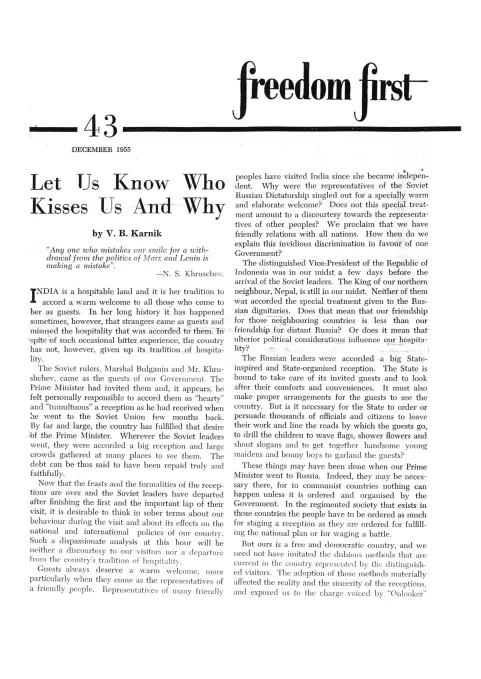
periodical issue
Freedom First
By V. B. Karnik, Bertram D. Wolfe, Alex Atkinson, M.A.V.
Edited, printed & published for the Democratic Research Service by V. B. Karnik at The Kanoda Press, 109 Parsi Bazar Street, Bombay 1 · Bombay · 1956
12 pages
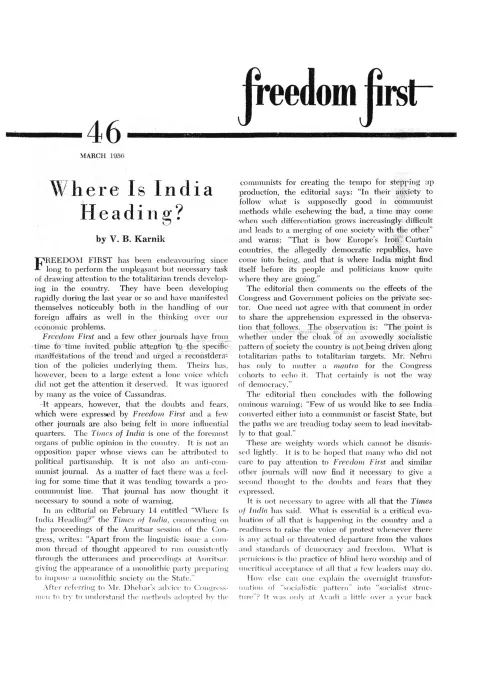
Freedom First
Summary
This is the complete March 1956 issue (No. 46) of Freedom First, the monthly organ of the Democratic Research Service, edited by V. B. Karnik. In the rendered pages the issue runs its full 12 pages: an editorial by Karnik warning that Congress’s shift from “socialistic pattern” to “socialist structure” risks tipping India toward one-party, totalitarian rule, echoing a Times of India editorial; a Notes section defending the Democratic Research Service against Blitz’s communist-aligned attacks, discussing a Copyright Bill before the Rajya Sabha, criticizing the political exploitation of schoolchildren, and noting the World Federation of Trade Unions’ expulsion from Vienna; a substantial analytical essay by the American Sovietologist Bertram D. Wolfe dissecting the post-Stalin “collective leadership” of Khrushchev, Bulganin, Malenkov, Molotov and Beria as an unstable interregnum within an unchanged totalitarian system; a satirical travel piece by Alex Atkinson (reprinted from Punch) mocking Soviet tourism propaganda; a piece on the PEN International controversy over admitting a Soviet PEN centre; short book reviews (a memoir of a persecuted Czechoslovak nun, a new foreign-affairs magazine The Ambassador, and Walter Lippmann’s The Public Philosophy); notes on the Indian Committee for Cultural Freedom’s activities; and a closing page of juxtaposed quotations, “With Many Voices,” contrasting Western and communist statements on politics and tolerance. The volume’s argumentative center is anti-totalitarian and anti-communist advocacy for liberal democracy, defending civil liberties and public opinion against both Soviet-style tyranny and domestic drift toward centralized, one-party governance.
Key points
-
V. B. Karnik’s editorial ‘Where Is India Heading?’ uses a Times of India editorial on the Congress Amritsar session to warn that the shift from ‘socialistic pattern’ to ‘socialist structure,’ adopted without debate, risks one-party totalitarian drift.
-
A ‘Notes’ section rebuts a Blitz allegation that the Democratic Research Service instigated the Samyukta Maharashtra riots, criticises a new Copyright Bill for halving the copyright term to 25 years, and reports Austria’s success in expelling the communist-aligned World Federation of Trade Unions from Vienna.
-
Bertram D. Wolfe’s essay on the post-Stalin ‘collective leadership’ of Khrushchev, Bulganin, Malenkov, Molotov and Beria argues the Soviet system’s lack of any legitimate succession mechanism makes collective rule an inherently unstable interregnum.
-
Alex Atkinson’s satirical mock travel-brochure ‘Come To Sunny Russia,’ reprinted from Punch, lampoons Soviet tourism propaganda against the real drabness and surveillance of Moscow life.
-
An item on the PEN International controversy quotes President Charles Morgan’s 1955 questions about whether a Soviet PEN centre could ever be genuinely free of state control, and his refusal to admit writers who are ‘instruments of tyranny.’
-
Reviews cover Sister Cecilia, an escaped Slovak nun’s memoir of Czechoslovak communist persecution (A.A.), the launch of the new magazine The Ambassador edited by Sudhir Hendre, and Walter Lippmann’s The Public Philosophy, which the reviewer connects to the Indian idea of raja dharma.
-
I.C.C.F. News reports a Martha Graham seminar, a lecture by Prof. W. S. Woytinsky on the world economy, and a reception for four visiting Japanese women writers.
Essays
Where Is India Heading?
By V. B. Karnik
In this editorial, V. B. Karnik uses a Times of India editorial (“Where Is India Heading?”, Feb 14) commenting on the Congress’s Amritsar session to argue that Freedom First’s long-standing warnings about totalitarian drift in India are now being echoed by mainstream opinion. He traces how the Congress shifted from the loosely-defined “socialistic pattern” to the more rigid “socialist structure” without public debate, simply because Nehru proposed it and the party obeyed. Karnik warns that unchecked one-party dominance, blind hero-worship, and uncritical deference to leaders could lead India down the same path as the communist states of Eastern Europe, and argues that only a vigorous, free public opinion—not the goodwill of any individual leader—can guarantee that democracy and economic advancement do not collapse into totalitarian control.
- Times of India’s Feb 14 editorial ‘Where Is India Heading?’ warned that Congress proceedings at Amritsar showed a ‘monolithic party’ preparing to impose a ‘monolithic society’ on the state.
- The shift from ‘socialistic pattern’ to ‘socialist structure’ happened without any recorded internal debate; delegates simply followed the Prime Minister’s cue.
- Karnik argues political democracy must evolve into social democracy, but democratic means must be preserved even while pursuing socialization.
- Soviet Russia and Eastern Europe are cited as examples of socialism achieved by destroying democracy and installing monolithic parties beholden to a single leader.
- The remedy is a free, alert, and informed public opinion that persists in scrutinizing government and party actions rather than a ‘lone voice or two.‘
New Soviet Leaders
By Bertram D. Wolfe
An unsigned Notes section comprising four short items. ‘A New Low’ rebuts a Blitz magazine story alleging the Democratic Research Service instigated the Bombay-for-Samyukta-Maharashtra riots, showing the claim rests on a fabricated link to A. D. Gorwala (misidentified as a DRS member) and reasserting that DRS is a nonpartisan information group. ‘Copyright Bill’ analyzes a new Copyright Bill before the Rajya Sabha, criticizing its reduction of the copyright term from 50 to 25 years and its proposed Copyright Board with registration requirements as inconsistent with India’s Berne-Berlin and Universal Copyright Convention obligations. ‘Exploitation of Students’ criticizes the use of schoolchildren for political demonstrations, citing Nehru’s own call at the All India Youth Congress for students to shun agitational politics and a Bombay State Education Department circular against using students for party purposes. ‘Austria And The W.F.T.U.’ reports the Austrian government’s success in expelling the communist-aligned World Federation of Trade Unions from Vienna after Austria regained sovereign independence.
- Blitz falsely claimed the Democratic Research Service instigated the Bombay-for-Samyukta-Maharashtra disturbances, based on misidentifying A. D. Gorwala (‘Vidura’) as a DRS member.
- DRS is described as an information and research group of members from Congress, PSP and others, not engaged in forming opposition parties.
- The new Copyright Bill halves the copyright term to 25 years and creates a Copyright Board with registration and quasi-judicial powers, seen as inconsistent with international convention obligations and democratic legal norms.
- Political parties’ use of schoolchildren in demonstrations is criticized; Nehru himself asked students to avoid agitational politics.
- The W.F.T.U., described as a communist front organisation, was compelled to leave Vienna after Austria regained full sovereignty.
Come To Sunny Russia
By Alex Atkinson
Bertram D. Wolfe analyzes the nature of Soviet totalitarianism and the post-Stalin succession crisis, in an essay noted (per its editorial headnote) as written before the 20th Congress of the CPSU. Wolfe argues the Soviet system’s inherent dynamics—its fear of disorder, absence of any legitimate mechanism for succession, and cult of an infallible leader—make ‘collective leadership’ an inherently unstable, transitional phase rather than a genuine departure from dictatorship. He traces the successive falls of Malenkov (stripped of the premiership and forced to confess policy failures), Beria (executed), and Molotov (forced into a humiliating public confession), leaving Khrushchev as ‘more equal than others’ within a nominal duumvirate with Bulganin. Wolfe contends that all the ‘new’ men were in fact co-makers of Stalin’s policies while he lived, and that the substance of Soviet policy—the drive to remake society, industrial primacy, agricultural collectivization, and the pursuit of world revolution—continues undiminished regardless of who holds nominal power.
- The Soviet system lacks any legitimate, peaceful mechanism for succession because it has no living party in the normal sense, only a ‘pretorian guard’ serving the leader.
- Malenkov was removed as First Party Secretary two weeks after Stalin’s death and later forced to confess ‘guilt and responsibility’ for failures in agriculture.
- Beria was executed in December 1953 and became a ‘retroactive traitor… then an unperson.’
- Molotov confessed in September 1955 to an ‘ideological error’ regarding the state of socialist society in the USSR.
- Khrushchev emerges as the dominant figure, backed by the Army and secret police machinery, in an unstable ‘collective leadership’ with Bulganin.
- Wolfe predicts continued struggle for a single successor because the dynamics of totalitarian dictatorship inherently resist genuine collective rule.
- Stalin’s 1952 pamphlet Economic Problems of Socialism is identified as the source of the formulae still guiding Khrushchev and Bulganin’s policies.
A P.E.N. Centre In Soviet Russia?
By M.A.V.
A satirical mock travel-brochure by Alex Atkinson, reproduced from Punch (London), lampooning the idea of Soviet tourism. Presented as an upbeat advertisement urging readers to holiday in ‘sunny Russia,’ the piece mocks the drabness and surveillance of Moscow life—plainclothes police, endless queues, absent bars, kitsch Intourist hotels—and satirizes the standardized, hostile questions Muscovites are trained to ask foreign visitors about Western hypocrisy and imperialism. It closes with a mock-serious note that ‘architecture was recently abolished’ and a wry sign-off about needing ‘a good fat notebook’ to survive the trip’s paperwork.
- Presented as a chic holiday advertisement for the USSR, contrasting sardonically with the real hardships of Soviet life.
- Describes Intourist hotels, potted plants and ‘old-world charm,’ alongside plainclothes secret police and constant surveillance.
- Lists stock hostile questions Soviet citizens are trained to lob at English tourists (e.g., about lynching, Knightsbridge slums, war preparations).
- Notes the near-total absence of bars, the endless queues for basic goods, and the high price of consumer items like chocolate and apples.
- Satire is framed as reprinted from Punch, signalling its intent as British satirical commentary rather than straight reportage.
Notes (A New Low; Copyright Bill; Exploitation Of Students; Austria And The W.F.T.U.)
This unsigned piece (initialed M.A.V.) reports on the controversy over a proposal to form a PEN Centre in Soviet Russia. It quotes at length PEN International President Charles Morgan’s 1955 Vienna address raising four searching questions about whether a PEN centre under a totalitarian regime could be genuinely free, open to critics, and capable of honest discussion, and his declaration that PEN would never receive ‘writers who are the instruments of tyranny.’ The piece concludes that Soviet Russia’s rigid censorship, the doctrine of ‘Socialist Realism,’ and cases like Lysenko’s demonstrate that no genuine cultural freedom exists there, and warns that the Soviet government seeks to use a PEN centre as another front for infiltrating and controlling free-world cultural circles.
- PEN International’s Secretary wrote to Konstantin Simonov of the Soviet Writers’ Association about forming a Russian PEN Centre, to be considered ‘in the context of the Charter.’
- PEN President Charles Morgan’s Vienna address (June 12, 1955) posed four questions about whether a Soviet PEN centre could be free, open to dissenters, and non-propagandistic.
- Morgan declared he would do nothing to endanger PEN’s basic principle that writers serving as ‘instruments of tyranny’ should not be admitted.
- The PEN Charter’s clause 4 commits members to oppose suppression of free expression, a standard the article says Soviet cultural policy categorically violates.
- The Lysenko affair and ‘Socialist Realism’ are cited as evidence that Soviet authorities control all fields of thought and punish deviation.
Review: Sister Cecilia
By A. A.
A book review (initialed A.A.) of Sister Cecilia (Longmans, Green and Co.), the account told to William Brinkley by a Slovak nun who escaped Czechoslovakian communist police after they came to arrest her at the hospital where she nursed the sick, and who spent a year as a fugitive before reaching the West via Austria and Germany. The review frames the memoir as revealing ‘the nature of the treatment that the communists mete out to religious bodies and persons.’
- Sister Cecilia, a Slovak nun and teacher, evaded arrest by Czechoslovakian communist police and lived a year underground before reaching America.
- The Czechoslovak communist regime ordered nuns to stop teaching; Sister Cecilia continued caring for sick children in a Bratislava hospital.
- The review presents her escape and year in hiding as illustrative of communist persecution of religious orders.
Review: The Ambassador
By M.A.V.
A short review (initialed M.A.V.) welcomes the launch of The Ambassador, a new fortnightly views magazine on international affairs edited by Sudhir Hendre in Bombay, praising it as a needed outlet for independent, outspoken discussion of foreign policy in a climate where official or fashionable views otherwise dominate the press.
- The Ambassador is a new fortnightly magazine on international problems, edited by Sudhir Hendre in Bombay.
- The review argues there is too little informed discussion of foreign affairs in India and that official/fashionable views crowd out independent opinion.
- The venture is praised as creditable and welcome for outspoken journalism on foreign policy.
Books To Read: The Public Philosophy (review of Walter Lippmann’s book)
By M.A.V.
A review (initialed M.A.V., continued from page 10 to page 11) of Walter Lippmann’s The Public Philosophy (Hamish Hamilton, 1955). The reviewer summarizes Lippmann’s thesis that Western democracies have suffered a ‘catastrophic eclipse’ of the older tradition of public-spirited governance since 1914, as total war forced governing classes to defer to mass passions rather than act on independent judgment of the public good. The review connects this to an Indian idea of raja dharma/rajya dharma as the country’s own version of a ‘public philosophy,’ arguing democratic statesmen should lead public opinion with disinterested courage rather than merely follow it, and calls for India to relate constitutional democracy to the ethical precepts of dharma found in the Upanishads and Vedanta.
- Lippmann argues total wars have forced Western governments to appeal to mass opinion, eroding the older tradition of an independent ‘public philosophy’ guiding statesmen.
- The review says Western civilisation since Pericles and Socrates developed a tradition placing the common good above sectional interest, now eclipsed since 1914.
- Modern relativism (‘There is nothing good or bad but thinking makes it so’) is blamed for weakening belief in objective values underpinning public philosophy.
- The reviewer proposes raja dharma / rajya dharma as an Indian equivalent of Lippmann’s public philosophy, rooted in the Upanishads and Vedanta.
- Democratic statesmen are urged to lead and, where necessary, correct the passions of the masses rather than simply follow them.
I.C.C.F. News
An unsigned ‘I.C.C.F. News’ column reporting the Indian Committee for Cultural Freedom’s activities in February 1956: two Quest-sponsored meetings (a seminar on Martha Graham’s impact on Indian audiences, and a discussion on linguistic provinces led by S. Natarajan); a Calcutta reception for Rukminidevi Arundale, M.P.; a lecture by Prof. W. S. Woytinsky on the world economy; V. B. Karnik’s visits to Bangalore and Madras on Committee business; a reception for four visiting Japanese women writers; and a visit by Dr. Max Yergan and Mrs. Yergan of New York to the Committee’s Bombay office.
- Quest held a Seminar on Martha Graham (Feb 14) and a discussion on ‘The Question of Linguistic Provinces’ led by S. Natarajan (Feb 17).
- Rukminidevi Arundale, M.P., was received in Calcutta on Feb 11 for presenting dance dramas; Dr. Kalidas Nag, M.P. presided.
- Prof. W. S. Woytinsky lectured on ‘Outlook of the World Economy’ at the Ramakrishna Mission Institute of Culture on Feb 12.
- V. B. Karnik, Hon. Secretary of the Committee, lectured on the Second Five Year Plan in Bangalore and met committee members in Madras.
- Four Japanese women writers (Tsuyako Abe, Yoshiko Shibaki, Shigeko Yuki, Ayako Sono) were received in New Delhi and Bombay.
- Dr. Max Yergan and Mrs. Yergan of New York visited the Committee’s Bombay office on Feb 21 to discuss India-free world relations.
With Many Voices
‘With Many Voices’ is a closing compilation of short quotations juxtaposing Western liberal and communist statements on politics, tolerance, and internationalism, framed by an epigraph from Tennyson. It pairs remarks from figures like Hugh Gaitskell, Salvador de Madariaga, Ajoy Ghosh, Charles Morgan, and Walter Lippmann against quotations from Pravda, Vishinsky, and Lenin, illustrating the contrast between free and totalitarian conceptions of tolerance, legality, and the role of statesmen.
- Quotations are drawn from major newspapers (New York Times, The Times, The Observer) and journals covering January-February 1956.
- Hugh Gaitskell is quoted twice on the dangers of political ‘terrorism of words’ and stale slogans.
- Soviet and communist voices (Pravda, Vishinsky, Lenin) are juxtaposed to illustrate a fundamentally different, instrumentalist view of legality and internationalism.
- Charles Morgan’s ‘tolerance is a great virtue… moral courage is a virtue at least equal to the virtue of tolerance’ recurs from the PEN piece earlier in the issue.
- The page also carries the subscription form for Freedom First and the publication’s colophon naming V. B. Karnik as editor, printer and publisher.
Generated by the v1.5 extraction pipeline. Awaiting editorial review.
Metadata and summary are AI-extracted from the source PDF and reviewed for editorial accuracy. The original work is available via the Read PDF tab above (where present); paragraph-level citation inside the PDF is deferred to a future engagement.