periodical issue
Freedom First
Edited, printed & published for the Democratic Research Service by V. B. Karnik at The Kanada Press, 109 Parsi Bazar Street, Bombay 1. · Bombay · 1956
12 pages
Freedom First
Summary
This is issue No. 48 of Freedom First (May 1956), the monthly journal of the Democratic Research Service published from Bombay under the auspices of the Indian Committee for Cultural Freedom. The issue opens with M. A. Venkata Rao’s reflection on the Buddha’s teaching timed to the 2500th anniversary of the Buddha’s birth, enlightenment, and death, reading Buddhist thought against modern existentialism and Bertrand Russell’s phenomenalism. An unsigned ‘Notes’ section comments on the Bulganin-Khrushchev tour of Britain, the de-Stalinisation debate and its implications for Mao’s China, the Franco-Vietnamese withdrawal agreement and President Diem’s position in South Vietnam, government vetting of foreign delegations, and the collapse of enthusiasm among Singapore students who had emigrated to Communist China. S. R. Tikekar contributes a detailed critique of the new Copyright Bill from an author’s perspective, arguing it weakens authors’ rights relative to publishers and the state. An unsigned piece, ‘The End of Equality in U.S.S.R.,’ uses Mikoyan’s admissions about income disparity in the Soviet Union to argue that Freedom First’s editorial position — that free societies achieve greater equality through progressive taxation and regulated capitalism than Soviet-style planning — has been vindicated. Nabakishore Das writes on the prospects for democracy in India, warning that caste hierarchy, illiteracy, and the absence of a genuine opposition party threaten Indian democracy’s future. The issue closes with book reviews (of the symposium Why I Oppose Communism and Bertrand Russell’s Human Society in Ethics and Politics), notices of the Democratic Research Service and Indian Committee for Cultural Freedom’s activities, and ‘With Many Voices,’ a column of topical quotations from public figures and the press.
Key points
-
M. A. Venkata Rao’s ‘Two Thousand Five Hundred Years’ marks the Buddha’s 2500th anniversary, reading his rejection of external authority as a contrast to totalitarian states that mould the individual mind.
-
A ‘Notes’ section recounts the hostile British reception of Bulganin and Khrushchev’s 1956 UK visit, reports the collapse of Singapore student emigration to Communist China after early arrivals discovered repression, and dismisses the Cominform’s dissolution as a hollow gesture.
-
S. R. Tikekar’s ‘Copyright Bill: Author’s Viewpoint’ criticises the new Bill for halving the copyright term to 25 years and vesting commissioned works’ copyright in employers rather than authors.
-
‘The End Of Equality In U.S.S.R.’ cites Mikoyan’s admission of a 62-to-1 income disparity between scientists and average Soviet workers to argue regulated capitalism has achieved more equality than Soviet-style planning.
-
Nabakishore Das’s ‘Prospects Of Democracy In India’ warns that caste hierarchy and illiteracy, documented via 1951 Census figures, threaten Indian democracy absent a genuine opposition party.
-
A review of the symposium Why I Oppose Communism traces Minoo Masani’s contribution recounting disillusionment with the USSR after the 1936 Purges, alongside M. A. Venkata Rao’s review of Bertrand Russell’s Human Society In Ethics And Politics.
-
A reader’s letter cites Raymond Garthoff’s How Russia Makes War to add further evidence of Soviet military pay disparities between privates and generals.
Essays
Two Thousand Five Hundred Years
By M. A. Venkata Rao
No summary was extracted for this article. Listed for completeness.
Notes (Ten Days That Shook Khrushchev; His Waterloo)
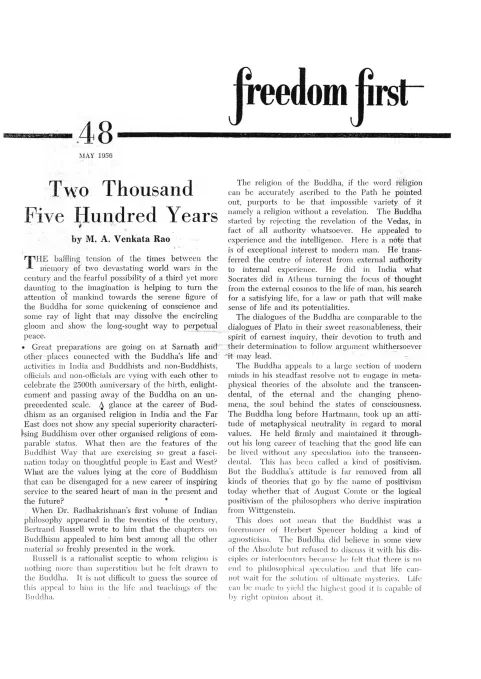
M. A. Venkata Rao marks the 2500th anniversary of the Buddha’s birth, enlightenment, and passing with an essay situating Buddhist thought as a response to the anguish of an age caught between the memory of two world wars and the fear of a third. He reads the Buddha as a rationalist who rejected Vedic revelation and all external authority in favour of experience and intelligence, comparing him to Socrates in turning philosophical attention from the external cosmos to the inner life of man. The piece traces the four noble truths, the doctrines of anatman and anithya, and the ethical disciplines of panchsila and meditation, and closes by connecting Bertrand Russell’s phenomenalism and sympathy for Buddhist ideas of impermanence to the Buddha’s own refusal to speculate on ultimate metaphysical questions. Venkata Rao contrasts the Buddha’s respect for the individuality of his disciples with the way totalitarian states of the present day seek to mould minds, and hopes the anniversary celebrations will advance a universal humanistic ethos and world peace.
- The 2500th anniversary of the Buddha is being marked with major state and Buddhist observances, prompting reflection on Buddhism’s renewed appeal in a nuclear age.
- The Buddha rejected Vedic revelation and all external authority, appealing instead to experience and intelligence, paralleling Socrates’s turn to human inquiry.
- The four noble truths (suffering, its cause in desire/trishna, the possibility of release, and the path) form the starting point of Buddhist ethics, alongside the doctrines of anitya (impermanence) and anatman (no-self).
- Bertrand Russell’s own phenomenalism and admiration for Buddhist thought is invoked as evidence of Buddhism’s contemporary intellectual relevance.
- The Buddha’s insistence that disciples rely on themselves (‘Be ye lamps unto yourselves’) is held up as a contrast to totalitarian regimes that reduce the individual to a controlled mass.
Notes (Mao And Stalin; South Vietnam Free At Last; So What?; Iron Curtain For India?; Illusion Shattered)
An unsigned editorial ‘Notes’ section runs across several short pieces. ‘Ten Days That Shook Khrushchev’ and ‘His Waterloo’ recount the hostile reception given to Bulganin and Khrushchev on their 1956 visit to Britain, including protests by Eastern European exiles, a dressing-down from Hugh Gaitskell over Soviet labour camps, and Khrushchev’s threat to drop a hydrogen bomb after being heckled. ‘Mao And Stalin’ considers the implications of Khrushchev’s de-Stalinisation speech for Communist China, arguing Mao is likely to continue following Stalin’s model despite nominal conformity with the new Kremlin line. ‘South Vietnam Free At Last’ welcomes the French withdrawal agreement and praises President Diem for demanding free elections against Viet Minh communist rule. ‘Iron Curtain For India?’ criticises a reported government circular requiring organisations to route foreign-delegation invitations through the Ministry of External Affairs, calling it a step toward an iron curtain. ‘Illusion Shattered’ reports the collapse in the numbers of Singapore students emigrating to Communist China after early arrivals discovered repression and forced ‘confessions.’ ‘So What?’ is sceptical of the announced dissolution of the Cominform, arguing it is a mere formality given the Soviet Union’s many other front organisations for exerting influence abroad.
- British crowds and politicians gave Bulganin and Khrushchev a hostile reception during their 1956 UK visit, including protests by Polish, Czechoslovak, and Baltic exiles.
- Khrushchev’s de-Stalinisation speech is read as creating strain with Maoist China, though Mao is expected to keep following Stalin’s model despite public conformity with Moscow.
- The French withdrawal from Vietnam by June 30 is welcomed, with President Diem credited for demanding genuinely free unification elections against Viet Minh communist rule.
- A government circular reportedly requiring NGOs to route foreign-delegation invitations through the Ministry of External Affairs is criticised as an incipient ‘Iron Curtain for India.’
- Student emigration from Singapore to Communist China collapsed from about 10,000/month to just 20 by December 1955, attributed to disillusionment among early migrants.
- The dissolution of the Cominform is dismissed as a hollow gesture given the USSR’s thirteen-plus other international front organisations.
Copyright Bill: Author’s Viewpoint
By S. R. Tikekar
S. R. Tikekar assesses the new Copyright Bill introduced in the Rajya Sabha, which was intended to replace the 1914 Copyright Act (itself the UK Act of 1911 extended to India). Writing from an author’s viewpoint, Tikekar finds little to commend and much to condemn: the term of copyright is cut from fifty to twenty-five years after the author’s death, works created during employment are declared to belong to the employer absent an agreement to the contrary, and ‘optional registration’ subjects authors to bureaucratic scrutiny and fees for asserting a right that should be inherent. He criticises the licensing provisions for translations as biased toward ‘mechanical contrivances’ and against authors, and objects that no authors’ or literary bodies were consulted in drafting the Bill, unlike the British Copyright Report of 1952. Tikekar closes by arguing that India lacks the organised authors’ and composers’ societies found in Europe and the USA that could bargain collectively for royalties and protection, leaving individual authors exposed, especially against infringement by state broadcasting and publishing bodies.
- The new Copyright Bill would replace the 1914 Act (based on the UK Act of 1911) with 82 clauses across 15 chapters, versus 36 clauses in the present Act.
- The term of copyright is reduced from fifty to twenty-five years after the author’s death, and copyright of works produced during employment defaults to the employer absent a contrary agreement.
- The Bill’s ‘optional registration’ process requires proving authorship and paying a fee, subjecting authors to bureaucratic scrutiny for what Tikekar considers an inherent right.
- Licensing provisions for translations vest authority in an official whose competence to judge translation quality across India’s many languages is doubted.
- No authors’ or literary bodies were consulted in drafting the Bill, unlike Britain’s 1952 Copyright Report process.
- India lacks organised authors’/composers’ societies comparable to Europe or the USA that could bargain collectively for royalties and protection against infringement, including by state bodies like All India Radio.
The End Of Equality In U.S.S.R.
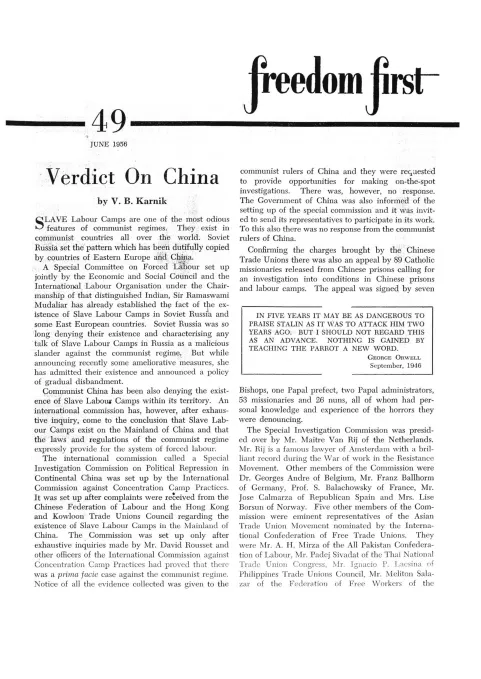
An unsigned piece, ‘The End Of Equality In U.S.S.R.,’ argues that the Russian Revolution’s founding promise of equality of income has been exposed as false by admissions from Soviet leaders themselves. It recounts how independent studies gradually revealed tyranny, slave labour camps, and persistent income disparities in the USSR despite decades of totalitarian rule, and cites Mikoyan’s admission to the Indian Planning Commission in March 1956 that a scientist-academician could earn 25,000 rubles a month against an average worker’s 400 rubles, and that Soviet incomes have no upper ceiling. The piece uses this to vindicate Freedom First’s long-standing position that Marxist-Leninist central planning is not necessary for reducing inequality, contrasting it with the ‘regulated capitalism’ path of the US New Deal/Fair Deal and Britain’s cautious democratic socialism, both of which the author argues have achieved greater equality and social security while preserving democratic liberties, free trade unions, and the rule of law.
- The Russian Revolution’s Marxist promise of income equality is presented as a founding myth that independent scholarship gradually exposed as false.
- Mikoyan admitted to Indian officials in March 1956 that a Soviet scientist-academician could earn about 62 times an average worker’s wage, with no ceiling on incomes at all.
- The piece claims this vindicates Freedom First’s recurring argument that Soviet-style planning does not deliver on its equality promise.
- Regulated capitalism (citing the US New Deal and Fair Deal) and British democratic socialism are held up as producing greater equality and social security while preserving democratic freedoms.
- The article frames the core editorial creed of the magazine: ‘freedom first’ — that freedom is not merely instrumental to the good life but is itself the highest good.
Prospects Of Democracy In India
By Nabakishore Das
Nabakishore Das examines the prospects for democracy in independent India, arguing that democracy as a form of polity is closely tied to cultural pattern and that India’s rigid, caste-based Hindu social structure poses a deeper threat to democratic prospects than communism does. He traces the four-caste Hindu Law tradition and its unequal privileges, and argues that liberal education has nourished Indian democracy only among an educated elite disconnected from the illiterate ‘mass’ who form its real political base — a gap he documents with 1951 Census literacy figures ranging from about 10.8% in Uttar Pradesh to 46.4% in Travancore-Cochin. Das warns that universal adult franchise combined with rampant ‘casteism’ in elections, the absence of a well-organised opposition party, and the Congress Party’s drift toward a vaguely defined ‘Socialist Pattern’ could allow the ruling party to become autocratic or leave a vacuum eventually filled by a Fascist or Communist dictatorship. He concludes that India needs both a genuine opposition party and a new social philosophy to reshape its static cultural values to fit democratic governance.
- Democracy is presented as culturally contingent; India’s caste-divided Hindu social structure is described as inherently undemocratic, citing the four-fold varna hierarchy in Hindu Law.
- Liberal education has nourished Indian democracy only among an educated minority, leaving the illiterate mass — the ‘real masters’ of political democracy — outside its reach.
- 1951 Census literacy rates are cited by state/region, ranging from 10.8% (Uttar Pradesh) to 46.4% (Travancore-Cochin), showing the state’s failure to meet Article 45’s ten-year free-education directive.
- Universal adult franchise combined with electoral ‘casteism’ and special courting of Harijan and Adivasi votes are identified as structural risks to healthy democratic competition.
- The absence of a well-organised opposition party threatens to make the Congress Party autocratic, risking eventual collapse of democracy into Fascist or Communist dictatorship.
- The Congress Party’s adoption of a ‘Socialist Pattern’ is criticised as a vague diplomatic move that confuses the common man about the difference between right and left.
Review: Why I Oppose Communism
By A. A.
The ‘Review’ section covers two books. The first review, unsigned (initialled ‘A. A.’), covers Why I Oppose Communism, a symposium of short essays by distinguished contributors — including Bertrand Russell, Lieut. General Sir Brian Horrocks, scientist C. D. Darlington, trade unionist Sam Watson, author Stephen Spender, Indian writer Minoo Masani, Roman Catholic writer Douglas Woodruff, businessman Hugh Lonsdale, and educationist Sir John Sargent — each giving a distinct reason for opposing communism, from Russell’s philosophical objection to Marx’s doctrines and the abandonment of democracy, to Masani’s account of his own disillusionment with the USSR after the 1936 Purges. The second review, by M. A. Venkata Rao, covers Bertrand Russell’s Human Society In Ethics And Politics, noting Russell’s proposal (later put to Nehru) that India appoint scientists to investigate the consequences of nuclear explosions, and engaging with Russell’s phenomenalist account of human nature as a bundle of impulses, closing with an extended quotation of Russell’s hopeful vision of a world free of hunger, illness, and fear.
- Why I Oppose Communism is a symposium booklet with contributions from Bertrand Russell, Sir Brian Horrocks, C. D. Darlington, Sam Watson, Stephen Spender, Minoo Masani, Douglas Woodruff, Hugh Lonsdale, and Sir John Sargent, each giving a distinct professional or personal ground for opposing communism.
- Minoo Masani’s contribution traces his path from boyhood rebelliousness and socialist enthusiasm (influenced by Wells, Shaw, Upton Sinclair, and John Reed) through visits to the USSR in 1927 and 1935 to disillusionment after the 1936 Great Purges.
- Russell’s Human Society In Ethics And Politics is noted for proposing that India, as a neutral state, investigate the consequences of nuclear war — a proposal Russell put to Nehru personally but which came to nothing.
- The review engages with Russell’s phenomenalist view of human nature as a bundle of self-regarding and other-regarding impulses, and the tension between reason and impulse in his ethical theory.
- The review closes admiringly on Russell’s ‘moving passage’ envisioning a hopeful future world free of hunger, illness, fear, and excessive toil.
Essay 7
Short news notices report on the activities of two affiliated bodies. The Democratic Research Service records a meeting between its members and American labour leader Walter Reuther in Bombay on 12 April to discuss India-US relations and labour’s role in industrial society. The Indian Committee for Cultural Freedom (I.C.C.F.) reports a public meeting held on 16 April, jointly with the P.E.N. All India Centre and the Indian Institute for Educational and Cultural Co-operation, to discuss the Indian Copyright Bill of 1955, with speeches by Sir Rustom Masani, B. V. Warerkar, M. R. Masani, Amy Rustomjee, and Prof. M. A. Venkata Rao, culminating in a resolution to convey the meeting’s views to the Education Ministry and Parliament’s Select Committee. The I.C.C.F. also held an April 13 luncheon honouring American soprano Leontyne Price, and its Patna Group organised a Ramayana recital, tea parties honouring K. M. Munshi and other dignitaries, and a dance/music series featuring Rukmini Devi Arundale and the Kalakshetra troupe.
- The Democratic Research Service met American labour leader Walter Reuther in Bombay on 12 April 1956 to discuss India-US relations and labour’s role in industrial society.
- The I.C.C.F. held a public meeting on 16 April 1956, jointly with P.E.N. All India Centre and the Indian Institute for Educational and Cultural Co-operation, to discuss the Copyright Bill of 1955 and passed a resolution to convey views to the Education Ministry and Parliament’s Select Committee.
- Speakers at the Copyright Bill meeting included Sir Rustom Masani (presiding), B. V. Warerkar M.P., M. R. Masani, Amy Rustomjee, and Prof. M. A. Venkata Rao.
- The I.C.C.F. hosted a luncheon on 13 April honouring American soprano Leontyne Price.
- The I.C.C.F.’s Patna Group organised a Tulsidas Ramayana recital, tea parties for K. M. Munshi and other dignitaries, and a dance/music series with Rukmini Devi Arundale and the Kalakshetra troupe.
Review: Human Society In Ethics And Politics (by Bertrand Russell)
By M. A. Venkata Rao
‘With Many Voices’ is a recurring column of topical quotations drawn from public figures, statesmen, and the press, framed by an epigraph from Tennyson. Selections cover Cold War rhetoric — including Khrushchev’s remark to Harold Wilson that he cannot understand why anyone should enter a country except to pump it out, and John Foster Dulles on the future belonging to freedom rather than servitude — alongside domestic Indian political commentary, such as Acharya Vinoba Bhave’s dismissal of over-patriotism as arrogance and a note on Pandit Pant questioning Asoka Mehta’s shift on communist-backed governance in Travancore-Cochin. Other quotations touch on Malaya’s rejection of unconditional communist peace talks, Walter Reuther’s claim that America can prove Marx wrong on scarcity, and wry commentary on economic planning and political rhetoric from British and Indian sources.
- The column collects short topical quotations from politicians, columnists, and public figures, framed by a Tennyson epigraph on seeking ‘a newer world.’
- Khrushchev is quoted telling Harold Wilson, M.P., that he cannot understand why anyone should enter a country except to pump it out.
- John Foster Dulles is quoted asserting that the future belongs to freedom and diversity, not domination and conformity.
- Acharya Vinoba Bhave is quoted dismissing over-patriotism as ‘nothing but arrogance.’
- A note references Pandit Pant questioning Asoka Mehta over his shift toward favouring a communist-backed P.S.P. government in Travancore-Cochin, despite Mehta’s earlier description of communists as ‘hangmen of democracy.’
Generated by the v1.5 extraction pipeline. Awaiting editorial review.
Metadata and summary are AI-extracted from the source PDF and reviewed for editorial accuracy. The original work is available via the Read PDF tab above (where present); paragraph-level citation inside the PDF is deferred to a future engagement.